Wow … this one from 1911 A poor 10-year-old child had a truly traumatic workplace injury and the civil case by her parents against the employer was dismissed since the “ten-year-old girl knew the dangers of her work and must assume all the responsibility of having her arms torn out”. Good to see the VP… Continue reading 1911: Traumatic workplace injury to a child and seen to have “taken responsibility of the risks”
Year: 2025

Can serious industrial accidents be eliminated? Article from 1917 equally valid today
Can serious industrial accidents be eliminated? Oof, this was a banger read – from 1917. Talks about: · Focusing on effective workplace design and engineering – not just machine guarding · Not focusing on “careless” workers and such stuff · Focusing on the severity of incidents and not just their frequency · The primary duty of the employer should… Continue reading Can serious industrial accidents be eliminated? Article from 1917 equally valid today

Learning to fail intelligently – Amy Edmondson
Not much I need to add here – another banger from Amy Edmonson and colleague from 2005, exploring ‘intelligent failures’. Summary posed in a couple of weeks. They explore identifying failures, analysing failures and experimentation for learning – and barriers from technical and social perspectives. Technical and social barriers: · Complex systems make many small failures… Continue reading Learning to fail intelligently – Amy Edmondson
Humans are fallible and we should design out harm: 1913 rail safety article
“What a time to be alive!” – People in 1913, probably. This interesting article from 1913 about rail safety comes to some interesting proposals: human fallibility is a normal and expected thing, that we should seek design and systems solutions where possible, and companies always prioritise profit over ‘safety’ trade-offs: · “In the past, when an accident… Continue reading Humans are fallible and we should design out harm: 1913 rail safety article
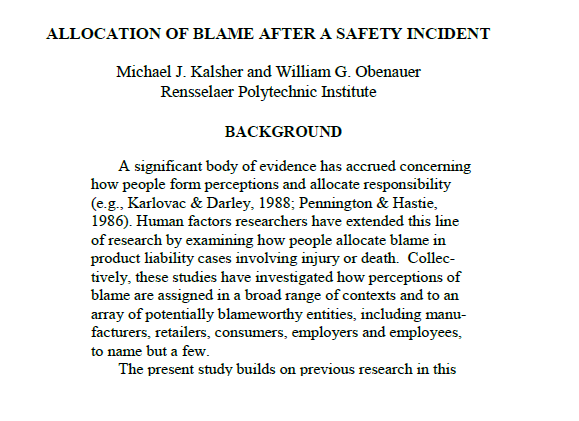
Allocation of Blame After a Safety Incident
This single page conference paper discussed an experiment on how blame is allocated following incidents. The scenario was a “realistic, but fictitious” incident involving a worker (both experienced or not experienced, depending on the scenario), whom is killed when touching an energised bus bar while feeding electrical wire into a pedestal. They systematically manipulated the… Continue reading Allocation of Blame After a Safety Incident

Compendium: Blame, Just Culture & language
Here’s another compendium of articles exploring blame and language in the construction of post-hoc causality explanations, or how blame effects learning and investigations. The other part covers some articles around Just Culture and restorative culture. Note: I’ve mostly focused on articles that I’ve either already summarised or that I could find a full text link… Continue reading Compendium: Blame, Just Culture & language

Human Performance Tools: Engaging Workers as the Best Defense Against Errors & Error Precursors
This article covered a more progressive view on human performance, with suggestions on some tools. Too much to cover, so just a few points. They start by saying to consider three truisms: “To err is human. Workers are fallible. Errors are inevitable (as well as predictable)”. These are fundamentals to understanding the human performance approach… Continue reading Human Performance Tools: Engaging Workers as the Best Defense Against Errors & Error Precursors
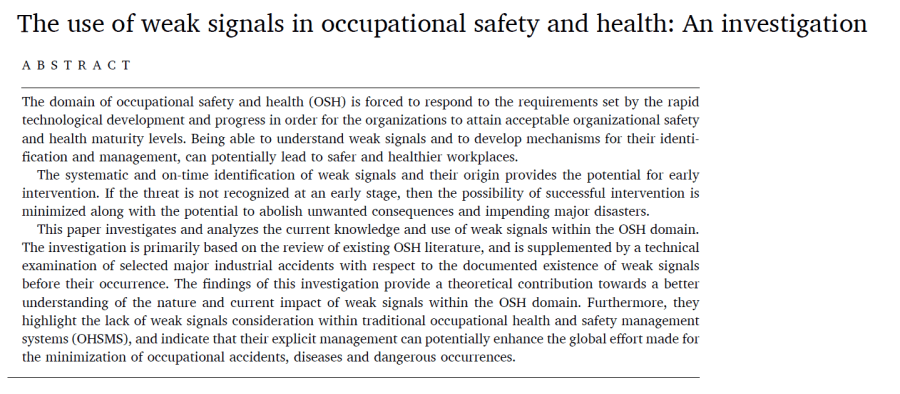
The use of weak signals in occupational safety and health: An investigation
This study explored current knowledge and use of weak signals in safety. Thanks to Clive Lloyd for sharing this a couple weeks back. As you’d expect, this sort of topic, based on accidents, is pretty replete with hindsight and outcome knowledge but is interesting nevertheless. Extracts: · They have been defined as an “…imprecise early indication… Continue reading The use of weak signals in occupational safety and health: An investigation

Boards of directors’ influences on occupational health and safety: a scoping review of evidence and best practices
This literature review evaluated the impact of boards of directors on workplace safety. 49 studies met inclusion. Way too much to cover. Background: · “There is a growing understanding that operative leadership, from line managers to senior management, plays an important role in occupational health and safety” · Leadership “do not act in a vacuum”… Continue reading Boards of directors’ influences on occupational health and safety: a scoping review of evidence and best practices
Site update: easier access to compendiums
Just a minor tweak to the side banner – which now has direct links to the research compendiums.
 SafetyInsights.org