Can Safety-II principles expand learning within investigations?
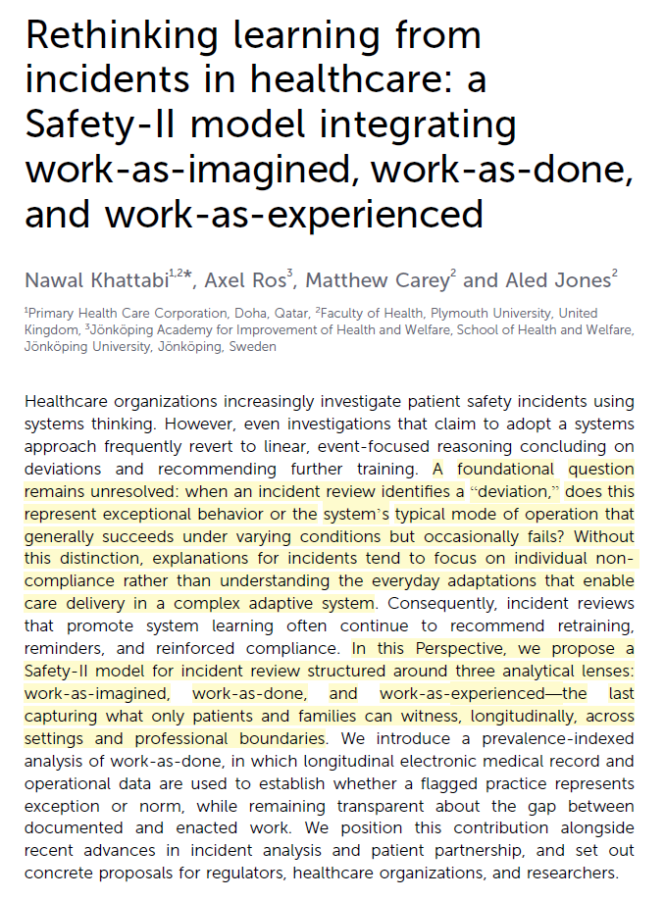
This article proposes a Safety-II framed incident review model for healthcare capturing WAI (work-as-imagined), WAD (work-as-done) and WAE (work-as-experienced).
Shared under an open access licence.
PS. Check out my YouTube and recent Critical Control / barrier vid: https://youtube.com/@safe_as_pod?si=iUaDPJynPemQRZhY
Shout a coffee: https://buymeacoffee.com/benhutchinson
Extracts:
· “A foundational question remains unresolved: when an incident review identifies a “deviation,” does this represent exceptional behavior or the system’s typical mode of operation that generally succeeds under varying conditions but occasionally fails?”
· “Without this distinction, explanations for incidents tend to focus on individual non-compliance rather than understanding the everyday adaptations that enable care delivery in a complex adaptive system”
· Despite >3 decades of increased attention on human performance variability in healthcare (e.g. to err is human), “healthcare systems have achieved limited and uneven reductions in patient harm”
· Legacy issues in investigations (shallow, non-systematic focus etc.) mean that “many investigations become procedurally complete yet epistemically limited”
· “in complex healthcare systems, safety depends on the capacity of people, teams, technologies, and organizations to adjust performance under variable and often imperfect conditions … the same performance variability that enables care to succeed in everyday practice may, under different conditions, contribute to harm”
· Their model is said to capture “work-as-done (the actual practices and actions of individuals and processes), work-as-imagined (the policies, guidelines and planned procedures), and work-as-experienced (the communication and care received by the patient) to understand different aspects and perspectives of incidents occurring with a complex system”
· This approach evaluates whether “practices identified as “deviations” in adverse events represent a deviation or normalized system functioning. Without establishing how frequently such practices occur over time and across settings, incident investigations risk misclassifying routine adaptive drift as individual error, thereby perpetuating Safety-I logic under a Safety-II label”
· They note it’s not just about gaining data on WAI, WAD and WAE, but “in reconciling them to determine whether practices identified during investigation represent routine system adaptation”
· “The same variability labelled “error” after harm may be the very adaptation that enables success under conditions the system routinely generates”
· “This is the analytical step that transforms Safety-II from philosophy into investigative method: not merely acknowledging the gap between work-as-imagined and work-as-done, but establishing whether a practice represents exceptional deviation or normalized drift”

 SafetyInsights.org