Does deferring decision-making to automated systems degrade our ability to understand our own organisations?
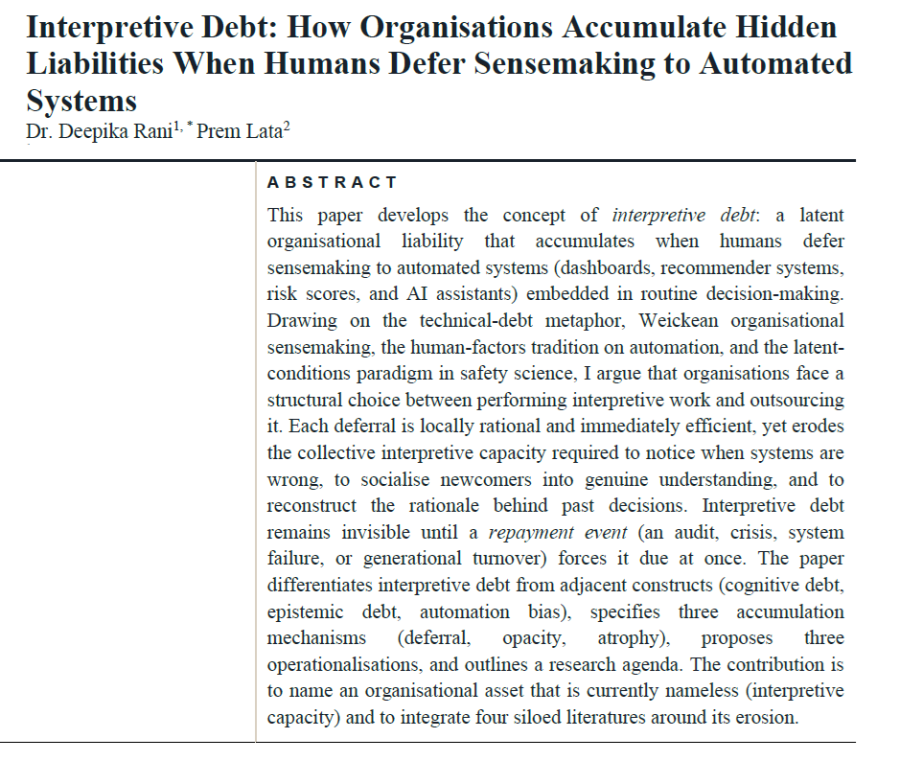
This Weickian sensemaking theory article argues ‘Perhaps’ – what they call interpretive debt.
E.g. a loan officer dets a ‘decline’ flag from an AI tool but accepts the recommendation without reviewing the applicant’s bank statements, or a manager relies on a green dashboard without checking the operational data beneath it.
In other words, accepting a system’s output (risk scores, dash indicators, AI drafts etc) without doing the mental work to figure out why.
PS. Check out my YouTube and recent Critical Control / barrier vid: https://youtube.com/@safe_as_pod?si=iUaDPJynPemQRZhY
Shout a coffee: https://buymeacoffee.com/benhutchinson
Extracts:
· “Interpretive debt is a latent organisational liability that accumulates when human members of an organisation systematically defer sensemaking work to automated decision-support systems”
· “Interpretive debt remains invisible until a repayment event (an audit, crisis, system failure, or generational turnover) forces it due at once”
· “Each deferral is locally rational and immediately efficient, yet erodes the collective interpretive capacity required to notice when systems are wrong”
· “The decision was reached efficiently. The justification has evaporated”

· “Automation simultaneously requires high skill (for rare crucial interventions) while destroying it (because operators no longer practise)”
· “Interpretive debt is not directly observable in routine operations. It manifests only when an external trigger… forces the organisation to perform interpretation it has not been performing”
· “Interpretive debt names an accumulating organisational property whose effects compound over time”
· “Each unexercised interpretive practice makes the next interpretive demand harder to meet, because the supporting tacit knowledge thins”
· “Interpretive debt has a characteristic temporal signature: long periods of routine operation… punctuated by short, expensive periods in which the organisation is asked to do interpretive work it can no longer do”
· “Opacity thus compounds the deferral mechanism: even an organisation that wishes to re-perform interpretation may find that the relevant inputs and reasoning are technically inaccessible”
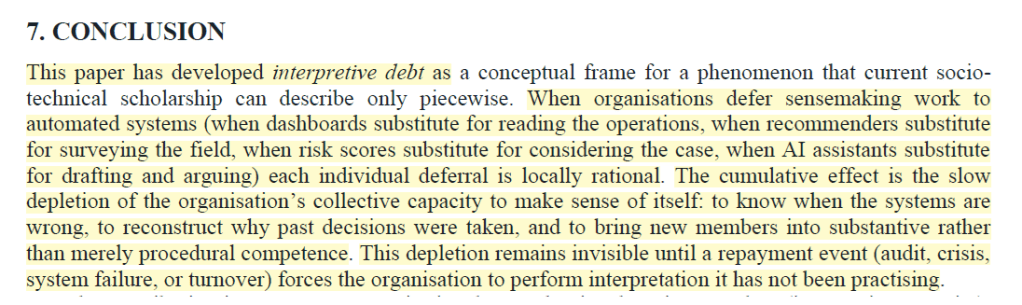
· “When organisations defer sensemaking work to automated systems … The cumulative effect is the slow depletion of the organisation’s collective capacity to make sense of itself: to know when the systems are wrong, to reconstruct why past decisions were taken, and to bring new members into substantive rather than merely procedural competence”
· “This depletion remains invisible until a repayment event (audit, crisis, system failure, or turnover) forces the organisation to perform interpretation it has not been practising”
#weick #sensemaking

 SafetyInsights.org