Are incidents most likely to kill the ones we keep classifying as ‘minor’?
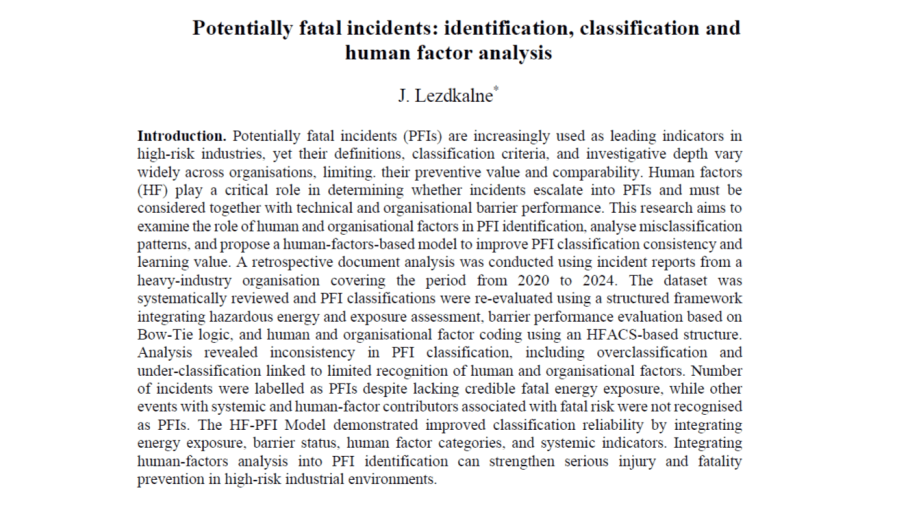
This article applied a HFACS, hazardous energy, and barrier performance evaluation framework to 62 investigation reports.
PS. Check out my YouTube: https://youtube.com/@safe_as_pod?si=V2dbdmW–WbnhzA9
Shout a coffee: https://buymeacoffee.com/benhutchinson
Extracts:
· “some events … labelled as PFIs despite lacking credible fatal potential, while others, involving substantial fatal risk, remain classified as minor”
· “Severity of an injury depends on circumstances, while potential for a fatal outcome is a property of the work system”
· “Fatal outcomes were not explained by isolated unsafe acts or single technical failures, but by the interaction of hazardous energy, exposure conditions, barrier performance, and human-organisational context”
· “[SIFs] are driven by different combinations of exposure, system conditions, and barrier failures, rather than by an accumulation of minor unsafe acts alone”
· “Fatal potential exists even when no injury occurs, provided that energy transfer was fatal under slightly altered conditions”
· “Fatal potential is most missed in events with minor or absent injury consequences, supporting the argument that realised severity does not reliably reflect escalation potential”
· “near misses with low injury consequence are often treated as low severity events, even when the hazard exposure and barrier state indicate credible fatal potential”
· “Injury severity is a circumstantial outcome, whereas fatal potential can be assessed more reliably by examining energy exposure and barrier status”
· “Of the 62 analysed cases, 39 incidents (63%) were identified as misclassified […]. Among these, 25 incidents (40%) were classified as under-classified PFIs […] despite involving credible fatal potential”
· “Under-classification occurred nearly twice as frequently as over-classification, indicating a tendency to under-recognise fatal potential in events without severe or visible injury consequences”
· “Although these [human and organisational] factors were often mentioned descriptively in investigation reports, they were rarely linked to fatal-risk escalation in the original PFI classification”
· “When injury is minor or absent, investigators may downgrade event significance, even where exposure conditions and barrier integrity indicate clear possibility of the fatal outcome”
· “Under-classified PFIs were characterised by degraded, bypassed, or human-dependent preventive controls and frequent procedure–practice gaps”
· “Human and organisational factors affect barrier integrity, and barrier integrity determines whether high-energy exposure can escalate into a fatal event”
· “Procedure vs. practice gaps, informal workarounds, and production-driven deviations were frequently present in under-classified PFIs but seldom framed as escalation factors in original investigations”
· “Realised injury severity should be separated from fatal potential in PFIs”
Study link: https://doi.org/10.15159/ar.26.021

 SafetyInsights.org