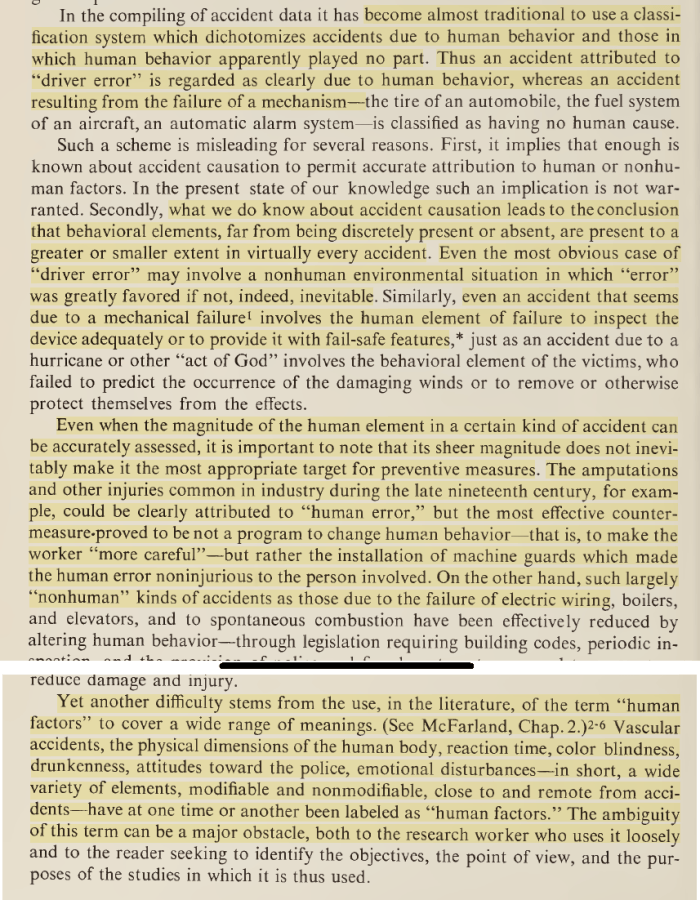
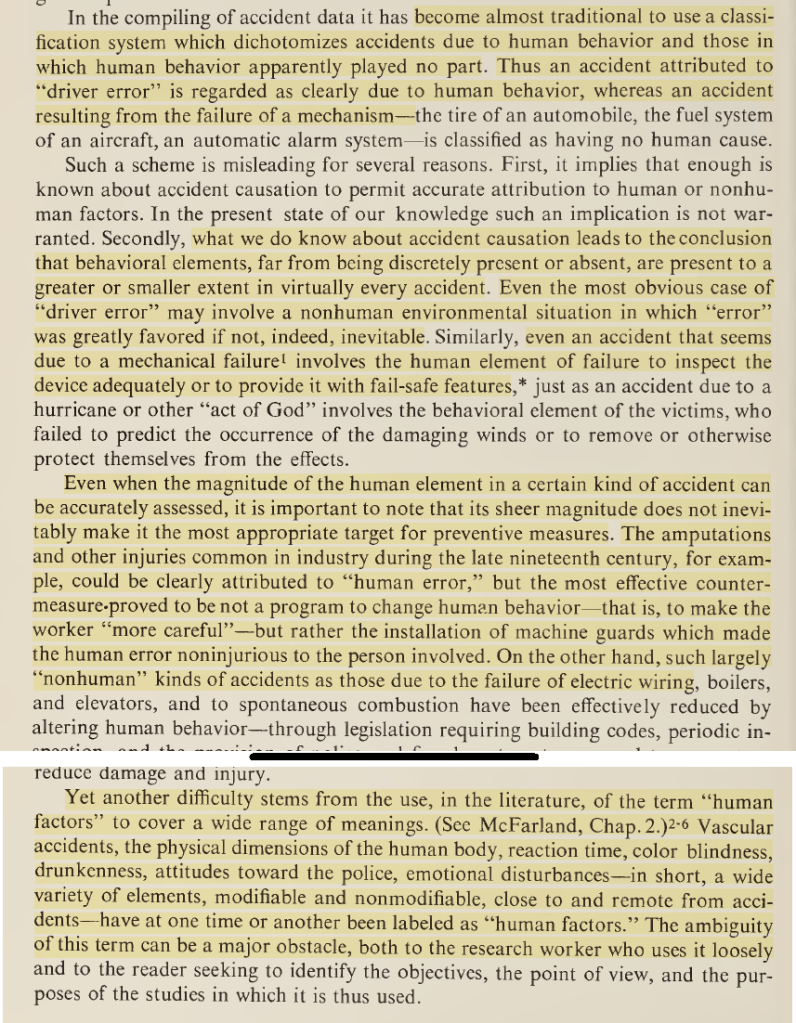
An interesting challenge to the idea of ‘human error’ as a sufficient explanation back in 1964.
This is from Haddon, Suchman & Klein’s 1964 book ‘Accident Research: Methods and Approaches’.
Their argument is still as relevant today: behaviour is rarely separate from the environment where it occurs. And as of `64, the “ambiguity of this term can be a major obstacle”.
And while it can be tempting to separate “accidents due to human behavior” from those “in which human behavior apparently played no part”, it’s likely to be an artificial distinction.
And even if we do directly identify a human contribution, that doesn’t mean the person is necessarily the best target for remediation.
E.g. machine guarding, fail-safe design and other system controls can make foreseeable variability (and perhaps less foreseeable) less hazardous.
Causation and contributions may help us understand an event (with our own worldviews and models, of course), but prevention and mitigation should also require us to identify where intervention will have the greatest effect for the given resources.
Some other interesting stuff in this book that I’ll post at some point.
PS. Check out my YouTube: https://youtube.com/@safe_as_pod?si=V2dbdmW–WbnhzA9
Shout a coffee: https://buymeacoffee.com/benhutchinson

 SafetyInsights.org