“How can I know what I think till I see what I say?” I’ve always liked this expression from Karl Weick (taken from Graham Wallas), discussing the retrospective justification element of sensemaking. Pretty heavy for a Sunday morning my time. But here we are. Sensemaking is argued to entail: (image 1) · Thoughts justifying earlier words… Continue reading “How can I know what I think till I see what I say?” – Karl Weick on sensemaking
Author: Ben Hutchinson
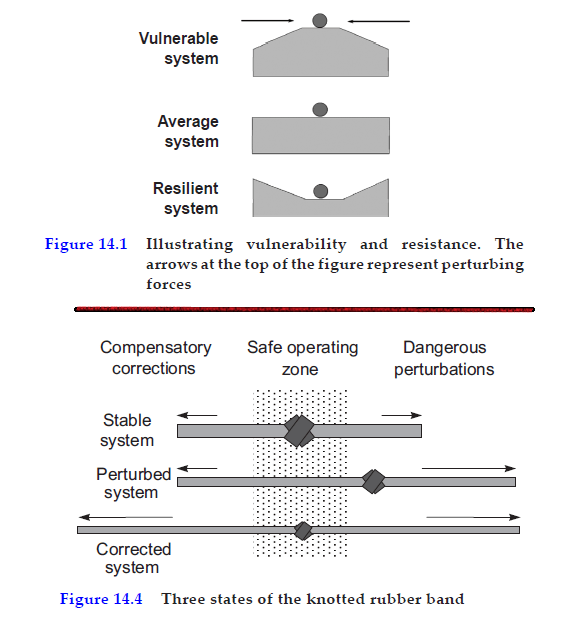
Achieving a safe and stable high-risk system: James Reason ‘Human Contribution’
A few extracts from James Reason’s ‘Human Contribution’. He proposes a couple of different representations of safety (image 1) · The first (14.1), represents the notions of vulnerability and resilience · The ball bearing is sitting at different locations on blocks – in the vulnerable system, perturbations topple the ball · It’s of course the most stable in… Continue reading Achieving a safe and stable high-risk system: James Reason ‘Human Contribution’
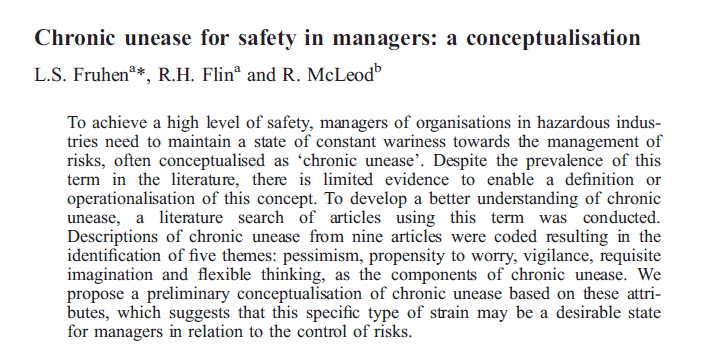
Chronic unease for safety in managers: a conceptualisation
Just a basic post today – some extracts from a paper exploring chronic unease: · Drawing on Reason’s concept, chronic unease has gone by various definitions over the years (image 1) · For Reason, it was the “tendencies of wariness towards risks” · And as a “contrast to complacency, resulting from the absence of negative events, leading ‘people… Continue reading Chronic unease for safety in managers: a conceptualisation

Human Success: Old wine in new bottles, or a shift of mindset for HRA in an automated world?
A really interesting conference paper from Andreas Bye, discussing whether shifting Human Reliability Analysis (HRA) terminology from human error to human success would help alleviate some of the blame-connotations. Also discussed is the human role in automated systems. It was meant to be a mini-post with a few dot-points and a couple of images, but… Continue reading Human Success: Old wine in new bottles, or a shift of mindset for HRA in an automated world?

Understanding Accidents – From Root Causes to Performance Variability
This 2002 discussion paper from Erik Hollnagel unpacks some assumptions of different accident models. Note: In this work, accident model isn’t the specific tool or method (e.g. ICAM), but a “frame of reference as the accident model, i.e., a stereotypical way of thinking about how an accident occurs”. i.e. the mental models and justifications on… Continue reading Understanding Accidents – From Root Causes to Performance Variability
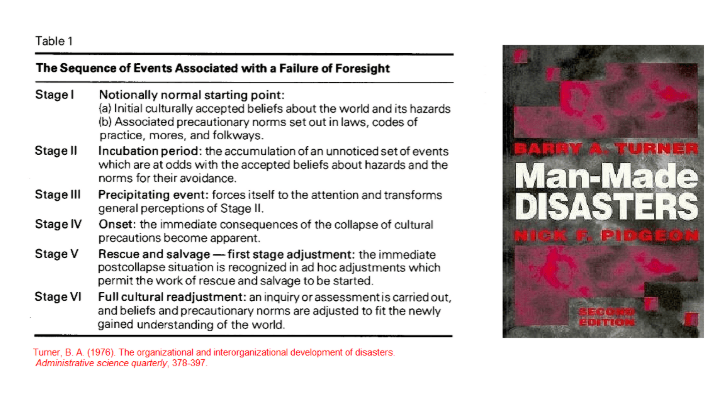
Foresights before disaster: An ode to Barry Turner
So while I don’t often explicitly refer to the late Barry Turner’s work on LinkedIn or regularly post his articles, he’s been the most influential researcher on my own work and is tacitly embedded in my language and thinking. If you’ve heard of Man-Made Disasters, disaster incubation, perceptual horizon, decoy phenomena, failures of foresight (and… Continue reading Foresights before disaster: An ode to Barry Turner

What Control Measures Should I Use? Applying the Total Worker Health Hierarchy of Controls to Manage Workplace Fatigue
This new paper from Drew Dawson and others reconceptualised fatigue risk management within Total Worker Health (TWH) Hierarchy of Controls (HOC). THW HOC works as an extension to the traditional HOC, and “presents strategies in order of effectiveness, ranging from “eliminate,” “substitute,” “redesign,” “educate,” and “encourage” categories” They say that while is mostly associated with… Continue reading What Control Measures Should I Use? Applying the Total Worker Health Hierarchy of Controls to Manage Workplace Fatigue
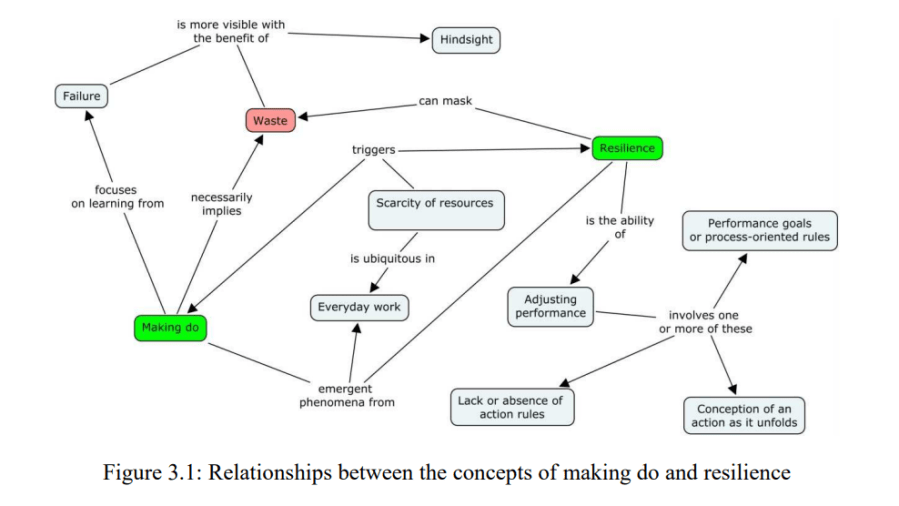
The difference between ‘making do’ and resilience in complex systems
This paper explores the difference between ‘making do’ and resilience. Not a summary, but a few extracts: · Making do has been defined, from a waste perspective as “a situation where a task is started without all its standard inputs, or the execution of a task is continued although the availability of at least one standard… Continue reading The difference between ‘making do’ and resilience in complex systems
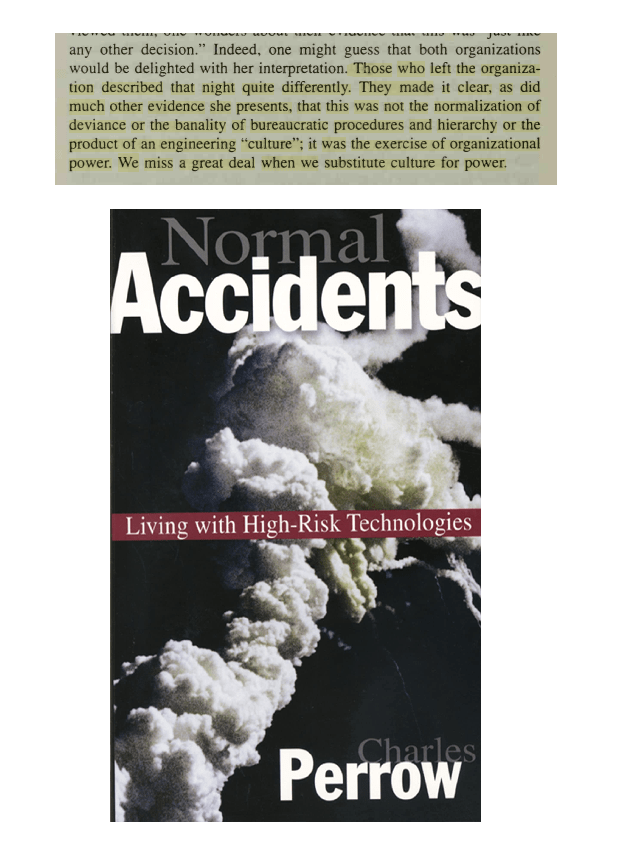
“We miss a great deal when we substitute culture for power” – Charles Perrow on the role of power in disaster
“We miss a great deal when we substitute culture for power” I love this quote from Perrow in Normal Accidents (emphasis added). Perrow briefly discusses the role of power in organising risky technology. Discussing Vaughan’s interpretation of the Challenger disaster: · “I also find the role of power and interests minimized in Diane Vaughn’s otherwise excellent… Continue reading “We miss a great deal when we substitute culture for power” – Charles Perrow on the role of power in disaster

Safety Management Systems may struggle with psychosocial factors and other complex phenomena
Certified safety management systems (OHSM) may struggle with complex, multi-factorial matters, like psychosocial safety. Extracts: · The OHSM “does not necessarily tackle the most urgent work environment issues and may exclude important aspects of the work environment such as psychosocial factors” · “some [OHSM] approaches may be ill-equipped to tackle complex sociotechnical issues and psychosocial matters, and… Continue reading Safety Management Systems may struggle with psychosocial factors and other complex phenomena
 SafetyInsights.org