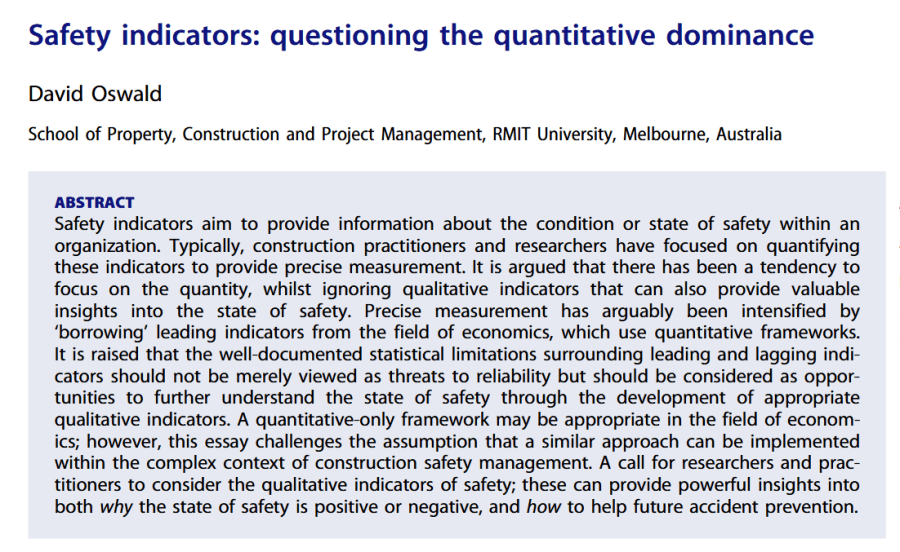
This paper challenges the dominance of quantitative safety indicators in construction and argues for the addition of qualitative indicators, to better inform quantitative. First, the matter of safety vs unsafety is touched upon. It’s said that in one view safety has been defined as an absence of undesirable occurrences. This “makes it problematic to measure,… Continue reading Safety indicators: questioning the quantitative dominance
The (electronic) walls between us: How employee monitoring undermines ethical leadership
This explored the role employee electronic monitoring (EM) plays in undermining ethical leadership by eroding trust. Data was via survey from a diverse field sample of supervisors and their employees. Providing background on ethical leadership and employees, it’s said: Relating to EL and EM: Results Core findings included: They also found that monitoring had no… Continue reading The (electronic) walls between us: How employee monitoring undermines ethical leadership
Stripped of Agency: The Paradoxical Effect of Employee Monitoring on Deviance
This study explored how workplace monitoring of employees (e.g. via surveillance systems in email, screens, vehicle IVMS, cameras etc.) impacts employee behaviour and how, when and why it may result in greater unethical (“deviant”) behaviour. Two separate studies were ran. Nicely, the paper begins with a quote from one worker reflecting on his experience with… Continue reading Stripped of Agency: The Paradoxical Effect of Employee Monitoring on Deviance
Reducing workplace accidents through the use of leadership interventions: A quasi-experimental field study
This studied the effects of training supervisors in leadership (LX) theory around transformational (TFL) and active transactional behaviours (TSL) on leadership behaviour, safety climate, employee safety behaviours after a 8-week period. TFL emphasises inspiring and motivating leader behaviours; which in turn, encourages employees to engage in higher levels of safety participation and noted to build… Continue reading Reducing workplace accidents through the use of leadership interventions: A quasi-experimental field study
Relationship between minor and major accidents
I think it’s safe to say there’s differing opinions on the relationships between hazards & minor/major precursors & events. In one stream, a delineation is drawn for process vs personal indicators & hazards; nicely articulated by Andrew Hopkins discussing the BP Texas City disaster – where BP was largely relying on injury metrics over process… Continue reading Relationship between minor and major accidents
Are we using the right tools to manage variation, errors and omissions?
This brief discussion paper quickly discussed a few methods used in healthcare for managing variation and quality of care. They included: Incident reporting systems Investigations Checklists Providing background, it’s said that: Some industries have been particularly successful at managing variability at a systemic and sophisticated level – aviation for instance But noting this, variability is… Continue reading Are we using the right tools to manage variation, errors and omissions?
Awareness of sleepiness and ability to predict sleep onset: Can drivers avoid falling asleep at the wheel?
Abstract Objectives Regarding the causes of sleep-related accidents, this study assesses whether individuals can anticipate sleep onset accurately and how individuals acknowledge and use physiological and cognitive cues to make judgments related to sleep onset. Methods A group of 41 partially sleep-deprived subjects predicted the likelihood of sleep in 30 consecutive two-minute intervals and noted… Continue reading Awareness of sleepiness and ability to predict sleep onset: Can drivers avoid falling asleep at the wheel?
Beyond metrics? Utilizing ‘soft intelligence’ for healthcare quality and safety
This was a really interesting study that explored the collection and use of ‘soft intelligence’ in healthcare. Soft data (what we may also call small data, as opposed to big data) is the type that derives from sources beyond the conventional metrics and formal knowledge-sharing and management systems. I can’t do this study justice, so… Continue reading Beyond metrics? Utilizing ‘soft intelligence’ for healthcare quality and safety
Complexity of women’s modern-day challenges in construction
This explored some challenges faced by women working in the Construction Industry (CI), by way of in-depth interviews & drawing on complexity theory to explore the complex, multi-layered issues. First, existing literature was covered. The CI is perceived as masculine, hostile and dangerous – fostering a male dominant image. Up to 40% of women in… Continue reading Complexity of women’s modern-day challenges in construction
Goal Conflicts, Classical Management and Constructivism: How Operators Get Things Done
This explored goal realisation & goal conflicts when viewed from the model 1 / model 2 frame of rule perception and management. The sample was via semi-structured interviews in a single military operational unit. While rules and regulations are a necessary resource in organisations – they can also restrict the ability of people to scope… Continue reading Goal Conflicts, Classical Management and Constructivism: How Operators Get Things Done

