On the importance of designing safe-to-fail systems. A beautiful reflection from one of the GOATs in public safety – William Haddon Jr, about how dying for a moment of distraction, due to largely design matters, is “too high a penalty to pay for being human”. This comes from an upcoming summary of a 1993 article… Continue reading Not designing safe-to-fail systems is “too high a penalty to pay for being human”
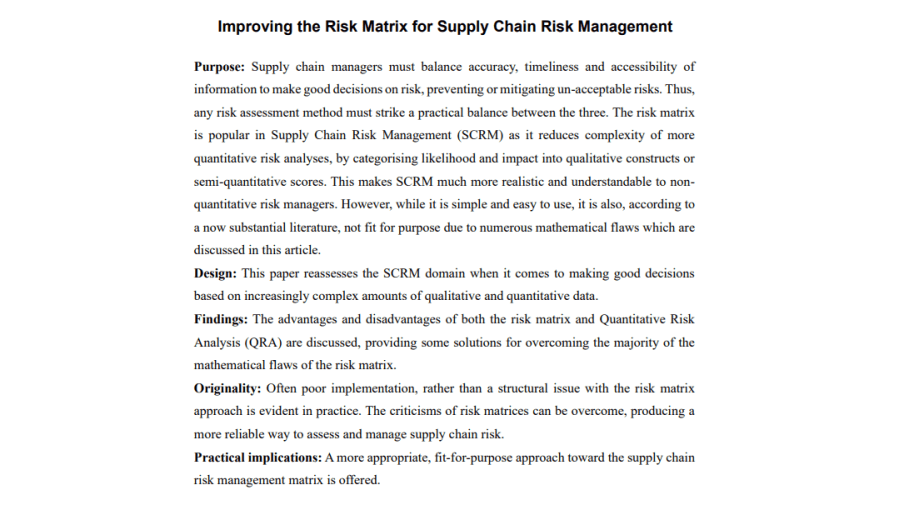
Improving the Risk Matrix for Supply Chain Risk Management
This paper discusses risk matrices (RMs) for supply chain risk management (SCRM). It was meant to be just a few dot-points, but…here we are. Extracts: · “the main aim of SCRM is to identify whether a risk is “acceptable”, “tolerable” or “unacceptable”, and, if the latter two, to identify if and how a risk might… Continue reading Improving the Risk Matrix for Supply Chain Risk Management
Error Traps, Learning from Normal Work & Marcin Nazaruk’s new book
Are your workplace observations calibrated to error traps and workplace design, or just superficial behaviours? A couple of extracts from Marcin Nazaruk‘s new book ‘Learning from Normal Work’. This part reflects on a well-intentioned, but rather shallow, workplace observation from John (using the Walk-Through / Talk-Through method…this method and others will be covered on my… Continue reading Error Traps, Learning from Normal Work & Marcin Nazaruk’s new book
Risk barrier and bow tie quality issues
What are some common issues with barrier / risk control systems, and bow ties? Extracts: · Multiple barrier definitions exist, one is “Safety barriers are physical and/or nonphysical means planned to prevent, control, or mitigate undesired events or accidents” · “This definition allows for both hardware barriers (e.g., Emergency Shutdown Systems) and for non-physical barriers (e.g., inspection… Continue reading Risk barrier and bow tie quality issues

Safe As 36: How audits fail prior to major accidents
How do audits fail to avert major disasters? What do investigations after a major accident say about the performance, or failures, of audits? Today’s article is Hutchinson, B., Dekker, S., & Rae, A. (2024). How audits fail according to accident investigations: A counterfactual logic analysis. Process Safety Progress, 43(3), 441-454. Spotify: https://open.spotify.com/episode/0GiQ6QeAYGFZhxmppb5n3k?si=gB3Hvpi3RpaPtLsGChZSZw Make sure to subscribe to… Continue reading Safe As 36: How audits fail prior to major accidents
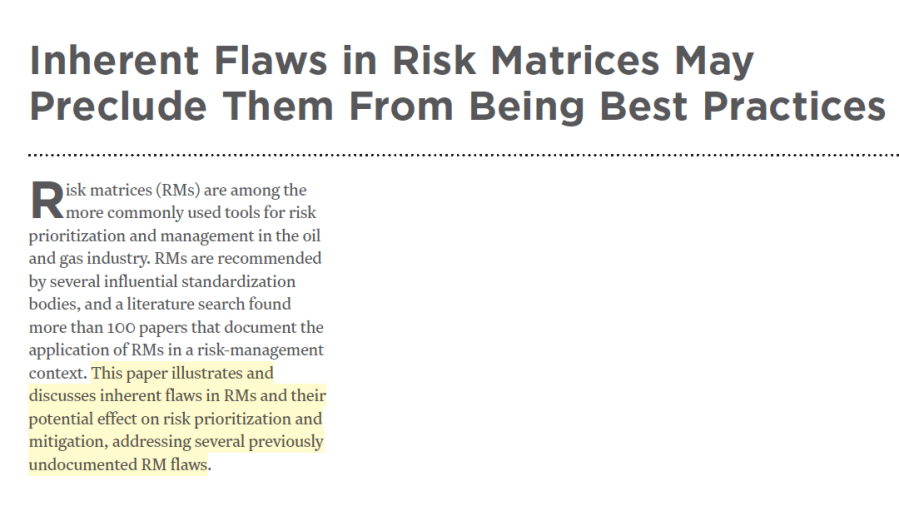
Inherent Flaws in Risk Matrices May Preclude Them From Being Best Practices
Are some risk matrices too inherently flawed to be considered as best practice? This discussion paper explored some critical flaws. Extracts: · “Risk matrices (RMs) are among the more commonly used tools for risk prioritization and management in the oil and gas industry” and “are recommended by several influential standardization bodies” · The popularity of RMs is… Continue reading Inherent Flaws in Risk Matrices May Preclude Them From Being Best Practices
Was your last incident a one off issue or systemic system flaws?
Was your last incident a one-off occurrence or systemic failure? Two extracts discussing this theme – first from Greg Smith (Proving Safety), and then Desai Link (‘Beyond the Incident’), who expanded the discussion on Greg’s question. Images from Desai’s book. Greg Argues: · An important aspect of assurance is “to continually question whether issues that we… Continue reading Was your last incident a one off issue or systemic system flaws?
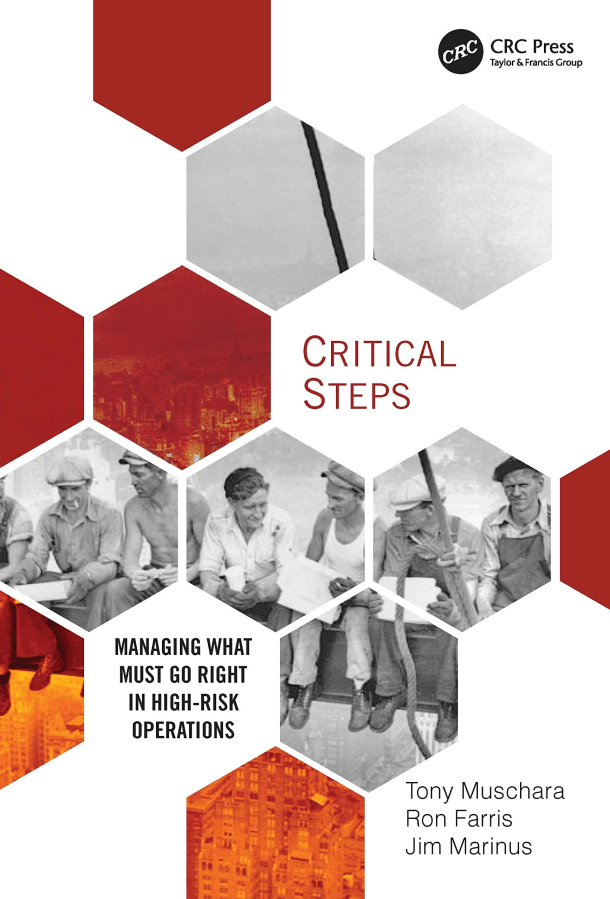
Safe As 35 (quickisode): Critical Steps for managing hazardous work
Some task steps are so important, that marshal or exchange so much energy, that they must go right first time, every time. These are called Critical Steps. Let’s explore critical steps and risk important decisions. Today’s source is: Muschara, T., Farris, R., & Marinus, J. (2021). Critical steps: managing what must go right in high-risk operations.… Continue reading Safe As 35 (quickisode): Critical Steps for managing hazardous work
Kletz: Accidents due to human error is about as useful as saying falls are due to gravity
“Saying an accident is due to human failing is about as helpful as saying that a fall is due to gravity. It is true but it does not lead to constructive action”. Some of the classic, and well-known, wisdom from Kletz (source: An Engineer’s View of Human Error). Extracts: · The whole ‘most accidents are due… Continue reading Kletz: Accidents due to human error is about as useful as saying falls are due to gravity

Safe as 34: The failure of critical controls in construction
How reliable are the critical controls within construction? Which critical controls fail, and how? Today’s article is Selleck, R., Hassall, M., & Cattani, M. (2022). Determining the reliability of critical controls in construction projects. Safety, 8(3), 64. Spotify: https://open.spotify.com/episode/2hkc0OmL5QTlcseIHJgN8P?si=eylRnvw3QrKPNSsy0YjkZA Apple: https://podcasts.apple.com/us/podcast/e34-the-failure-of-critical-controls-in-construction/id1819811788?i=1000726762389 Make sure to subscribe to Safe As on Spotify/Apple, and if you find it useful then… Continue reading Safe as 34: The failure of critical controls in construction

