
Investigations are reputed to be ‘fact finding’ exercises: objective searches for facts and truth. How what role does investigator bias play in constructing the incident findings? Today’s article is: MacLean, C. L., & Dror, I. E. (2023). Measuring base-rate bias error in workplace safety investigators. Journal of safety research, 84, 108-116. Spotify: https://open.spotify.com/episode/2sd92JGDTL4vq4s9AGJ2ac?si=tWpXuga6RwqmF0r-AiWPnw Apple: https://podcasts.apple.com/us/podcast/e39-how-biased-are-incident-investigators/id1819811788?i=1000728238089 Make sure… Continue reading Safe As 39: How biased are incident investigators?
Tag: bias
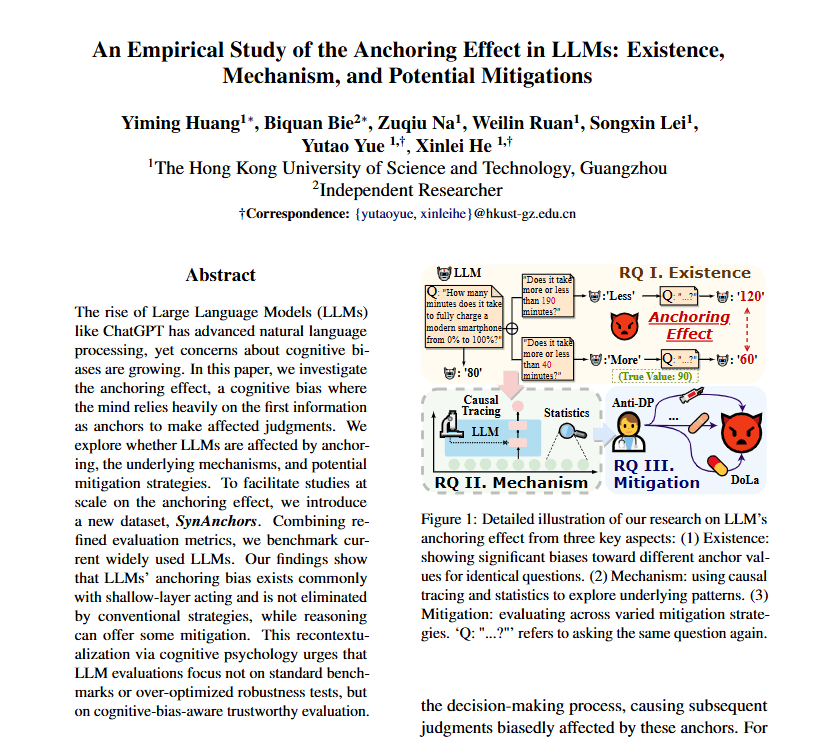
An Empirical Study of the Anchoring Effect in LLMs: Existence, Mechanism, and Potential Mitigations
This study found that several LLMs are fairly easily influenced by anchoring effects, consistent with human anchoring bias. Extracts: · “Although LLMs surpass humans in standard benchmarks, their psychological traits remain understudied despite their growing importance” · “The anchoring effect is a ubiquitous cognitive bias (Furnham and Boo, 2011) and influences decisions in many fields” · “Under uncertainty,… Continue reading An Empirical Study of the Anchoring Effect in LLMs: Existence, Mechanism, and Potential Mitigations

Confirmation bias and priming in investigations: ‘Human & Organizational Potential’
Here’s one of (prob) several upcoming posts about Ivan Pupulidy, PhD and Crista Vesel, MSc’s book ‘Human and Organizational Potential’. This part looks at confirmation bias within investigations and uses the US Forest Service’s then current Investigation Guide: · “Confirmation bias is a tendency to search for information that confirms one’s preconceptions. When discussing confirmation bias… Continue reading Confirmation bias and priming in investigations: ‘Human & Organizational Potential’

Why do doctors make poor decisions? Spotlighting ‘noise’ as an under-recognised source of error in clinical practice
A brief read covering the concept of noise, pertaining to judgements. This is based on the work from Kahneman, Sibony and Sunstein. From the article: · While biases in judgements have captured a lot of attention, “it has been suggested that ‘noise’ (defined as an undesirable variability in human judgements) is a highly important, yet under-recognised… Continue reading Why do doctors make poor decisions? Spotlighting ‘noise’ as an under-recognised source of error in clinical practice

“I think, therefore I err”: An article about ‘good errors’, heuristics and intelligent systems
“Every intelligent system makes errors”, so said Gerd Gigerenzer. Here’s a couple of page extracts from a 2005 paper. Not sure if I’ll summarise it or not (it’s really interesting, but tough to capture in a summary…) The paper: · Challenges the rationalistic and normative ideal as cognition as purely a logical and rational one, ignoring… Continue reading “I think, therefore I err”: An article about ‘good errors’, heuristics and intelligent systems
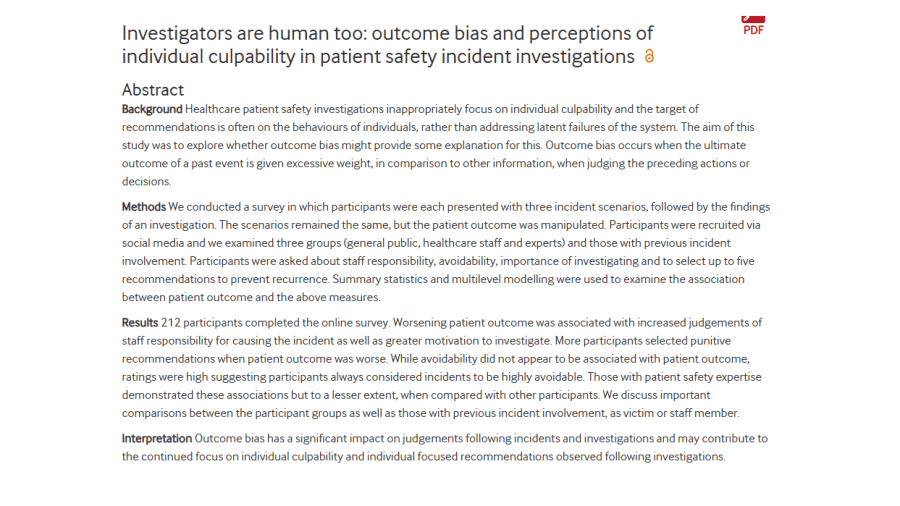
Investigators are human too: outcome bias and perceptions of individual culpability in patient safety incident investigations
This study explored whether outcome bias might explain why healthcare investigations focus on individual culpability over addressing latent conditions in the system. 212 participants were allocated to one of three scenarios followed by the findings of an investigation (see scenario overviews below). For background: · Prior work has identified that the “overwhelming majority of recommendations… Continue reading Investigators are human too: outcome bias and perceptions of individual culpability in patient safety incident investigations
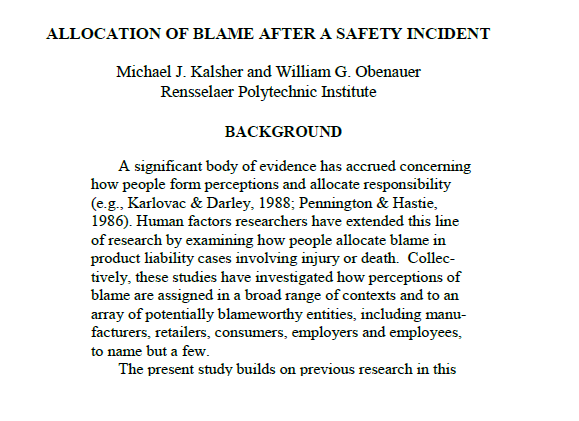
Allocation of Blame After a Safety Incident
This single page conference paper discussed an experiment on how blame is allocated following incidents. The scenario was a “realistic, but fictitious” incident involving a worker (both experienced or not experienced, depending on the scenario), whom is killed when touching an energised bus bar while feeding electrical wire into a pedestal. They systematically manipulated the… Continue reading Allocation of Blame After a Safety Incident
Dual-Process Theories of Higher Cognition: type 1 and type 2 preferred over system 1 and system 2
I think it’s fair to say that Kahneman has been central in the general awareness of cognitive processing concepts, like System 1 / System 2. Dual processing concepts (but also tri-processing), have a long history, but also have their critics. Moreover, system 1 / system 2 isn’t currently the preferred nomenclature. If this topic interests… Continue reading Dual-Process Theories of Higher Cognition: type 1 and type 2 preferred over system 1 and system 2
 SafetyInsights.org