Is your work making you physically or mentally sick? This video unpacks a meta-analysis which analysed 72 studies on the links between psychosocial risks on health. Among other findings – established links were found between job strain and cardiovascular diseases and mental ill health. #psychosocial #risk #health #safety #hse #mentalhealth
Tag: health
The Critical Role of Psychological Risk and Safety in Eliciting Worker Well-Being
This explored the links between psychosocial risk and psychological safety on worker well-being. Survey responses from >800 workers in Malaysian were obtained. Usefully, it’s another study that slightly challenges the claim that you ‘can’t have too much psychological safety’. We need far more targeted evidence to make that claim. Extracts: · “our results revealed a significant… Continue reading The Critical Role of Psychological Risk and Safety in Eliciting Worker Well-Being

Large Language Models in Lung Cancer: Systematic Review
This systematic review of 28 studies explored the application of LLMs for lung cancer care and management. Probably few surprises here. And it’s focused mostly on LLMs, rather than specialised AI models. Extracts: · The review identified 7 primary application domains of LLMs in LC: auxiliary diagnosis, information extraction, question answering, scientific research, medical education, nursing… Continue reading Large Language Models in Lung Cancer: Systematic Review

Safe As 25: Do workers in high-risk industries use and value procedures?
Are your safety procedures effective aids to help navigate safe and reliable work? Do you know? And, do your workers use and value those procedures? Today we’re uncovering the painful realisation of how a compliance culture can erode trust, disengage workers and leave you dangerously exposed when things go wrong. Today’s study is Peres, S.… Continue reading Safe As 25: Do workers in high-risk industries use and value procedures?

Sleep Problems and Workplace Violence: A Systematic Review and Meta-Analysis
Are sleep problems (SP) and workplace violence (WV) related? Quite possibly. This meta-analysis and systematic review unpacked 34 studies exploring the links. Extracts: VW can be classified into four types: · “Type 1, Criminal Intent, when no legitimate relationship exists between the perpetrator and the business or its employees and the perpetrator commits a crime (robbery,… Continue reading Sleep Problems and Workplace Violence: A Systematic Review and Meta-Analysis

The day-to-day stability of safety climate in the offshore oil and gas industry
Is safety climate stable day-to-day or more dynamic and variable? A really interesting study which explored the stability of safety climate over a 28 day offshore work period (hitch). Background: · “Safety climate is a domain-specific form of organizational climate (Schneider, 1975). It is defined as ‘shared perceptions with regard to the priority of safety policies,… Continue reading The day-to-day stability of safety climate in the offshore oil and gas industry

Endoscopist De-Skilling after Exposure to Artificial Intelligence in Colonoscopy: A Multicenter Observational Study
Does AI use contribute to de-skilling? Probably, according to this study of endoscopists. This study compared >1.4k patient outcomes who underwent non-AI assisted colonoscopy before and after AI implementation. Background: · A recent meta-analysis of 20 randomised trials “showed an absolute 8.1 % increase in ADR [Adenoma detection rate] with the use of AI during colonoscopy.5… Continue reading Endoscopist De-Skilling after Exposure to Artificial Intelligence in Colonoscopy: A Multicenter Observational Study

Working Too Hard to Advise You Not to Work Too Hard: Psychosocial Risk Factors and Quality of Life Among Occupational Health and Safety Experts
OHS professionals exposed to several psychosocial risks in the course of their work, according to this study, amplified by the social interactivity of their role. This Turkish study surveyed 101 OHS experts (65 male, 36 female) on psychosocial factors, quality of life and more. Key findings: · While OHS professionals may help others with eliminating or… Continue reading Working Too Hard to Advise You Not to Work Too Hard: Psychosocial Risk Factors and Quality of Life Among Occupational Health and Safety Experts

Safe As podcast ep15: Root Cause Analyses (RCA) and incident prevention – do they ‘work’?
Many organisations rely on their root cause analyses (RCA) to help learn about incidents, and, ideally, prevent incident reoccurrences. So the logic goes. But does the published evidence support RCA approaches as effective means for preventing incident reoccurrences? Today’s paper is Martin-Delgado, J., Martínez-García, A., Aranaz, J. M., Valencia-Martín, J. L., & Mira, J. J.… Continue reading Safe As podcast ep15: Root Cause Analyses (RCA) and incident prevention – do they ‘work’?
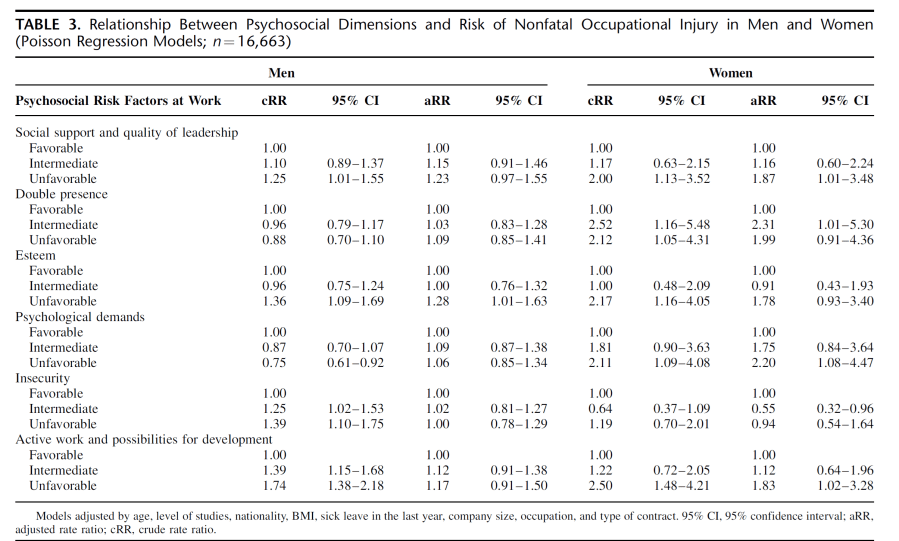
Exposure to Psychosocial Risk Factors at Work and the Incidence of Occupational Injuries: A Cohort Study in Spain
This study explored the links between psychosocial risk factors (PRF) on the incident of occupational injuries (OIs). Compared to many other studies, they used a dynamic cohort longitudinal design (>16k) participants over 1 year follow-up. The Copenhagen Psychosocial Questionnaire was used. For background: Findings: Why are PRF and OI potentially linked? They suggest: Limitations were… Continue reading Exposure to Psychosocial Risk Factors at Work and the Incidence of Occupational Injuries: A Cohort Study in Spain
 SafetyInsights.org