
This was an interesting article from 1912 highlighting the role that fatigue has in industrial accidents. Also challenges ‘carelessness’, saying it doesn’t account for the effects of fatigue. While scientific knowledge has progressed over the century, it’s cool how well they articulated the issue. · Image 1 top panel shows a breakdown of accidents per time… Continue reading 1912 article discussing the role of fatigue in industrial accidents and arguing against ‘carelessness’ as an “ultimate cause”
Tag: health

What Control Measures Should I Use? Applying the Total Worker Health Hierarchy of Controls to Manage Workplace Fatigue
This new paper from Drew Dawson and others reconceptualised fatigue risk management within Total Worker Health (TWH) Hierarchy of Controls (HOC). THW HOC works as an extension to the traditional HOC, and “presents strategies in order of effectiveness, ranging from “eliminate,” “substitute,” “redesign,” “educate,” and “encourage” categories” They say that while is mostly associated with… Continue reading What Control Measures Should I Use? Applying the Total Worker Health Hierarchy of Controls to Manage Workplace Fatigue

Safety Management Systems may struggle with psychosocial factors and other complex phenomena
Certified safety management systems (OHSM) may struggle with complex, multi-factorial matters, like psychosocial safety. Extracts: · The OHSM “does not necessarily tackle the most urgent work environment issues and may exclude important aspects of the work environment such as psychosocial factors” · “some [OHSM] approaches may be ill-equipped to tackle complex sociotechnical issues and psychosocial matters, and… Continue reading Safety Management Systems may struggle with psychosocial factors and other complex phenomena

Why do doctors make poor decisions? Spotlighting ‘noise’ as an under-recognised source of error in clinical practice
A brief read covering the concept of noise, pertaining to judgements. This is based on the work from Kahneman, Sibony and Sunstein. From the article: · While biases in judgements have captured a lot of attention, “it has been suggested that ‘noise’ (defined as an undesirable variability in human judgements) is a highly important, yet under-recognised… Continue reading Why do doctors make poor decisions? Spotlighting ‘noise’ as an under-recognised source of error in clinical practice
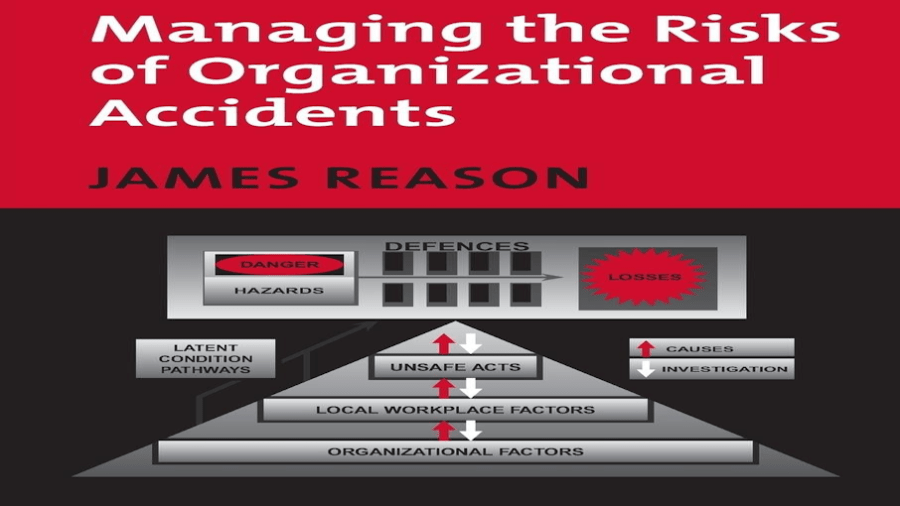
A life of Reason: A mini-compendium of James Reason’s contributions
Seems fitting to cover some work from James Reason and to reflect on his enduring impact on our professional work, thinking and models. I’ve focused more on articles I’ve summarised or posted an image extract of, or could find a full-text article for. It’s NOT systematic. I’ve also included articles not from Reason but whom… Continue reading A life of Reason: A mini-compendium of James Reason’s contributions
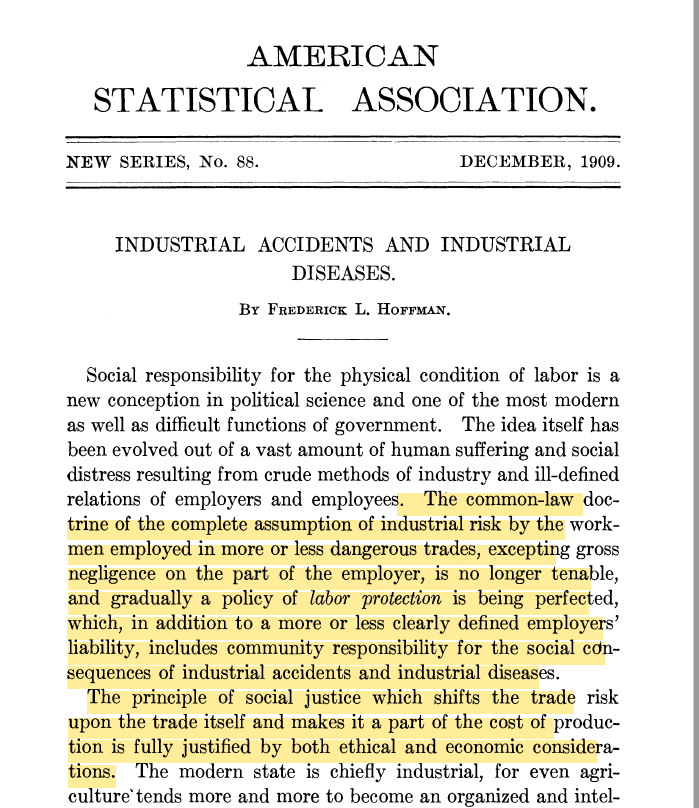
Industrial Accidents and Industrial Diseases – 1909 article
Another interesting read from 1909, talking about ‘social responsibility’ and industrial accidents & diseases in the US. Really modern thinking here – that: 1) ‘trade’ should bear the fair burden of injury 2) compensation is about justice and social responsibility 3) a worker’s free will to work in dangerous industries is a myth (they often… Continue reading Industrial Accidents and Industrial Diseases – 1909 article
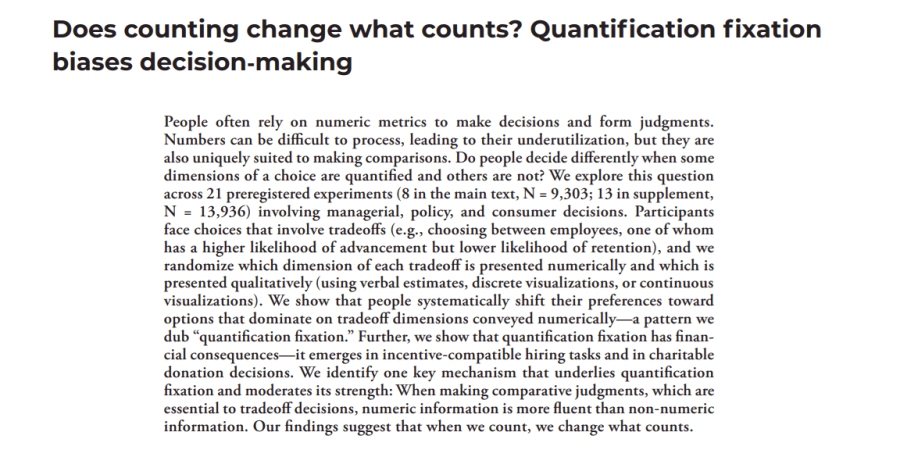
Does counting change what counts? Quantification fixation biases decision-making
Saw this posted on LinkedIn (forget who shared it) and found it really interesting. This study, across 21 experiments and 23k participants in managerial, policy and consumer contexts, studied how numbers and quantification distorts decision-making Context: · Quantification is spreading and has reached into almost every personal and professional area · New-borns are given Apgar… Continue reading Does counting change what counts? Quantification fixation biases decision-making

Can serious industrial accidents be eliminated? Article from 1917 equally valid today
Can serious industrial accidents be eliminated? Oof, this was a banger read – from 1917. Talks about: · Focusing on effective workplace design and engineering – not just machine guarding · Not focusing on “careless” workers and such stuff · Focusing on the severity of incidents and not just their frequency · The primary duty of the employer should… Continue reading Can serious industrial accidents be eliminated? Article from 1917 equally valid today
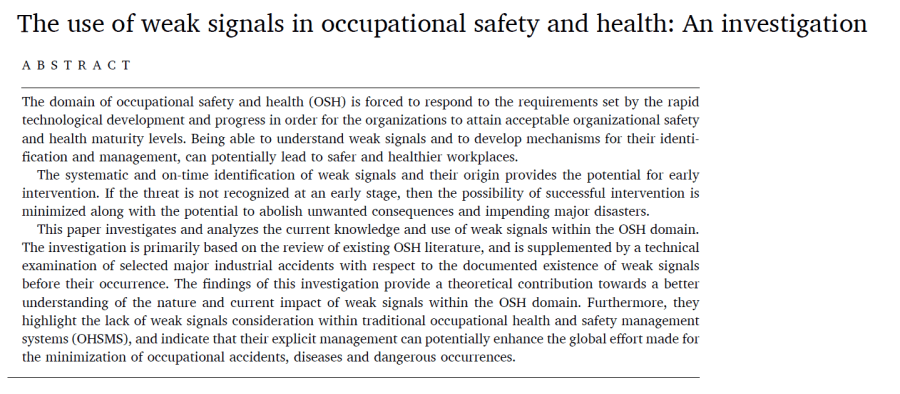
The use of weak signals in occupational safety and health: An investigation
This study explored current knowledge and use of weak signals in safety. Thanks to Clive Lloyd for sharing this a couple weeks back. As you’d expect, this sort of topic, based on accidents, is pretty replete with hindsight and outcome knowledge but is interesting nevertheless. Extracts: · They have been defined as an “…imprecise early indication… Continue reading The use of weak signals in occupational safety and health: An investigation

The Impact of Physical Hazards on Workers’ Job Satisfaction in the Construction Industry: A Case Study of Korea
This explored the effects of physical hazard exposures on worker job satisfaction. Survey from >2k Korean construction workers. Background: · “physical hazards such as noise, vibration, and exposure to hazardous substances also contribute to job stress” and behavioural changes · “Continuous exposure to such risks can result in cumulative mental and physical strain, increasing job-related stress, and… Continue reading The Impact of Physical Hazards on Workers’ Job Satisfaction in the Construction Industry: A Case Study of Korea
 SafetyInsights.org