
A 2001 article from Sid Dekker discussing a contemporary view of human performance and organisational failure. You may recognise parts of this from Dekker’s later article ‘Is it 1947 yet?’. Too much to cover. And I’m relying heavily on quotes. Dekker reverts back to Fitts and Jones’ 1947 article which “laid the foundation for aviation… Continue reading Disinheriting Fitts and Jones `47 (2001 Sid Dekker article)
Tag: human error

“Punishing is about keeping our beliefs in a basically safe system intact. Learning is about changing these beliefs, and changing the system”
“Punishing is about keeping our beliefs in a basically safe system intact. Learning is about changing these beliefs, and changing the system” An interesting extract from Sid Dekker’s 2001 article ‘Disinheriting Fitts and Jones `47’. Summary in a week or two – but if you’ve read his later SafetyDifferently article ‘Is it 1947 yet?’, then… Continue reading “Punishing is about keeping our beliefs in a basically safe system intact. Learning is about changing these beliefs, and changing the system”

Safe AF #10: Are safety myths –like most accidents due to human error –holding us back?
Are our safety myths–like most accidents being the result of human error–holding back genuine improvement within safety? Can myths like these actually hamper learning, and increase operational risk? Today’s article is from Besnard, D., & Hollnagel, E. (2014). I want to believe: some myths about the management of industrial safety. Cognition, Technology & Work, 16, 13-23. Make… Continue reading Safe AF #10: Are safety myths –like most accidents due to human error –holding us back?
Short video from James Reason on types of errors
I’m sure others have posted this recently, but it’s an interesting video from James Reason talking about error and performance. I particularly love the retro-ambience. It’s like something you’d see on VHS in science class. Jim talks about some interesting properties of task errors. Like making tea, “these errors aren’t random or bizarre…we don’t find… Continue reading Short video from James Reason on types of errors
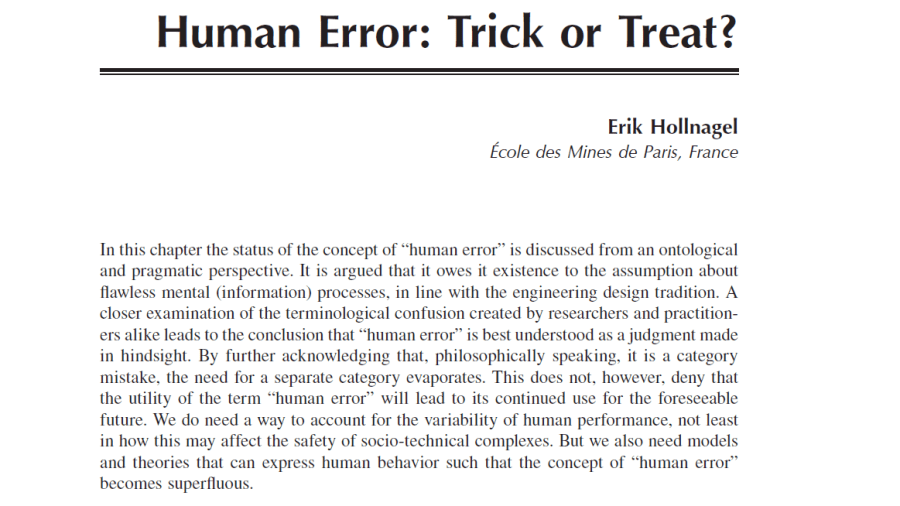
Human Error: Trick or Treat?
This 2007 chapter from Hollnagel unpacked whether we really need the concept of “human error” (HE). It’s a whole chapter, so I’ve skipped HEAPS. Tl;dr according to Hollnagel: · “there is no need of a theory of “human error” because the observed discrepancies in performance should be explained by a theory of normal performance rather… Continue reading Human Error: Trick or Treat?

Human Success: Old wine in new bottles, or a shift of mindset for HRA in an automated world?
A really interesting conference paper from Andreas Bye, discussing whether shifting Human Reliability Analysis (HRA) terminology from human error to human success would help alleviate some of the blame-connotations. Also discussed is the human role in automated systems. It was meant to be a mini-post with a few dot-points and a couple of images, but… Continue reading Human Success: Old wine in new bottles, or a shift of mindset for HRA in an automated world?

Human Performance Tools: Engaging Workers as the Best Defense Against Errors & Error Precursors
This article covered a more progressive view on human performance, with suggestions on some tools. Too much to cover, so just a few points. They start by saying to consider three truisms: “To err is human. Workers are fallible. Errors are inevitable (as well as predictable)”. These are fundamentals to understanding the human performance approach… Continue reading Human Performance Tools: Engaging Workers as the Best Defense Against Errors & Error Precursors

“Those found responsible have been sacked”: some observations on the usefulness of error
Another interesting paper co-authored by the late Richard Cook. This paper discusses the usefulness of error. It’s a larger post with a lot of quotes – I just can’t do a better or more succinct job of restating what they’ve already written. Providing background, they argue that while some see “error” as a dead-end, others… Continue reading “Those found responsible have been sacked”: some observations on the usefulness of error
 SafetyInsights.org