
Really interesting historical and critical account of Reason’s work, particularly the Swiss Cheese metaphor (SCM). It was meant to be a mini-post with a few extracts, but, meh, couldn’t be bothered cutting it back. Still not a summary, and skipped HEAPS, so highly recommend reading the free open access article. Background: · Reason’s foray into… Continue reading Good and bad reasons: The Swiss cheese model and its critics
Tag: james reason

Leveson and Dekker on Reason: How the Critics Got the Swiss Cheese Model Wrong – Andrew Hopkins
Andrew Hopkins in this article defends Reason’s Swiss Cheese Metaphor (SCM) from critiques from both Nancy Leveson and Sid Dekker. Just a few extracts. [** Be on the lookout for next week’s compendium dedicated to Hopkins & Hale] I’m taking no sides – just reporting what’s in the paper: · He selects criticisms of Reason’s work… Continue reading Leveson and Dekker on Reason: How the Critics Got the Swiss Cheese Model Wrong – Andrew Hopkins
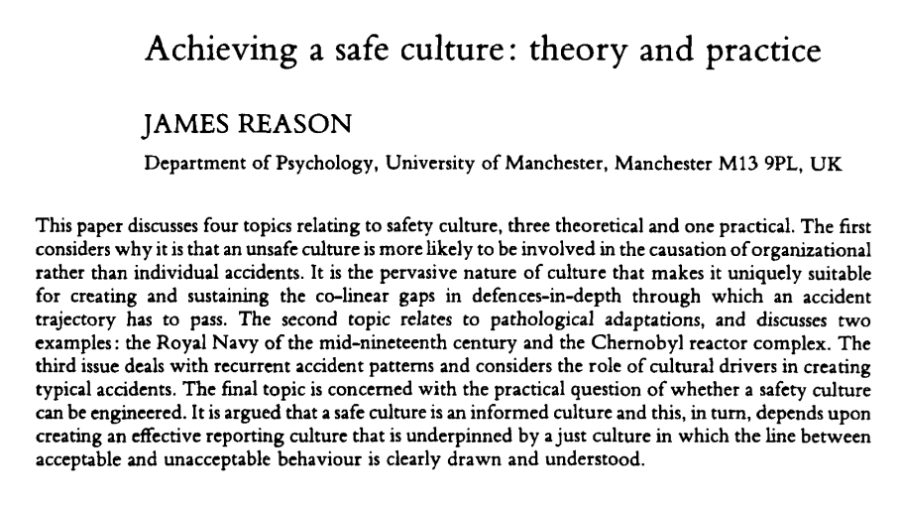
Achieving a safe culture: theory and practice
A 1998 paper from James Reason discussing complex system failures and cultures of safety (which he calls safety cultures, SC—note he often, but not always, says cultures as plural). Way too much to cover, so worth checking out the original paper. First Reason points out the lack of a single definition of SC, but one… Continue reading Achieving a safe culture: theory and practice

The contribution of latent human failures to the breakdown of complex systems
What is the role of frontline people within complex system failures? For James Reason, it was often just providing the local triggers to “manifest systemic weaknesses created by fallible decisions made earlier”. This 1990 paper goes through his thinking of human performance in complex failure. It was meant to be a small post, but couldn’t… Continue reading The contribution of latent human failures to the breakdown of complex systems
“By their nature, accidents are not directly controllable” – James Reason, 1993
“By their nature, accidents are not directly controllable”, so says James Reason in this 1993 article. Just a single extract from the article’s conclusion: · “Safety has two faces: a positive one relating to an organization’s intrinsic resistance to chance conjunctions of unsafe acts and hazards, and a negative one, revealed by accident and incident data,… Continue reading “By their nature, accidents are not directly controllable” – James Reason, 1993
Short video from James Reason on types of errors
I’m sure others have posted this recently, but it’s an interesting video from James Reason talking about error and performance. I particularly love the retro-ambience. It’s like something you’d see on VHS in science class. Jim talks about some interesting properties of task errors. Like making tea, “these errors aren’t random or bizarre…we don’t find… Continue reading Short video from James Reason on types of errors

Root-Causal Factors: Uncovering the Hows & Whys of Incidents
This 2016 article from Fred Manuele explores some facets of causality in investigations. It’s based mainly on two key sources: Hollnagel’s 2004 ‘Barriers and accident prevention’ and Dekker’s 2006 ‘Field Guide to Understanding Human Error’. Won’t be much new for most but has some nice arguments from authors like Hollnagel, Dekker and Leveson. First he… Continue reading Root-Causal Factors: Uncovering the Hows & Whys of Incidents
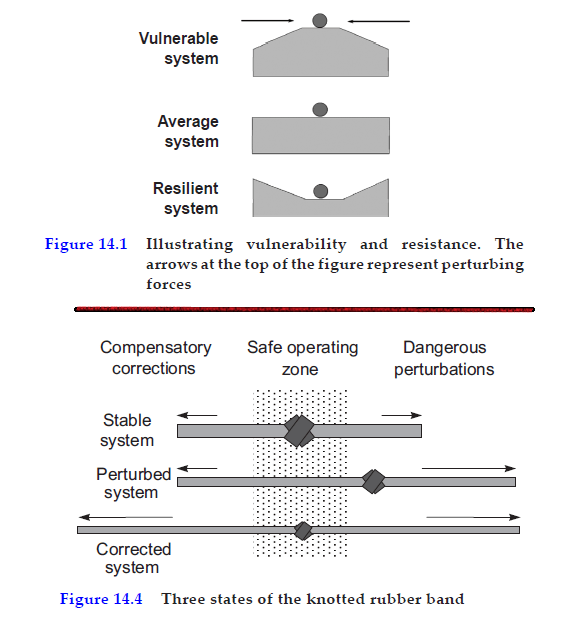
Achieving a safe and stable high-risk system: James Reason ‘Human Contribution’
A few extracts from James Reason’s ‘Human Contribution’. He proposes a couple of different representations of safety (image 1) · The first (14.1), represents the notions of vulnerability and resilience · The ball bearing is sitting at different locations on blocks – in the vulnerable system, perturbations topple the ball · It’s of course the most stable in… Continue reading Achieving a safe and stable high-risk system: James Reason ‘Human Contribution’
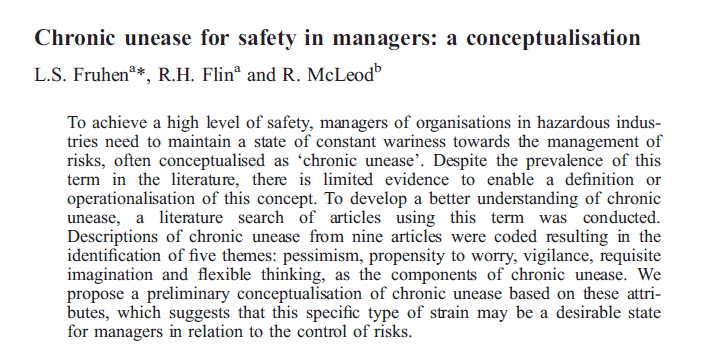
Chronic unease for safety in managers: a conceptualisation
Just a basic post today – some extracts from a paper exploring chronic unease: · Drawing on Reason’s concept, chronic unease has gone by various definitions over the years (image 1) · For Reason, it was the “tendencies of wariness towards risks” · And as a “contrast to complacency, resulting from the absence of negative events, leading ‘people… Continue reading Chronic unease for safety in managers: a conceptualisation
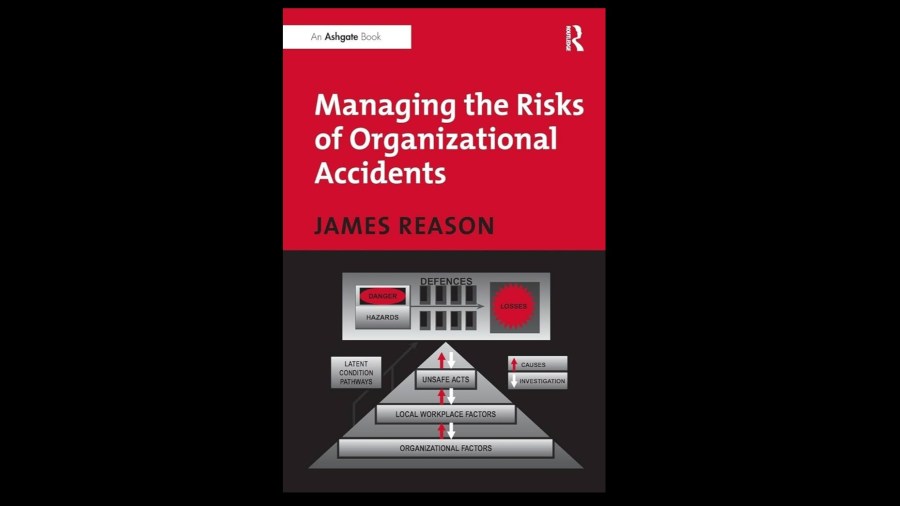
The mixed blessing of risk defences and redundancy: James Reason
A few random extracts from James Reason’s timelessly awesome Managing the Risks of Organizational accidents. (Note: This isn’t an endorsement of the somewhat linearity of defences-in-depth, since we have evidence that emergent behaviour can playout in reality and with equifinality etc) There’s hundreds of things I could extract (and maybe will in time), but here’s… Continue reading The mixed blessing of risk defences and redundancy: James Reason
 SafetyInsights.org