
Hopkins in this discussion paper explores organisational cultures, and how they effect safety. You’ll note he writes cultures, plural, rather than culture as a monolithic construct. Way too much to cover in this paper, so just a few points. Check out the full paper if the topic interests you. Hopkins starts with “Despite all that… Continue reading Studying organisational cultures and their effects on safety
Tag: major accident
The human factor: Pursuing success and averting drift into failure – YT video, Sidney Dekker
A 2018 presentation from Sid Dekker on success and drift into failure. One of many such, and no particular reason why this one over any other. Sid starts with an example he heard, supporting the bad apple thesis: “just get rid of the nurses who make mistakes and all will be a lot safer” “Now… Continue reading The human factor: Pursuing success and averting drift into failure – YT video, Sidney Dekker
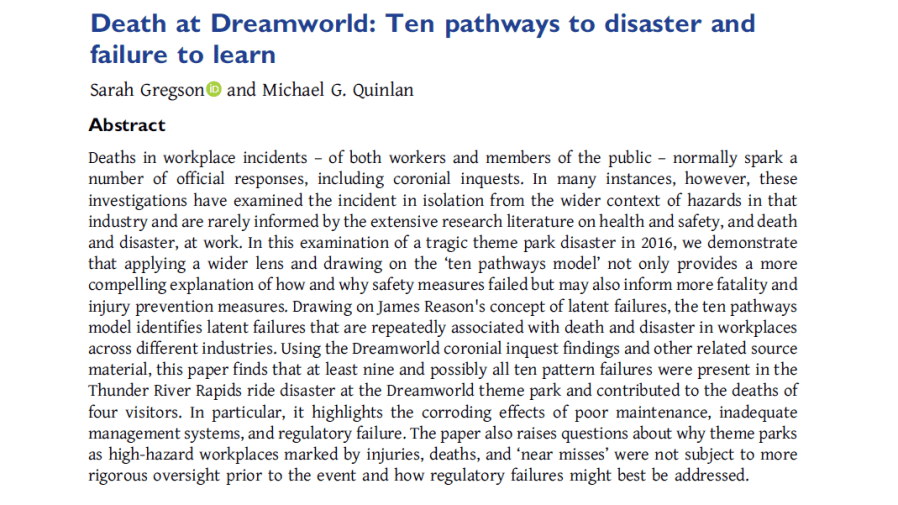
Death at Dreamworld: Ten pathways to disaster and failure to learn
This paper from Sarah Gregson and Michael Quinlan applies his ten pathways framework to the Dreamworld accident in 2016, killing four people. I’ve skipped a lot. [** Yes, hindsight and outcome biases are present with this type of analysis, as with my own auditing work. Doesn’t mean there isn’t value in exploring learning opportunities, but… Continue reading Death at Dreamworld: Ten pathways to disaster and failure to learn
Resilience terminology and a visualisation of resilience/robustness in practice
This may interest people. It covers concepts of resilient performance within seaports. It’s a bit random (seaports), but otherwise gives a handy overview of resilience terms and applications. The first two images are just basic definitions. Extracts: · Image 3 represents resilience elements during disruptions – from pre-disruption, to the disruption, then post-disruption. · During pre-disruption, the… Continue reading Resilience terminology and a visualisation of resilience/robustness in practice

Human Success: Old wine in new bottles, or a shift of mindset for HRA in an automated world?
A really interesting conference paper from Andreas Bye, discussing whether shifting Human Reliability Analysis (HRA) terminology from human error to human success would help alleviate some of the blame-connotations. Also discussed is the human role in automated systems. It was meant to be a mini-post with a few dot-points and a couple of images, but… Continue reading Human Success: Old wine in new bottles, or a shift of mindset for HRA in an automated world?
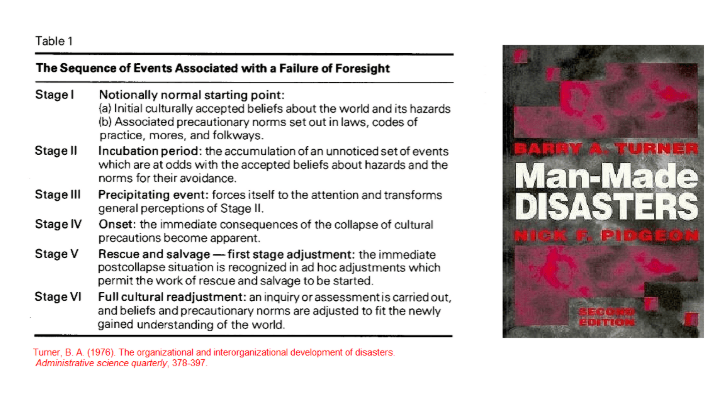
Foresights before disaster: An ode to Barry Turner
So while I don’t often explicitly refer to the late Barry Turner’s work on LinkedIn or regularly post his articles, he’s been the most influential researcher on my own work and is tacitly embedded in my language and thinking. If you’ve heard of Man-Made Disasters, disaster incubation, perceptual horizon, decoy phenomena, failures of foresight (and… Continue reading Foresights before disaster: An ode to Barry Turner
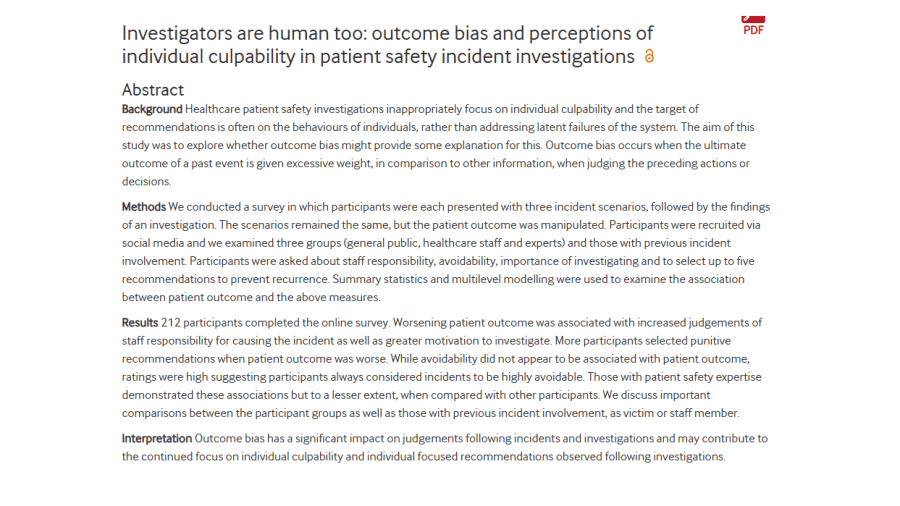
Investigators are human too: outcome bias and perceptions of individual culpability in patient safety incident investigations
This study explored whether outcome bias might explain why healthcare investigations focus on individual culpability over addressing latent conditions in the system. 212 participants were allocated to one of three scenarios followed by the findings of an investigation (see scenario overviews below). For background: · Prior work has identified that the “overwhelming majority of recommendations… Continue reading Investigators are human too: outcome bias and perceptions of individual culpability in patient safety incident investigations
Fukushima was a disaster “Made in Japan” according to the independent commission
Gotta love these really poetic parts of major accident inquiries… This from the Fukushima independent commission:“What must be admitted – very painfully – is that this was a disaster “Made in Japan.” AND “Its fundamental causes are to be found in the ingrained conventions of Japanese culture: our reflexive obedience; our reluctance to question authority;… Continue reading Fukushima was a disaster “Made in Japan” according to the independent commission
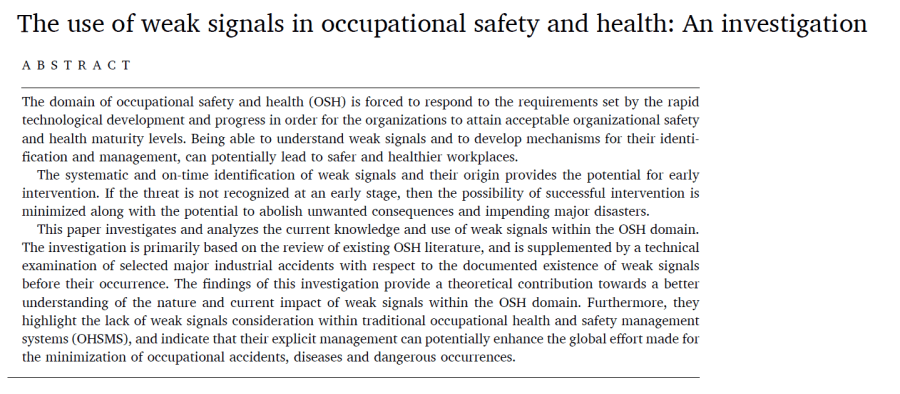
The use of weak signals in occupational safety and health: An investigation
This study explored current knowledge and use of weak signals in safety. Thanks to Clive Lloyd for sharing this a couple weeks back. As you’d expect, this sort of topic, based on accidents, is pretty replete with hindsight and outcome knowledge but is interesting nevertheless. Extracts: · They have been defined as an “…imprecise early indication… Continue reading The use of weak signals in occupational safety and health: An investigation
A culture of denial: Sociological similarities between the Moura and Gretley mine disasters
This 2000 paper from Hopkins compares the underlying sociological and organisation factors behind both the Moura and Gretley mine disasters. I’ve skipped a lot, so check out the full paper for the details. First he says that while every disaster has its own unique set of events, “It does not follow that every disaster requires… Continue reading A culture of denial: Sociological similarities between the Moura and Gretley mine disasters
 SafetyInsights.org