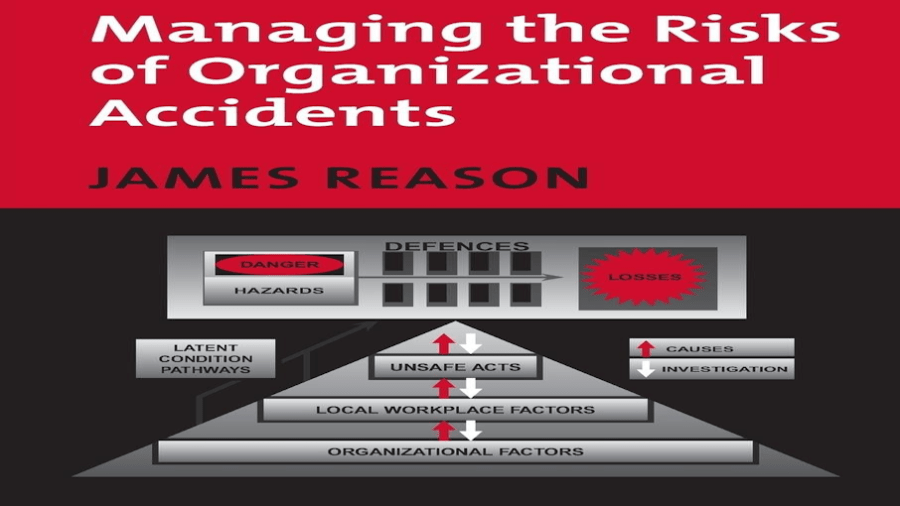
Seems fitting to cover some work from James Reason and to reflect on his enduring impact on our professional work, thinking and models. I’ve focused more on articles I’ve summarised or posted an image extract of, or could find a full-text article for. It’s NOT systematic. I’ve also included articles not from Reason but whom… Continue reading A life of Reason: A mini-compendium of James Reason’s contributions
Tag: major accidents
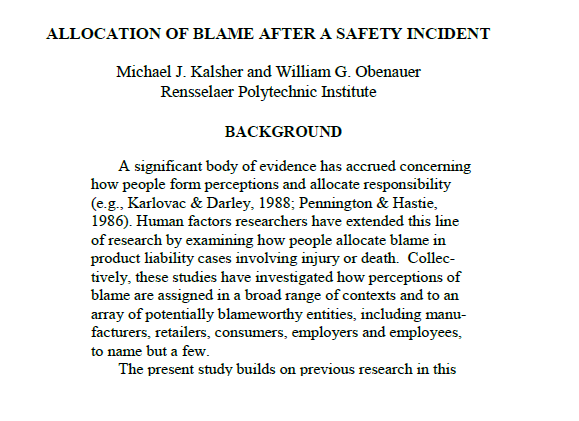
Allocation of Blame After a Safety Incident
This single page conference paper discussed an experiment on how blame is allocated following incidents. The scenario was a “realistic, but fictitious” incident involving a worker (both experienced or not experienced, depending on the scenario), whom is killed when touching an energised bus bar while feeding electrical wire into a pedestal. They systematically manipulated the… Continue reading Allocation of Blame After a Safety Incident

Factors affecting learning from incidents: A cross-industry review
This study systematically reviewed the research to unpack the factors that influence learning from incidents (LFI). Likely nothing new to anybody, but it is a good reference paper for tracking down specific research. Background: · Common reasons for ineffective LFI are “underreporting of incidents (Sanne, 2008), incapacity to identify latent circumstances (Jacobsson et al., 2009), the… Continue reading Factors affecting learning from incidents: A cross-industry review
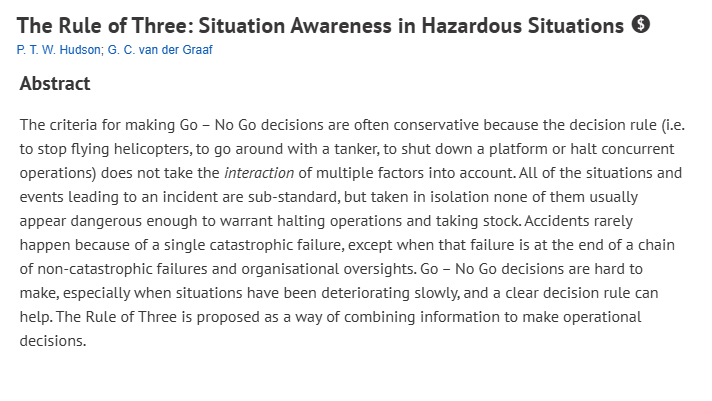
The rule of three: Situation awareness in hazardous situations
“The rule of three provides a mechanism that converts the risk continuum into a dichotomy for the purposes of decision-making. It does not, however, ignore the expertise of operators … Put another way, the rule of three structures expert decision-making; it does not replace it”

“Those found responsible have been sacked”: some observations on the usefulness of error
Another interesting paper co-authored by the late Richard Cook. This paper discusses the usefulness of error. It’s a larger post with a lot of quotes – I just can’t do a better or more succinct job of restating what they’ve already written. Providing background, they argue that while some see “error” as a dead-end, others… Continue reading “Those found responsible have been sacked”: some observations on the usefulness of error

Safety is simple…apparently: two visual representations of the same incident
Safety is simple, bruz … (apparently) (Both examples show the same event, but each uses a different lens. Images are slides taken from one of my presentations to highlight how investigations can be as much ‘constructions’, as searches for ‘objective’ facts, entirely separate to the perceiver or who gets to draw the line in the… Continue reading Safety is simple…apparently: two visual representations of the same incident
Safety Culture or: How cultures can both sensitise or blind us to danger
I’ve long been critical of the construct, and application of, ‘safety culture’ (at best, I’d probably be described as from the interpretive camp—e.g. ‘culture-as-metaphor’). I’ve covered lots of articles why – and others have argued far more nuanced reasons. So, I’m not covering that now. But in saying that, I’ve always found the following definition… Continue reading Safety Culture or: How cultures can both sensitise or blind us to danger
Foundations of Safety Science: Resilience Engineering and 3 analytical traps for resilience practitioners
Post 3 from ch.11 of the Foundations of Safety Science, exploring Resilience Engineering (RE) and the adaptive perspectives. This part focuses on 3 analytical traps for resilience practitioners/scholars to be cognisant of (you may recognise these from Johan Bergstrom’s youtube vid – link in comments). Extracts: · The first trap is the reductionist trap · Whereas “the… Continue reading Foundations of Safety Science: Resilience Engineering and 3 analytical traps for resilience practitioners
Foundation of Safety Science: Resilience Engineering and complex systems pt2
Post 2 from ch.11 of the Foundations of Safety Science, exploring Resilience Engineering (RE) and the adaptive perspectives. Some extracts: · RE sees failures not necessarily as breakdowns or malfunctioning of normal functions, but “the converse of the adaptations necessary to cope with the real world complexity” · Performance of individuals and organisations across all level “must… Continue reading Foundation of Safety Science: Resilience Engineering and complex systems pt2
Foundations of Safety Science: Resilience Engineering and safety as the presence of capacities
More extracts from Foundations of Safety Science, this time from Ch.11 on Resilience Engineering and the adaptive perspective. This is 1 of probably 2 or 3 more posts. Some extracts: These logics come from a wider body of safety science, which includes some intertwined positions, like: Parts 2 & 3…some other time. Ref: Dekker, S.… Continue reading Foundations of Safety Science: Resilience Engineering and safety as the presence of capacities
 SafetyInsights.org