
This explored the effects of physical hazard exposures on worker job satisfaction. Survey from >2k Korean construction workers. Background: · “physical hazards such as noise, vibration, and exposure to hazardous substances also contribute to job stress” and behavioural changes · “Continuous exposure to such risks can result in cumulative mental and physical strain, increasing job-related stress, and… Continue reading The Impact of Physical Hazards on Workers’ Job Satisfaction in the Construction Industry: A Case Study of Korea
Tag: mental-health
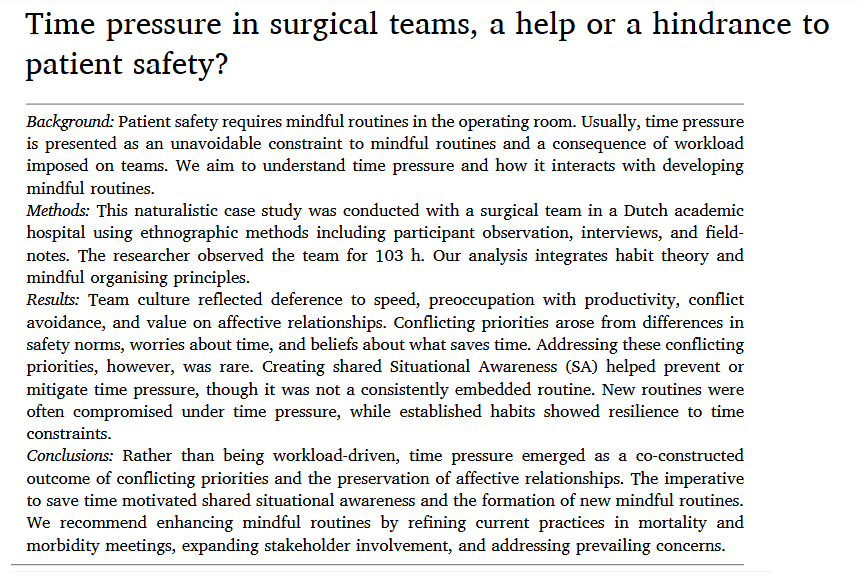
Time pressure in surgical teams, a help or a hindrance to patient safety?
I found this an interesting and brief read about the mindful routines of operating room staff, using a naturalistic decision making approach. Extracts: Ref: van Harten, A., Niessen, T. J., Koksma, J. J., Gooszen, H. G., & Abma, T. A. (2025). Heliyon. Shout me a coffee Study link: https://doi.org/10.1016/j.heliyon.2025.e41967 Shout me a coffee: https://buymeacoffee.com/benhutchinson LinkedIn post:… Continue reading Time pressure in surgical teams, a help or a hindrance to patient safety?

Production Pressure, Cognitive Failures, and Injuries Under an Insecure Job Climate
This study explored the links between production pressure, cognitive failures and injuries within an insecure job climate (JIC) environment. Data came from 1-month lagged survey data from 176 US workers. Extracts: · “Production pressure refers to an organizational emphasis on production to increase corporate profits and efficiency” · While intending to “eliminate wasteful contingencies of material, people,… Continue reading Production Pressure, Cognitive Failures, and Injuries Under an Insecure Job Climate
Poor psychosocial safety climate increases teleworker vulnerability to suicidal ideation
A poor psychosocial safety climate (PSC) increases teleworker vulnerability to suicide ideation, according to a new Japanese study. 1,988 participants were surveyed in a cross-sectional design. Key findings: · “poor PSC had a direct effect on an increase in suicidal ideation, even after controlling for task-level occupational factors in both teleworkers and nonteleworkers” · “the association between… Continue reading Poor psychosocial safety climate increases teleworker vulnerability to suicidal ideation
Impact of work hours on sleep quality: a non-linear and gendered disparity
This study explored the tipping point at which weekly workhours harm sleep in Australian adults – 25 to 64. Data was drawn from >9k people. Providing background they say: Results Key findings: Ref: Doan, T., Leach, L., & Strazdins, L. (2024). Impact of work hours on sleep quality: a non-linear and gendered disparity. Archives of Women’s… Continue reading Impact of work hours on sleep quality: a non-linear and gendered disparity
Work hours, weekend working, nonstandard work schedules and sleep quantity and quality: findings from the UK household longitudinal study
This explored the links between work hours, weekend working and atypical work schedules on sleep quantity and quality in a UK longitudinal sample. Data came from 25,000 employed men and women – but noting a limitation of self-reported data. For background: · Atypical work patterns, like working >35-40h weeks, weekend working and nonstandard schedules (outside of… Continue reading Work hours, weekend working, nonstandard work schedules and sleep quantity and quality: findings from the UK household longitudinal study
 SafetyInsights.org