
This meta-analysis investigated the relationship between work injuries and mental health challenges. 139 studies included. Background: · Mental health challenge is defined as prolonged deviations from the state of an individual’s psychological well-being · “These deviations manifest as noticeable shifts in cognition, emotion, or behavior resulting in psychological distress” · “various studies have documented that work injuries are… Continue reading Work injuries and mental health challenges: A meta-analysis of the bidirectional relationship
Tag: mental-health

Night shift work and indicators of cardiovascular risk: a systematic review and meta-analysis
This may interest people – a meta-analysis and systematic review of the effects night shift work has on markers of cardiovascular risk. Not a summary – you can read the full open access paper. 81 studies met inclusion criteria – 14 cohort and 67 cross-sectional. Findings: · “Night shift work is associated with increased inflammation · “HDL-C… Continue reading Night shift work and indicators of cardiovascular risk: a systematic review and meta-analysis

Avoiding ‘second victims’ in healthcare: what support do staff want for coping with patient safety incidents, what do they get and is it effective? A systematic review
This systematic review evaluated evidence for what support staff want vs what they receive, and whether the support is effective. 99 studies were included. Some extracts: · PSI (patient safety incident) lead to emotional shame, guilt, anger, shock, depression, fear, flashbacks, helplessness, fatigue, withdrawal and more · The three most desired support types staff want before and… Continue reading Avoiding ‘second victims’ in healthcare: what support do staff want for coping with patient safety incidents, what do they get and is it effective? A systematic review
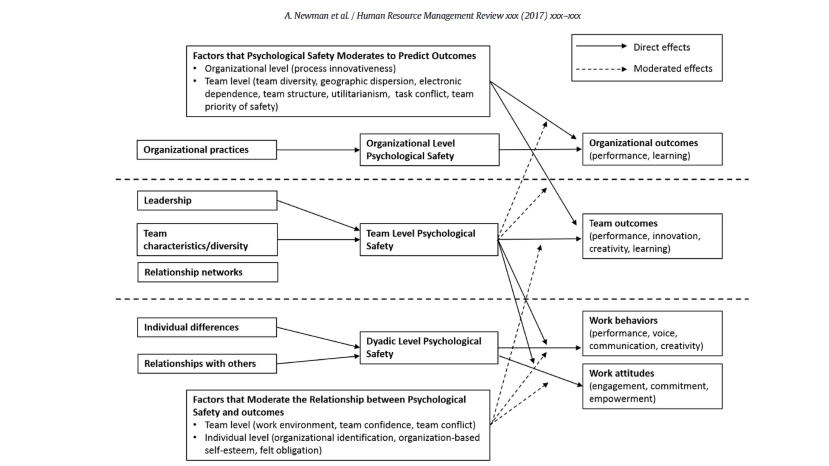
Mini-Compendium: Psychological Safety
Given the prominence of Psychological Safety (PS), it’s worth sharing some research. It’s likely among the most studied modern concepts in organisational theory – so I can barely scratch the surface. Focus first is articles I’ve summarised, and then on any other full-text items I can find. In my haste, I’ve probably included some psychological… Continue reading Mini-Compendium: Psychological Safety

Imbalanced sleep increases mortality risk by 14–34%: a meta-analysis
Poor sleep increases mortality risk by 14 – 34% according to a new meta-analysis. 79 cohort studies were included. Findings: · Inadequate sleep was defined as fewer than 7 h per night · 1/3 of adults regularly experience insufficient sleep which are “driven by lifestyle factors deeply rooted in modern society” · Chronic sleep deprivation has been linked… Continue reading Imbalanced sleep increases mortality risk by 14–34%: a meta-analysis

What Control Measures Should I Use? Applying the Total Worker Health Hierarchy of Controls to Manage Workplace Fatigue
This new paper from Drew Dawson and others reconceptualised fatigue risk management within Total Worker Health (TWH) Hierarchy of Controls (HOC). THW HOC works as an extension to the traditional HOC, and “presents strategies in order of effectiveness, ranging from “eliminate,” “substitute,” “redesign,” “educate,” and “encourage” categories” They say that while is mostly associated with… Continue reading What Control Measures Should I Use? Applying the Total Worker Health Hierarchy of Controls to Manage Workplace Fatigue

Safety Management Systems may struggle with psychosocial factors and other complex phenomena
Certified safety management systems (OHSM) may struggle with complex, multi-factorial matters, like psychosocial safety. Extracts: · The OHSM “does not necessarily tackle the most urgent work environment issues and may exclude important aspects of the work environment such as psychosocial factors” · “some [OHSM] approaches may be ill-equipped to tackle complex sociotechnical issues and psychosocial matters, and… Continue reading Safety Management Systems may struggle with psychosocial factors and other complex phenomena

Why do doctors make poor decisions? Spotlighting ‘noise’ as an under-recognised source of error in clinical practice
A brief read covering the concept of noise, pertaining to judgements. This is based on the work from Kahneman, Sibony and Sunstein. From the article: · While biases in judgements have captured a lot of attention, “it has been suggested that ‘noise’ (defined as an undesirable variability in human judgements) is a highly important, yet under-recognised… Continue reading Why do doctors make poor decisions? Spotlighting ‘noise’ as an under-recognised source of error in clinical practice
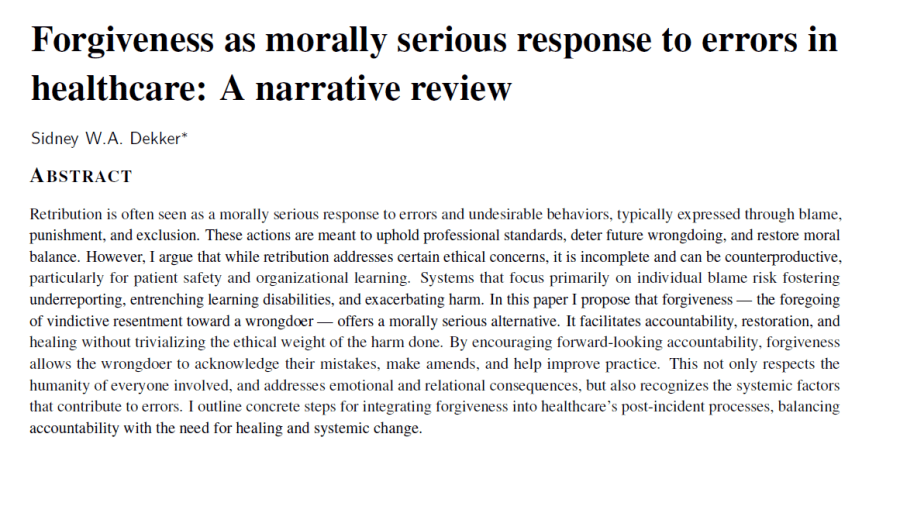
Forgiveness as morally serious response to errors in healthcare: A narrative review
An interesting and recent discussion paper from Sidney Dekker, exploring forgiveness as a ‘morally serious response’ to incidents, as opposed to retributive approaches. Tl;dr: · “while retribution addresses certain ethical concerns, it is incomplete and can be counterproductive, particularly for patient safety and organizational learning” · “Systems that focus primarily on individual blame risk fostering… Continue reading Forgiveness as morally serious response to errors in healthcare: A narrative review
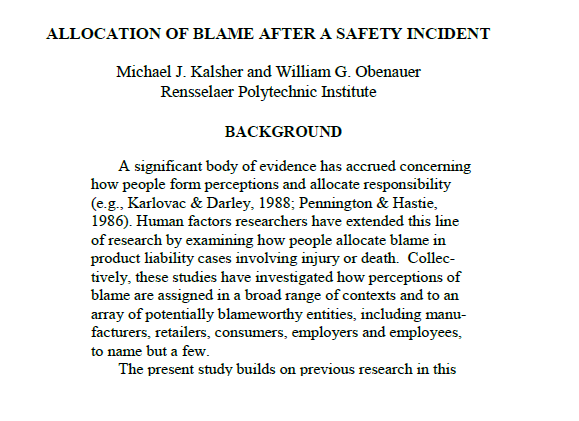
Allocation of Blame After a Safety Incident
This single page conference paper discussed an experiment on how blame is allocated following incidents. The scenario was a “realistic, but fictitious” incident involving a worker (both experienced or not experienced, depending on the scenario), whom is killed when touching an energised bus bar while feeding electrical wire into a pedestal. They systematically manipulated the… Continue reading Allocation of Blame After a Safety Incident
 SafetyInsights.org