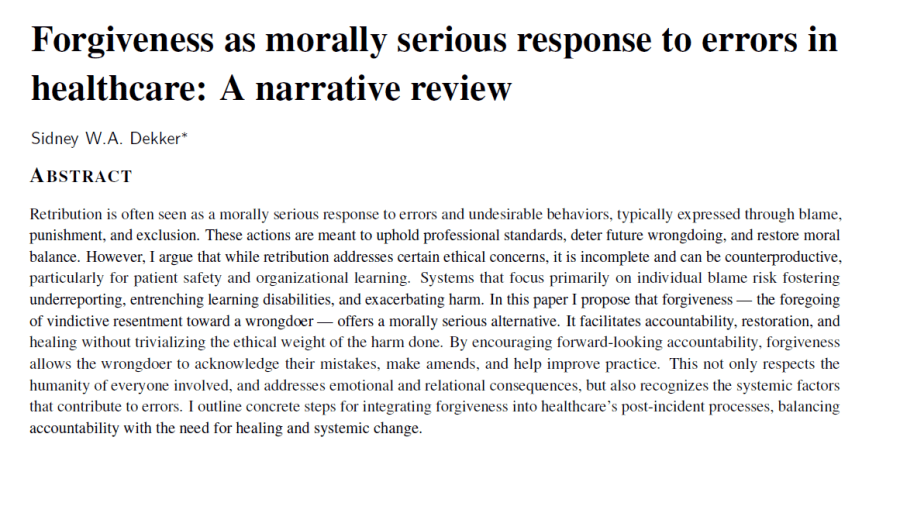
An interesting and recent discussion paper from Sidney Dekker, exploring forgiveness as a ‘morally serious response’ to incidents, as opposed to retributive approaches. Tl;dr: · “while retribution addresses certain ethical concerns, it is incomplete and can be counterproductive, particularly for patient safety and organizational learning” · “Systems that focus primarily on individual blame risk fostering… Continue reading Forgiveness as morally serious response to errors in healthcare: A narrative review
Tag: ohs
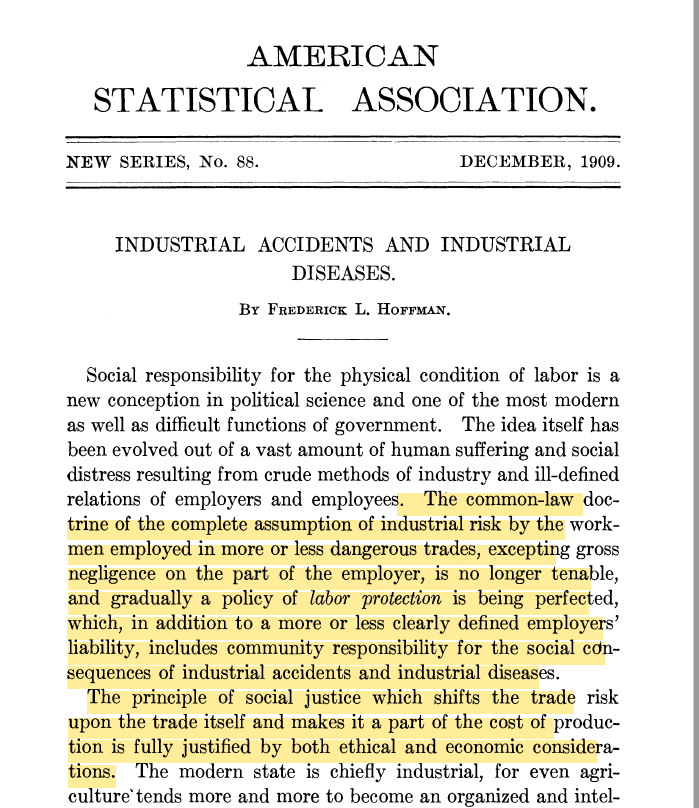
Industrial Accidents and Industrial Diseases – 1909 article
Another interesting read from 1909, talking about ‘social responsibility’ and industrial accidents & diseases in the US. Really modern thinking here – that: 1) ‘trade’ should bear the fair burden of injury 2) compensation is about justice and social responsibility 3) a worker’s free will to work in dangerous industries is a myth (they often… Continue reading Industrial Accidents and Industrial Diseases – 1909 article

Automation’s lacklustre effects on fatal accidents & cheap migrant labour hampering adoption of engineering controls
REALLY interesting findings from Associate Professor Masahiro Yoshida. It suggests that automation over a historical context didn’t really drive down workplace injuries since it tended to be employed in already mature industries. And, ready access to cheap migrant workforces may hinder broader industrial risk reduction due to a negative correlation with automation investment. And the… Continue reading Automation’s lacklustre effects on fatal accidents & cheap migrant labour hampering adoption of engineering controls

Can serious industrial accidents be eliminated? Article from 1917 equally valid today
Can serious industrial accidents be eliminated? Oof, this was a banger read – from 1917. Talks about: · Focusing on effective workplace design and engineering – not just machine guarding · Not focusing on “careless” workers and such stuff · Focusing on the severity of incidents and not just their frequency · The primary duty of the employer should… Continue reading Can serious industrial accidents be eliminated? Article from 1917 equally valid today
Allocation of Blame After a Safety Incident
This single page conference paper discussed an experiment on how blame is allocated following incidents. The scenario was a “realistic, but fictitious” incident involving a worker (both experienced or not experienced, depending on the scenario), whom is killed when touching an energised bus bar while feeding electrical wire into a pedestal. They systematically manipulated the… Continue reading Allocation of Blame After a Safety Incident

Compendium: Blame, Just Culture & language
Here’s another compendium of articles exploring blame and language in the construction of post-hoc causality explanations, or how blame effects learning and investigations. The other part covers some articles around Just Culture and restorative culture. Note: I’ve mostly focused on articles that I’ve either already summarised or that I could find a full text link… Continue reading Compendium: Blame, Just Culture & language

Human Performance Tools: Engaging Workers as the Best Defense Against Errors & Error Precursors
This article covered a more progressive view on human performance, with suggestions on some tools. Too much to cover, so just a few points. They start by saying to consider three truisms: “To err is human. Workers are fallible. Errors are inevitable (as well as predictable)”. These are fundamentals to understanding the human performance approach… Continue reading Human Performance Tools: Engaging Workers as the Best Defense Against Errors & Error Precursors
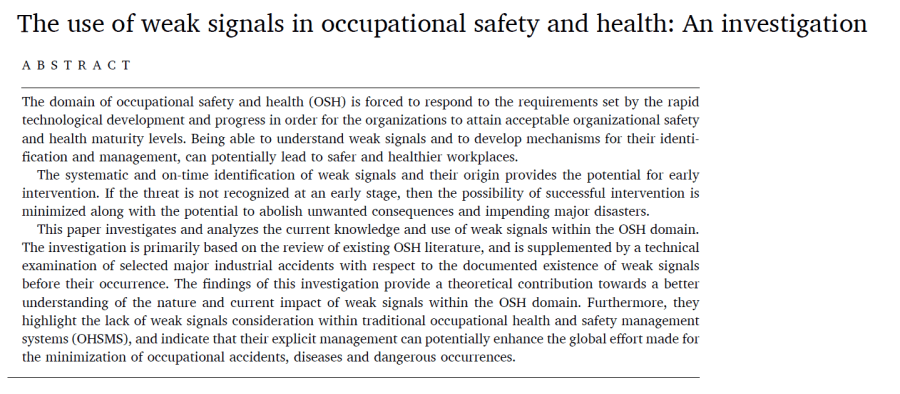
The use of weak signals in occupational safety and health: An investigation
This study explored current knowledge and use of weak signals in safety. Thanks to Clive Lloyd for sharing this a couple weeks back. As you’d expect, this sort of topic, based on accidents, is pretty replete with hindsight and outcome knowledge but is interesting nevertheless. Extracts: · They have been defined as an “…imprecise early indication… Continue reading The use of weak signals in occupational safety and health: An investigation

Boards of directors’ influences on occupational health and safety: a scoping review of evidence and best practices
This literature review evaluated the impact of boards of directors on workplace safety. 49 studies met inclusion. Way too much to cover. Background: · “There is a growing understanding that operative leadership, from line managers to senior management, plays an important role in occupational health and safety” · Leadership “do not act in a vacuum”… Continue reading Boards of directors’ influences on occupational health and safety: a scoping review of evidence and best practices

Formalised safety systems miss “three-quarters” of established factors linked to performance
Not much to say here – just found this an interesting extract from the ‘Digging Deeper’ focused on safety within NSW mining. They observe relating to the adoption of formalised safety management systems: · “Smaller organisations that take on such systems are often overwhelmed by their complexity” · And these systems “can be expensive to establish and… Continue reading Formalised safety systems miss “three-quarters” of established factors linked to performance
 SafetyInsights.org