
Here Don Norman discusses knowledge in the head vs knowledge in the world – from The Design of Everyday Things. Extracts:· “Every day we are confronted by numerous objects, devices, and services, each of which requires us to behave or act in some particular manner. Overall, we manage quite well” · “Our knowledge is often quite incomplete,… Continue reading Knowledge in the head vs the world: And how to design for cognition. Norman – Design of Everyday Things
Tag: philosophy
Mind the Gaps: How AI Shortcomings and Human Concerns May Disrupt Team Cognition in Human-AI Teams (HATs)
This study explored the integration and hesitations of AI embedded within human teams (Human-AI Teams, HATs). 30 professionals were interviewed. Not a summary, but some extracts: · “As AI takes on more complex roles in the workplace, it is increasingly expected to act as a teammate rather than just a tool” · HATs “must develop a shared… Continue reading Mind the Gaps: How AI Shortcomings and Human Concerns May Disrupt Team Cognition in Human-AI Teams (HATs)
“Indicators are partial reflections of reality, based on uncertain and imperfect models” – Part 2 Donella Meadows sustainable indicators
Part 2 of Meadow’s banger ‘Indicators and Information Systems for Sustainable Development’. Extracts: · “Indicators are partial reflections of reality, based on uncertain and imperfect models” · “The stock market price is not the value of the company. No indicator is the real system. Indicators are abstractions from systems” · And are “are abstractions from abstractions, from models,… Continue reading “Indicators are partial reflections of reality, based on uncertain and imperfect models” – Part 2 Donella Meadows sustainable indicators
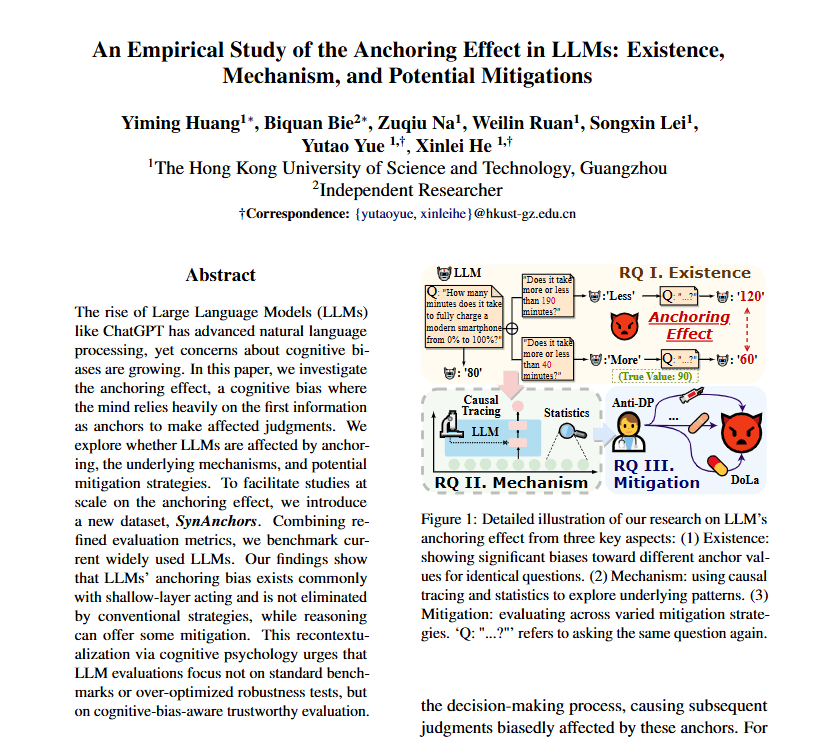
An Empirical Study of the Anchoring Effect in LLMs: Existence, Mechanism, and Potential Mitigations
This study found that several LLMs are fairly easily influenced by anchoring effects, consistent with human anchoring bias. Extracts: · “Although LLMs surpass humans in standard benchmarks, their psychological traits remain understudied despite their growing importance” · “The anchoring effect is a ubiquitous cognitive bias (Furnham and Boo, 2011) and influences decisions in many fields” · “Under uncertainty,… Continue reading An Empirical Study of the Anchoring Effect in LLMs: Existence, Mechanism, and Potential Mitigations
The issues of ‘root causes’ and infinite regression (the endless search for the causes of causes)
A really interesting, but challenging, read about the ontological status of ‘root causes’ and more pointedly, the problem of infinite regression. The author also proposes some stop rules to help navigate infinite regression. I’ve previously posted articles critical of the status of ‘root causes’, who argue it is more a process of implicit or explicit… Continue reading The issues of ‘root causes’ and infinite regression (the endless search for the causes of causes)
How complex systems (don’t) fail: YT video from late Richard Cook
A banger YT presentation from the late, great Richard Cook. He discusses ‘how complex systems fail’. Video link below. Some extracts: · “The surprise is not that there are so many accidents … The surprise is that there are so few” · “The normal world is not well-behaved … Even so, a lot of operational settings achieve… Continue reading How complex systems (don’t) fail: YT video from late Richard Cook
Leverage points to intervene in a system – Donella Meadows
In the lead up to next week’s compendium on systems thinking, here’s a banger from Donella Meadows. She explores system leverage points. Not a summary, but some extracts: · Leverage points are “places within a complex system .. where a small shift in one thing can produce big changes in everything” · The “state of the system”… Continue reading Leverage points to intervene in a system – Donella Meadows
“there is no such thing as a root cause [and therefore] there is technically no such thing as the beginning of a mishap” — Dekker
Extracts from Dekker’s work about the ontological and empirical shakiness of ‘root causes’. I’ve taken material from two versions of The Field Guide to Understanding Human Error (Investigations). In Dekker’s view: · “There is no ‘root’ cause” (or ‘root causes’) · Given the multiple angles and interactions in complex systems, you “can really construct “causes” from everywhere”… Continue reading “there is no such thing as a root cause [and therefore] there is technically no such thing as the beginning of a mishap” — Dekker

Why do doctors make poor decisions? Spotlighting ‘noise’ as an under-recognised source of error in clinical practice
A brief read covering the concept of noise, pertaining to judgements. This is based on the work from Kahneman, Sibony and Sunstein. From the article: · While biases in judgements have captured a lot of attention, “it has been suggested that ‘noise’ (defined as an undesirable variability in human judgements) is a highly important, yet under-recognised… Continue reading Why do doctors make poor decisions? Spotlighting ‘noise’ as an under-recognised source of error in clinical practice

“I think, therefore I err”: An article about ‘good errors’, heuristics and intelligent systems
“Every intelligent system makes errors”, so said Gerd Gigerenzer. Here’s a couple of page extracts from a 2005 paper. Not sure if I’ll summarise it or not (it’s really interesting, but tough to capture in a summary…) The paper: · Challenges the rationalistic and normative ideal as cognition as purely a logical and rational one, ignoring… Continue reading “I think, therefore I err”: An article about ‘good errors’, heuristics and intelligent systems
 SafetyInsights.org