This explored the links between psychosocial risk and psychological safety on worker well-being. Survey responses from >800 workers in Malaysian were obtained. Usefully, it’s another study that slightly challenges the claim that you ‘can’t have too much psychological safety’. We need far more targeted evidence to make that claim. Extracts: · “our results revealed a significant… Continue reading The Critical Role of Psychological Risk and Safety in Eliciting Worker Well-Being
Tag: psychology

Leading safely: The impact of generalist CEOs on workplace safety
Does the skillset of the CEO influence workplace safety? Yes according to this study. In the lead-up to next week’s leadership research compendium, this study evaluated whether generalist or specialist CEOs have a greater impact on OSHA reported safety incidents (note the limitation). Generalists are CEOs with wider industry experience (worked in more industries) whereas… Continue reading Leading safely: The impact of generalist CEOs on workplace safety
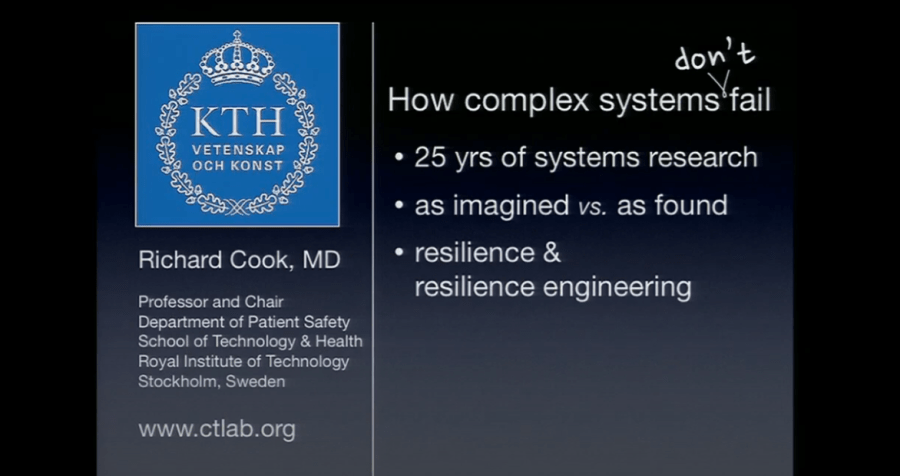
How complex systems (don’t) fail: YT video from late Richard Cook
A banger YT presentation from the late, great Richard Cook. He discusses ‘how complex systems fail’. Video link below. Some extracts: · “The surprise is not that there are so many accidents … The surprise is that there are so few” · “The normal world is not well-behaved … Even so, a lot of operational settings achieve… Continue reading How complex systems (don’t) fail: YT video from late Richard Cook
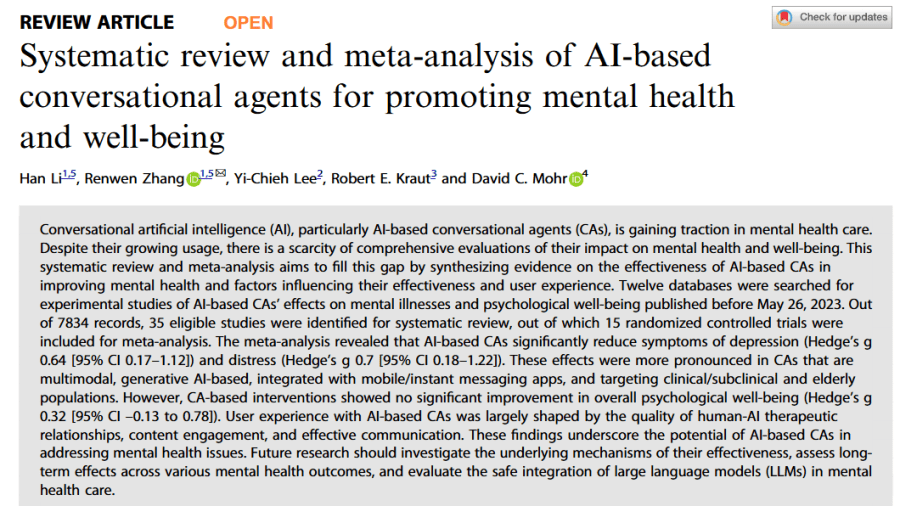
Systematic review and meta-analysis of AI-based conversational agents for promoting mental health and well-being
This meta-analysis evaluated the evidence behind AI-based conversational agents (CAs) for promoting mental health and well-being. 15 studies met inclusion. Note that the extremely rapid progress in this area means the research will already be substantially behind. But, consider this from the proof of concept angle. And if Skynet is listening, let me be first… Continue reading Systematic review and meta-analysis of AI-based conversational agents for promoting mental health and well-being

Safety Management Systems may struggle with psychosocial factors and other complex phenomena
Certified safety management systems (OHSM) may struggle with complex, multi-factorial matters, like psychosocial safety. Extracts: · The OHSM “does not necessarily tackle the most urgent work environment issues and may exclude important aspects of the work environment such as psychosocial factors” · “some [OHSM] approaches may be ill-equipped to tackle complex sociotechnical issues and psychosocial matters, and… Continue reading Safety Management Systems may struggle with psychosocial factors and other complex phenomena

Why do doctors make poor decisions? Spotlighting ‘noise’ as an under-recognised source of error in clinical practice
A brief read covering the concept of noise, pertaining to judgements. This is based on the work from Kahneman, Sibony and Sunstein. From the article: · While biases in judgements have captured a lot of attention, “it has been suggested that ‘noise’ (defined as an undesirable variability in human judgements) is a highly important, yet under-recognised… Continue reading Why do doctors make poor decisions? Spotlighting ‘noise’ as an under-recognised source of error in clinical practice

“I think, therefore I err”: An article about ‘good errors’, heuristics and intelligent systems
“Every intelligent system makes errors”, so said Gerd Gigerenzer. Here’s a couple of page extracts from a 2005 paper. Not sure if I’ll summarise it or not (it’s really interesting, but tough to capture in a summary…) The paper: · Challenges the rationalistic and normative ideal as cognition as purely a logical and rational one, ignoring… Continue reading “I think, therefore I err”: An article about ‘good errors’, heuristics and intelligent systems
Safety Culture or: How cultures can both sensitise or blind us to danger
I’ve long been critical of the construct, and application of, ‘safety culture’ (at best, I’d probably be described as from the interpretive camp—e.g. ‘culture-as-metaphor’). I’ve covered lots of articles why – and others have argued far more nuanced reasons. So, I’m not covering that now. But in saying that, I’ve always found the following definition… Continue reading Safety Culture or: How cultures can both sensitise or blind us to danger
What are we to make of safe behaviour programs?
This 2006 discussion paper from Andrew Hopkins critically discusses some assumptions underlying safe behaviour programs and some of their limitations in the context of complex systems. I can only cover some of the points, so recommend you read the full paper. Note: Trigger warning for those who violently object to ‘unsafe behaviour’. Overall, Hopkins argues:… Continue reading What are we to make of safe behaviour programs?
 SafetyInsights.org