
A brief read covering the concept of noise, pertaining to judgements. This is based on the work from Kahneman, Sibony and Sunstein. From the article: · While biases in judgements have captured a lot of attention, “it has been suggested that ‘noise’ (defined as an undesirable variability in human judgements) is a highly important, yet under-recognised… Continue reading Why do doctors make poor decisions? Spotlighting ‘noise’ as an under-recognised source of error in clinical practice
Tag: risk

An ode to Drs Richard Cook, Jens Rasmussen & Bob Wears: A mini-compendium of their legacies
This is long overdue – but I wanted to cover some of the work from these giants who have played a significant part in modern safety thinking. Focus is on articles I’ve written about or used extracts from, or could find a full-text link for, and higher-cited articles. It’s not systematic – and unfortunately a… Continue reading An ode to Drs Richard Cook, Jens Rasmussen & Bob Wears: A mini-compendium of their legacies

The Impact of Physical Hazards on Workers’ Job Satisfaction in the Construction Industry: A Case Study of Korea
This explored the effects of physical hazard exposures on worker job satisfaction. Survey from >2k Korean construction workers. Background: · “physical hazards such as noise, vibration, and exposure to hazardous substances also contribute to job stress” and behavioural changes · “Continuous exposure to such risks can result in cumulative mental and physical strain, increasing job-related stress, and… Continue reading The Impact of Physical Hazards on Workers’ Job Satisfaction in the Construction Industry: A Case Study of Korea
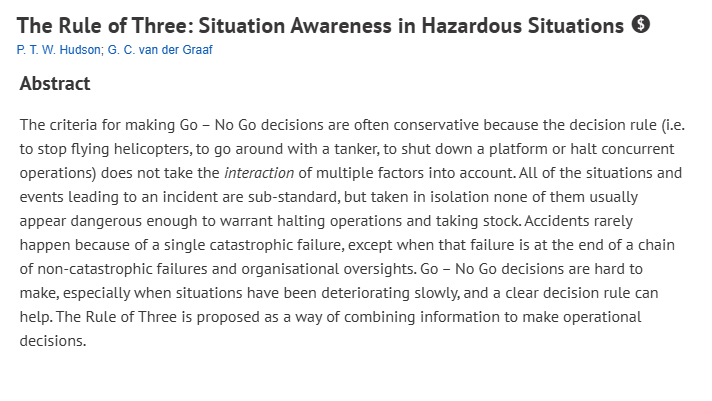
The rule of three: Situation awareness in hazardous situations
“The rule of three provides a mechanism that converts the risk continuum into a dichotomy for the purposes of decision-making. It does not, however, ignore the expertise of operators … Put another way, the rule of three structures expert decision-making; it does not replace it”

Does probability exist?
Really cool article talking about probability – does it exist? Is it an objective property of the world, or a subjective and constructed phenomenon? And more. Thanks to Ben Cattaneo for putting this on my radar. Can’t do this justice and I’ve skipped HEAPS, so check out the full paper. Thanks to **** for highlighting… Continue reading Does probability exist?
Trust, uncertainty and the reporting of workplace hazards and injuries
This study interviewed 121 workers across several Canadian sectors in temporary and permanent employment, exploring ways workers managed workplace hazards given employment insecurity. Not a summary – way too much to cover. Extracts: Ref: Hall, A. (2016). Trust, uncertainty and the reporting of workplaces hazards and injuries. Health, Risk & Society, 18(7-8), 427-448. Study link: https://doi.org/10.1080/13698575.2016.1264576 My… Continue reading Trust, uncertainty and the reporting of workplace hazards and injuries
Warnings and Hazard Communications
This book chapter explored research on the design and efficacy of written warnings and hazard communications, like you’d find in product information booklets, labels etc. It’s a whole chapter, so I can only touch on some points. First they say that, overall, safety warnings are a “third line of defense behind design and guarding”, they… Continue reading Warnings and Hazard Communications
Wrong, Strong, and Silent: What happens when automated systems with high autonomy and high authority misbehave?
This article from Dekker and Woods discusses the ‘risks of literal-minded automation’, being a “system that can’t tell if its model of the world is the world it is actually in”. This issue manifests in automated systems being wrong, strong and silent—and while the issue has existed for at least 70 years, the risk “looms… Continue reading Wrong, Strong, and Silent: What happens when automated systems with high autonomy and high authority misbehave?
Identifying risks and emergent risks across sociotechnical systems: The NETworked Hazard Analysis and Risk Management System (NETHARMS)
I found this pretty interesting from Dallat, Salmon and Goode, exploring a new systems-based risk assessment method called NETworked Hazard Analysis and Risk Management System (NET-HARMS). One key focus on NET-HARMS was revealing the harder to find emergent risks that emerge via interactions. WAY too much to cover in this paper – I’ve skipped large… Continue reading Identifying risks and emergent risks across sociotechnical systems: The NETworked Hazard Analysis and Risk Management System (NETHARMS)
 SafetyInsights.org