
This was an interesting article from 1912 highlighting the role that fatigue has in industrial accidents. Also challenges ‘carelessness’, saying it doesn’t account for the effects of fatigue. While scientific knowledge has progressed over the century, it’s cool how well they articulated the issue. · Image 1 top panel shows a breakdown of accidents per time… Continue reading 1912 article discussing the role of fatigue in industrial accidents and arguing against ‘carelessness’ as an “ultimate cause”
Tag: risk
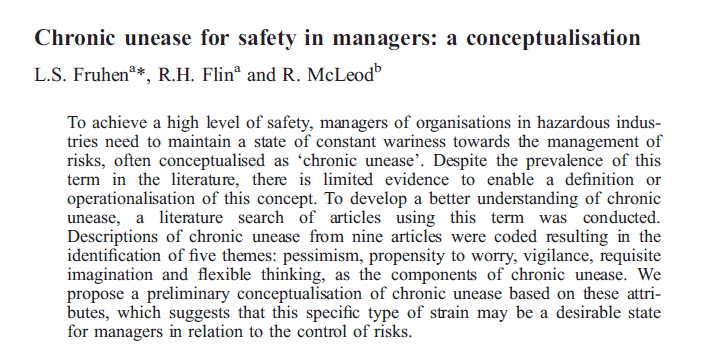
Chronic unease for safety in managers: a conceptualisation
Just a basic post today – some extracts from a paper exploring chronic unease: · Drawing on Reason’s concept, chronic unease has gone by various definitions over the years (image 1) · For Reason, it was the “tendencies of wariness towards risks” · And as a “contrast to complacency, resulting from the absence of negative events, leading ‘people… Continue reading Chronic unease for safety in managers: a conceptualisation

What Control Measures Should I Use? Applying the Total Worker Health Hierarchy of Controls to Manage Workplace Fatigue
This new paper from Drew Dawson and others reconceptualised fatigue risk management within Total Worker Health (TWH) Hierarchy of Controls (HOC). THW HOC works as an extension to the traditional HOC, and “presents strategies in order of effectiveness, ranging from “eliminate,” “substitute,” “redesign,” “educate,” and “encourage” categories” They say that while is mostly associated with… Continue reading What Control Measures Should I Use? Applying the Total Worker Health Hierarchy of Controls to Manage Workplace Fatigue
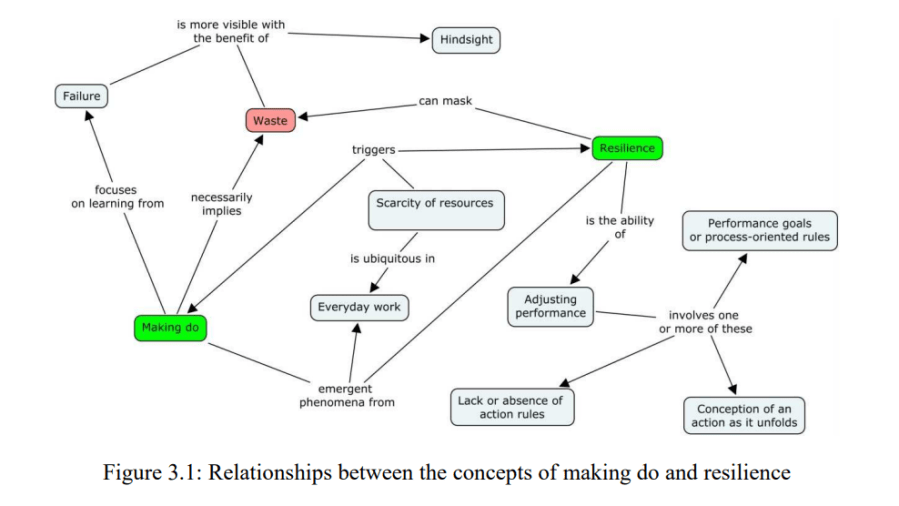
The difference between ‘making do’ and resilience in complex systems
This paper explores the difference between ‘making do’ and resilience. Not a summary, but a few extracts: · Making do has been defined, from a waste perspective as “a situation where a task is started without all its standard inputs, or the execution of a task is continued although the availability of at least one standard… Continue reading The difference between ‘making do’ and resilience in complex systems

Safety Management Systems may struggle with psychosocial factors and other complex phenomena
Certified safety management systems (OHSM) may struggle with complex, multi-factorial matters, like psychosocial safety. Extracts: · The OHSM “does not necessarily tackle the most urgent work environment issues and may exclude important aspects of the work environment such as psychosocial factors” · “some [OHSM] approaches may be ill-equipped to tackle complex sociotechnical issues and psychosocial matters, and… Continue reading Safety Management Systems may struggle with psychosocial factors and other complex phenomena

Why do doctors make poor decisions? Spotlighting ‘noise’ as an under-recognised source of error in clinical practice
A brief read covering the concept of noise, pertaining to judgements. This is based on the work from Kahneman, Sibony and Sunstein. From the article: · While biases in judgements have captured a lot of attention, “it has been suggested that ‘noise’ (defined as an undesirable variability in human judgements) is a highly important, yet under-recognised… Continue reading Why do doctors make poor decisions? Spotlighting ‘noise’ as an under-recognised source of error in clinical practice

An ode to Drs Richard Cook, Jens Rasmussen & Bob Wears: A mini-compendium of their legacies
This is long overdue – but I wanted to cover some of the work from these giants who have played a significant part in modern safety thinking. Focus is on articles I’ve written about or used extracts from, or could find a full-text link for, and higher-cited articles. It’s not systematic – and unfortunately a… Continue reading An ode to Drs Richard Cook, Jens Rasmussen & Bob Wears: A mini-compendium of their legacies

The Impact of Physical Hazards on Workers’ Job Satisfaction in the Construction Industry: A Case Study of Korea
This explored the effects of physical hazard exposures on worker job satisfaction. Survey from >2k Korean construction workers. Background: · “physical hazards such as noise, vibration, and exposure to hazardous substances also contribute to job stress” and behavioural changes · “Continuous exposure to such risks can result in cumulative mental and physical strain, increasing job-related stress, and… Continue reading The Impact of Physical Hazards on Workers’ Job Satisfaction in the Construction Industry: A Case Study of Korea
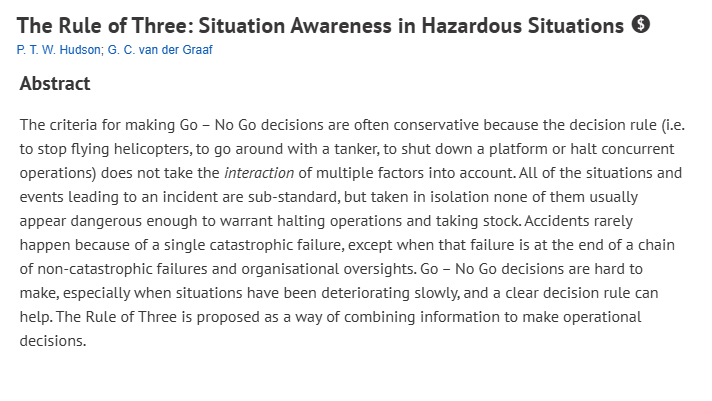
The rule of three: Situation awareness in hazardous situations
“The rule of three provides a mechanism that converts the risk continuum into a dichotomy for the purposes of decision-making. It does not, however, ignore the expertise of operators … Put another way, the rule of three structures expert decision-making; it does not replace it”

Does probability exist?
Really cool article talking about probability – does it exist? Is it an objective property of the world, or a subjective and constructed phenomenon? And more. Thanks to Ben Cattaneo for putting this on my radar. Can’t do this justice and I’ve skipped HEAPS, so check out the full paper. Thanks to **** for highlighting… Continue reading Does probability exist?

