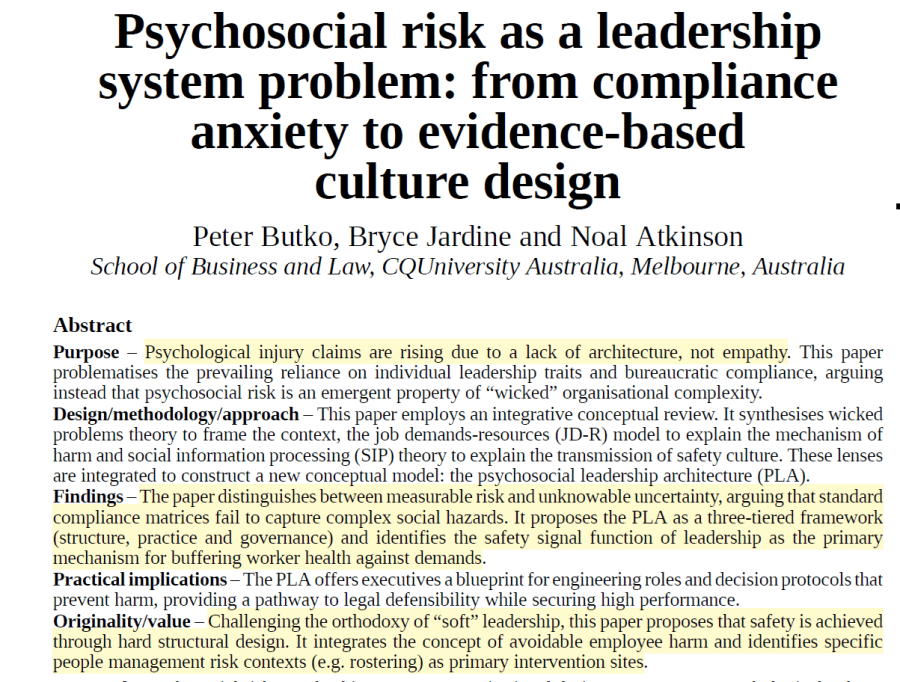
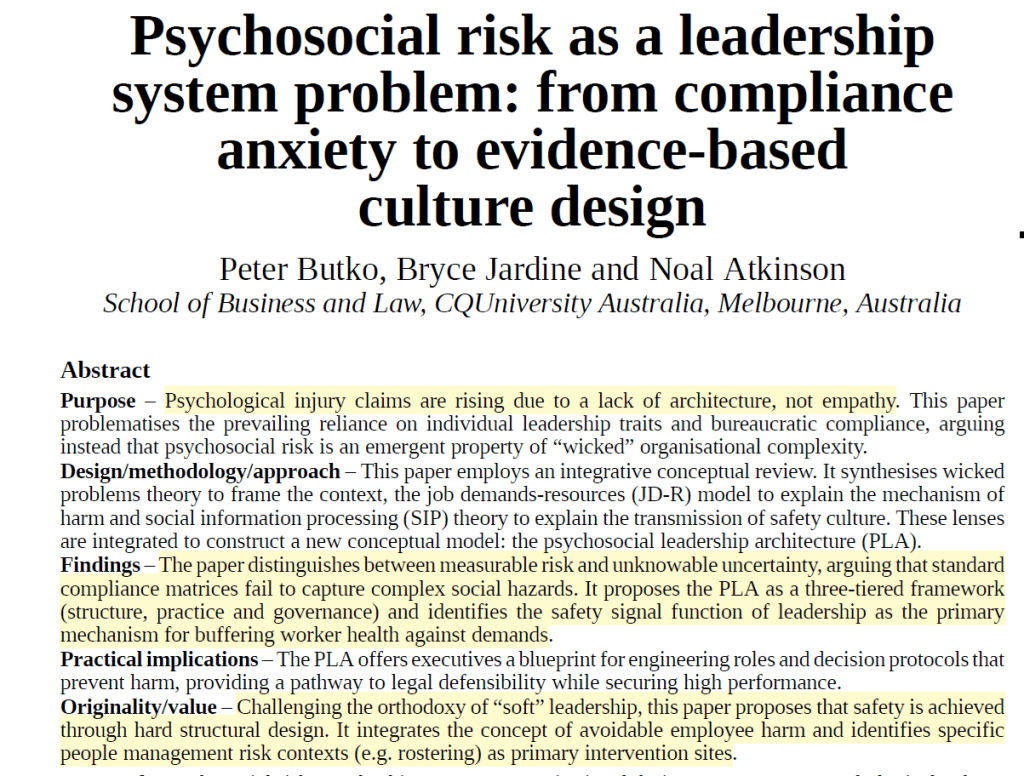
“Psychological injury claims are rising due to a lack of architecture, not empathy”
An interesting ‘integrative conceptual review’ of the traps of current compliance-driven approaches to psychosocial challenges, and a way forward.
They argue that the current approach places “reliance on individual leadership traits and bureaucratic compliance” over recognising the emergent/wicked nature of psychosocial risk.
PS. Check out my YouTube: https://youtube.com/@safe_as_pod?si=iUaDPJynPemQRZhY
Extracts:
· “Claims related to stress, bullying, and hostile work environments are costly, often exceeding the expense and recovery time of physical injuries”
· Despite recent regulatory focus on psychosocial hazards, “for many leaders, these new duties are experienced as a burden—a compliance minefield where every management decision regarding performance or attendance risks triggering a grievance”
· The “psychosocial regulation should not be viewed merely as a punitive imposition, but as a structural opportunity”
· They challenge the “orthodoxy of “soft” leadership” and argue that “safety is achieved through hard structural design”
· Physical hazards, like slippery floors, are ‘tame problems’; “the cause is observable, and the fix is permanent”
· However psychosocial hazards are “wicked” problems—defined by incomplete, contradictory, and changing requirement”
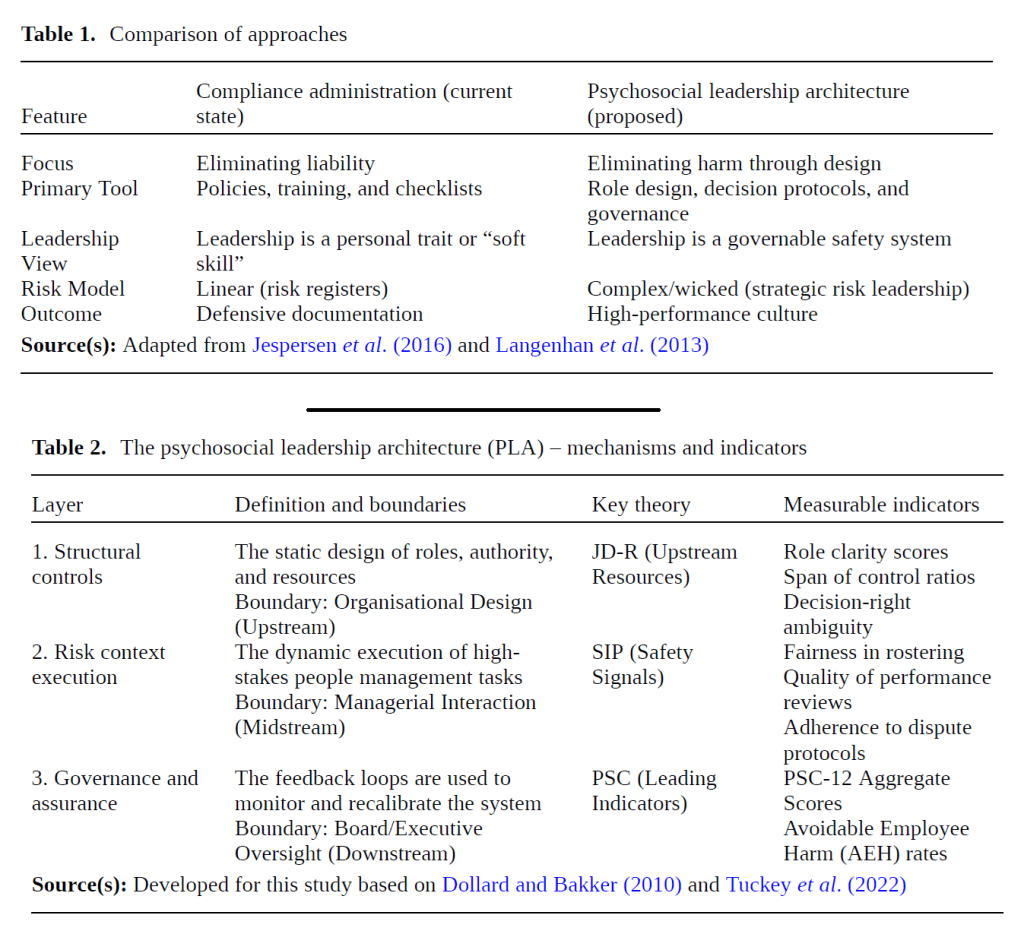
· They argue that current approaches “encourage organisations to view these hazards through the lens of traditional physical safety, leaders attempt to manage them using linear risk registers and static controls”
· This approach fails because “psychosocial risk is not static; it is dynamic and relational. It exists in the “backstage” micro-cultures of the organisation, where employees vent frustrations that are hidden from formal surveys”
· “Psychosocial hazards are … aspects of work design, organisation, and management that possess the potential to cause psychological or physical harm to workers”
· They say the ‘soft’ interventions are akin to painkillers – e.g. surveys and resilience training, that treat symptoms over causes
· These approaches can “carry significant perils … When leaders undergo development that emphasises performance-orientation without a concurrent adjustment in work design, it can inadvertently increase job demands, leading to higher absenteeism”
· “Training leaders to be “transformational” without giving them the structural resources to change the work environment creates a cynicism gap that exacerbates psychosocial risk”
· Current approaches confuse risk with uncertainty – “Risk refers to measurable events where probabilities can be calculated from historical data. However, psychosocial hazards reside in the domain of “uncertainty”
· When leaders apply linear risk matrices to complex social interactions, they engage in a “control illusion”
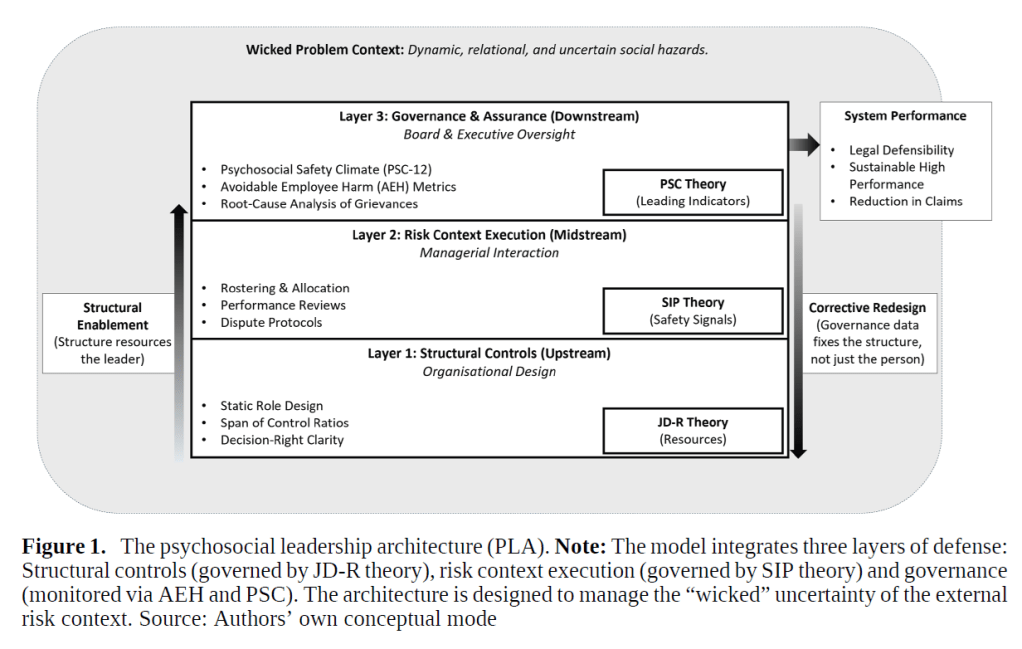
· They propose structural controls (org design ) for layer 1, where “Leadership behaviour or traits cannot make up for faults in the organisational framework”
· “Psychosocial risk increases dramatically when employees operate in ambiguous, contradictory, or persistently overloaded roles”
· Layer 2 focuses on dynamic execution of these controls – where “analysis of complaints indicates that bullying and psychological injury do not occur randomly but cluster around specific administrative interactions”
· Layer 3 is about measurement and governance infrastructure – where “psychosocial safety [moves] from an ambiguous aspiration to a governed domain of risk”
· And “Governance must focus on the continuous measurement of Psychosocial Safety Climate (PSC). High PSC is a powerful lead indicator, predicting lower levels of bullying and harassment”
· And finally, to operationalise these principles, they recommend organisations adopt a concept similar to healthcare (patient harm): ‘Avoidable Employee Harm’ (AEH)
Shout a coffee: https://buymeacoffee.com/benhutchinson
Study link: https://doi.org/10.1108/KRISM-12-2025-0015


