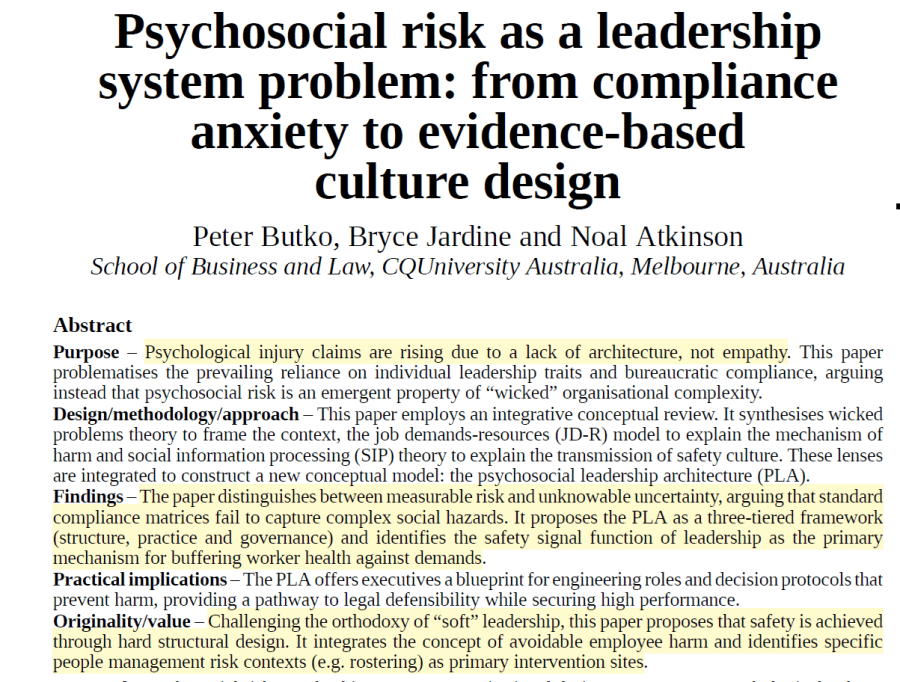
“Psychological injury claims are rising due to a lack of architecture, not empathy” An interesting ‘integrative conceptual review’ of the traps of current compliance-driven approaches to psychosocial challenges, and a way forward. They argue that the current approach places “reliance on individual leadership traits and bureaucratic compliance” over recognising the emergent/wicked nature of psychosocial risk.… Continue reading Psychosocial risk as a leadership system problem: from compliance anxiety to evidence-based culture design
Tag: education

Knowledge in the head vs the world: And how to design for cognition. Norman – Design of Everyday Things
Here Don Norman discusses knowledge in the head vs knowledge in the world – from The Design of Everyday Things. Extracts:· “Every day we are confronted by numerous objects, devices, and services, each of which requires us to behave or act in some particular manner. Overall, we manage quite well” · “Our knowledge is often quite incomplete,… Continue reading Knowledge in the head vs the world: And how to design for cognition. Norman – Design of Everyday Things

The literacy paradox: How AI literacy amplifies biases in evaluating AI-generated news articles
This study explored how AI literacy can amplify biases when evaluating AI-generated news based on their content type (data-driven vs emotional). Extracts: · “Higher AI literacy can intensify opposing biases. When individuals better understand the use of AI in creating data-driven articles, they exhibit automation bias… Conversely, when AI generates opinion- or emotion-based articles, high literacy… Continue reading The literacy paradox: How AI literacy amplifies biases in evaluating AI-generated news articles

Paradoxical safety leadership: Conceptualization and measurement
Should leaders embrace paradoxes and tensions? This study developed a paradoxical safety leadership (PSL) construct. Extracts: · PSL is a “multidimensional construct that consists of seemingly contradictory yet interrelated leader behaviors to meet competing goals and demands in safety management” · It integrates a “both-and approach to organizational tensions” to effectively manage “salient competing demands arising from… Continue reading Paradoxical safety leadership: Conceptualization and measurement

The impact of generative AI on critical thinking skills: a systematic review, conceptual framework and future research directions
The impact of generative AI on critical thinking skills: a systematic review, conceptual framework and future research directions How do generative AI (GenAI) models affect critical thinking skills? This systematic review unpacked 68 studies to explore the good and the bad. GenAI are “machine-learning algorithms, usually transformer-based large-language models (LLMs), that generate new text, code… Continue reading The impact of generative AI on critical thinking skills: a systematic review, conceptual framework and future research directions

The relationship between humble leadership and team adaptation: two paths model perspective
This study investigated how humble leadership fosters team outcomes, like team adaptation. Psychological safety climate and reflexivity were explored as mediating pathways. Surveys at two time points across 56 work teams (233 members) were collected. Background: · The word humility derives from the Latin humilitas, meaning from the earth/grounded · Humility has a long history and is… Continue reading The relationship between humble leadership and team adaptation: two paths model perspective
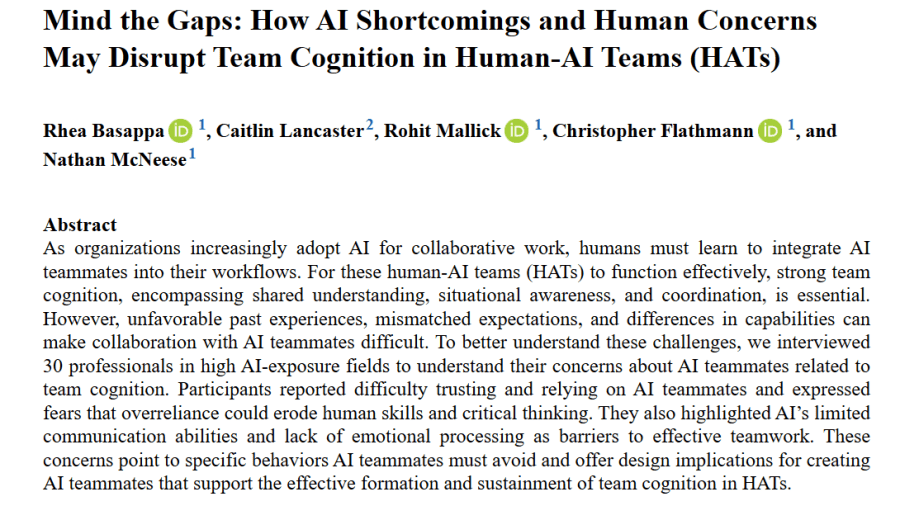
Mind the Gaps: How AI Shortcomings and Human Concerns May Disrupt Team Cognition in Human-AI Teams (HATs)
This study explored the integration and hesitations of AI embedded within human teams (Human-AI Teams, HATs). 30 professionals were interviewed. Not a summary, but some extracts: · “As AI takes on more complex roles in the workplace, it is increasingly expected to act as a teammate rather than just a tool” · HATs “must develop a shared… Continue reading Mind the Gaps: How AI Shortcomings and Human Concerns May Disrupt Team Cognition in Human-AI Teams (HATs)

Leading safely: The impact of generalist CEOs on workplace safety
Does the skillset of the CEO influence workplace safety? Yes according to this study. In the lead-up to next week’s leadership research compendium, this study evaluated whether generalist or specialist CEOs have a greater impact on OSHA reported safety incidents (note the limitation). Generalists are CEOs with wider industry experience (worked in more industries) whereas… Continue reading Leading safely: The impact of generalist CEOs on workplace safety
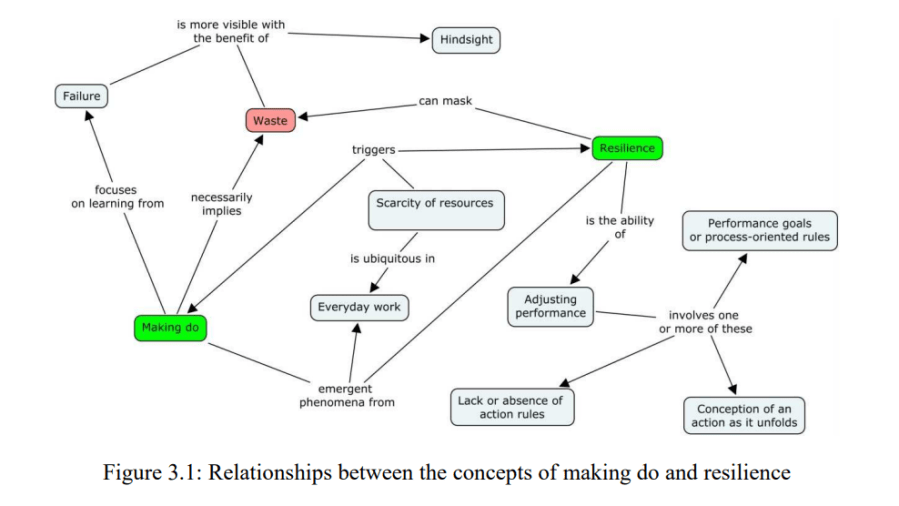
The difference between ‘making do’ and resilience in complex systems
This paper explores the difference between ‘making do’ and resilience. Not a summary, but a few extracts: · Making do has been defined, from a waste perspective as “a situation where a task is started without all its standard inputs, or the execution of a task is continued although the availability of at least one standard… Continue reading The difference between ‘making do’ and resilience in complex systems

Safety Management Systems may struggle with psychosocial factors and other complex phenomena
Certified safety management systems (OHSM) may struggle with complex, multi-factorial matters, like psychosocial safety. Extracts: · The OHSM “does not necessarily tackle the most urgent work environment issues and may exclude important aspects of the work environment such as psychosocial factors” · “some [OHSM] approaches may be ill-equipped to tackle complex sociotechnical issues and psychosocial matters, and… Continue reading Safety Management Systems may struggle with psychosocial factors and other complex phenomena
 SafetyInsights.org