More practical wisdom from the late, great Trevor Kletz. This explored a few elements of learning from experience – like the problems of just blaming people or changing procedures. First he targets the focus on changing procedures instead of improving designs. First, our first step should be, wherever reasonably practicable, is to remove the hazard… Continue reading Learning from experience
Author: Ben Hutchinson
“We might just as well reprimand a light-bulb for going out” than tell people to be more careful: Trevor Kletz and his classic aphorisms
There’s no use telling people to be more careful, “We might just as well reprimand a light-bulb for going out”. Trevor Kletz with his classic aphorisms about focusing on error and blame when we should instead be improving the design of workplaces and plant. Other extracts from his 1976 article ‘Accident Data – the need… Continue reading “We might just as well reprimand a light-bulb for going out” than tell people to be more careful: Trevor Kletz and his classic aphorisms
The issues of ‘root causes’ and infinite regression (the endless search for the causes of causes)
A really interesting, but challenging, read about the ontological status of ‘root causes’ and more pointedly, the problem of infinite regression. The author also proposes some stop rules to help navigate infinite regression. I’ve previously posted articles critical of the status of ‘root causes’, who argue it is more a process of implicit or explicit… Continue reading The issues of ‘root causes’ and infinite regression (the endless search for the causes of causes)
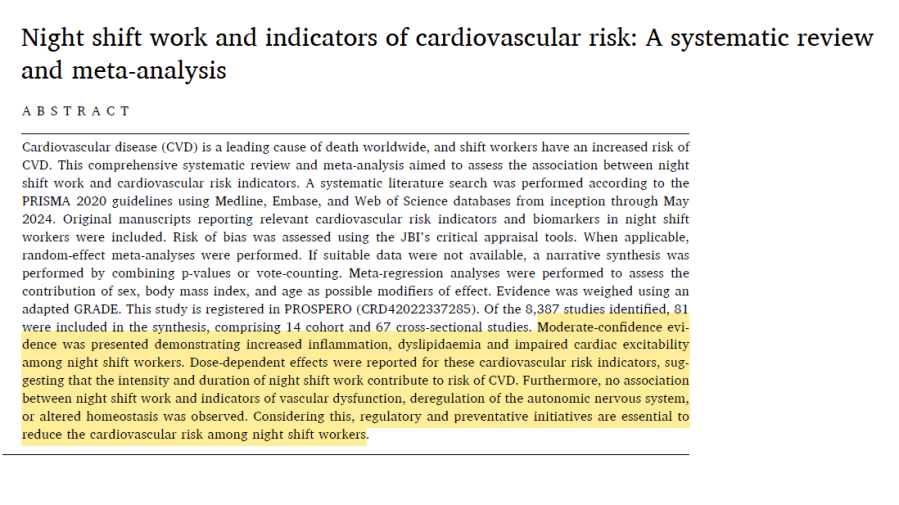
Night shift work and indicators of cardiovascular risk. A systematic review and meta-analysis
Night shift work linked to various indices of cardiovascular disease (CVD) risk in this systematic review and meta-analysis. 81 studies were evaluated. Extracts: · “Dose-dependent effects were reported for these cardiovascular risk indicators, suggesting that the intensity and duration of night shift work contribute to risk of CVD” · “This systematic review reports moderate-confidence evidence for inflammation,… Continue reading Night shift work and indicators of cardiovascular risk. A systematic review and meta-analysis
Ineffective audits and systems and false safety: Maritime NZ legal case
Third post from the Maritime NZ case where the CEO was charged under a failure to exercise due diligence for a work fatality (Ports of Auckland Limited (POAL). Some extracts on audits (and systems in post 2 in comments): · “Any effective system should also incorporate regular review and audit processes” · “the prosecution submits that prior… Continue reading Ineffective audits and systems and false safety: Maritime NZ legal case

‘Organisational safety culture principles’: In Patient safety culture
Some extracts from Guldenmund’s interesting article ‘Organisational safety culture principles’: · Culture can be studied via different aggregated levels, with many authors relating it as “consisting of a core surrounded by one or more layers, not unlike the anatomy of an onion” · “Whereas the core is something (deeply) hidden, the culture projects itself gradually through and… Continue reading ‘Organisational safety culture principles’: In Patient safety culture

Management of safety rules and procedures
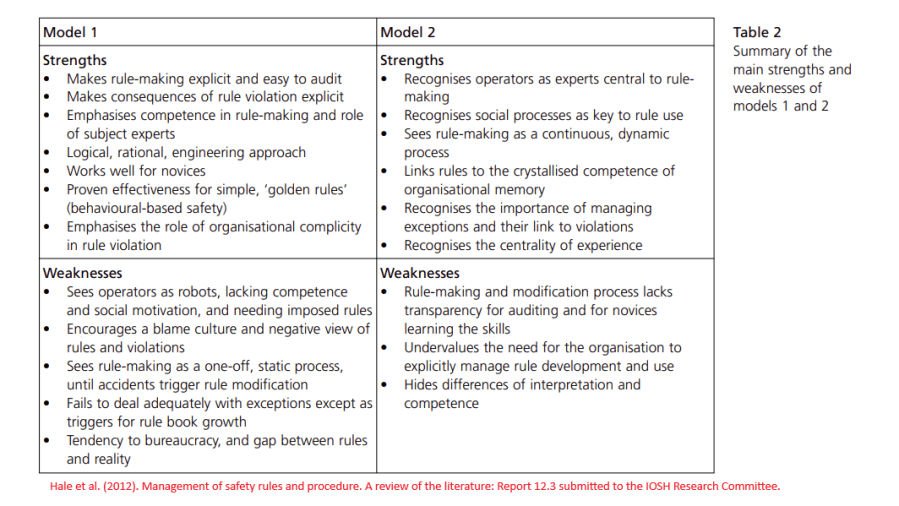
Really interesting report from Hale, Borys & Else about the nuances of rules, and contrasting model 1 / model 2. [* Check out this week’s compendium dedicated to Hale & Hopkins, link below] A few extracts: · A classic Dutch railways study showed that 3% of workers used rules often and 50% almost never, 47% found… Continue reading Management of safety rules and procedures

Exploring the relationship between major hazard, fatal and non-fatal accidents through outcomes and causes
This study from Linda Bellamy explored whether there is a relationship between major hazards, and fatal and non-fatal accidents. Analysis of 23k Dutch serious reportable accidents was analysed via the StoryBuilder software (largely based around bowties). [NB. As always, there’s certain limitations and nuances with relying on reported accidents, particularly around how they’re reported, how… Continue reading Exploring the relationship between major hazard, fatal and non-fatal accidents through outcomes and causes
Compendium: An ode to Andrew Hopkins & Andrew Hale
Two researchers & authors who have had a big impact on my practice and thinking are Andrew Hale and Andrew Hopkins. Thankfully, I was exposed to their work right at the start of my safety career. Why two Andrews? Why not three? I don’t know. Just two people who influenced my thinking around the same… Continue reading Compendium: An ode to Andrew Hopkins & Andrew Hale

Why safety performance indicators?
A response from Andrew Hale to Andrew Hopkins’ 2009 article about indicators (link in comments). [See tomorrow’s compendium dedicated to Hopkins & Hale] Extracts: · Hale starts with outlining why we need indicators, suggesting three obvious roles · Monitoring the level of safety in a system, which “answers the question: is the level of safety OK as… Continue reading Why safety performance indicators?
 SafetyInsights.org