Can adopting workplace AI technologies adversely affect employee psychological distress and depression? Yes according to this study. Online surveys of 381 employees in S.Korean companies was used. Background: · “In AI-centric environments .. AI reshapes jobs and workflows, affecting workers’ psychological health, satisfaction, commitment, and performance, as well as broader organizational outcomes” · “While AI adoption affects… Continue reading The dark side of artificial intelligence adoption: linking artificial intelligence adoption to employee depression via psychological safety and ethical leadership
Author: Ben Hutchinson
Preventing fatal accidents in construction through the management of barriers
This paper explored a (close-to) real-time safety performance indicator for barriers (sometimes called ‘controls’, although other typologies place barriers and safeguards under the broader category of ‘barriers’). The author developed and tested an indicator for the availability of barriers against fatal accidents during construction work. I’ve skipped a lot – but it’s open access, so… Continue reading Preventing fatal accidents in construction through the management of barriers
Night shifts and large gaps between work-as-prescribed and work-as-done: Maritime NZ case
Final post from the Maritime NZ case where the CEO (Gibson) was charged under a failure to exercise due diligence for a work fatality (Ports of Auckland Limited (POAL). Some extracts on night shift work and work-as-done: · “prior to Mr Kalati’s death, there was a culture, particularly on the nightshift, of the stevedores engaging in… Continue reading Night shifts and large gaps between work-as-prescribed and work-as-done: Maritime NZ case

CEO & board not receiving clear information on effectiveness of critical controls – Maritime NZ case
Fourth post from the Maritime NZ case where the CEO (Gibson) was charged under a failure to exercise due diligence for a work fatality (Ports of Auckland Limited (POAL). Some extracts on critical risks and controls: (** Post 2 in comments) · “As Mr Kahler succinctly put it, “gravity is generally [the] most common killer of… Continue reading CEO & board not receiving clear information on effectiveness of critical controls – Maritime NZ case
Local rationality question tool: understanding why it made sense at the time
An interesting tool for exploring a local rationality question tool (LRQ) in practice from Louise Roe, based on her conference paper. The tool has 25 items across situation, thoughts / decision making, preparedness, communication and anticipation. I’ve just covered a couple of sections (images 1 & 2). Extracts: · This tool has been used by the… Continue reading Local rationality question tool: understanding why it made sense at the time

Do metaphors in health messages work? Exploring emotional and cognitive factors
Do metaphors in health messages improve (intention for) self-protective behaviours? This study manipulated a few health messages (sun danger) via metaphorical vs literal risk messages, and sun damage as enemy combat. Extracts: · “People regularly encounter messages encouraging lifestyle behaviors that reduce the risk of illnesses such as cancer, influenza, and diabetes. But all too frequently… Continue reading Do metaphors in health messages work? Exploring emotional and cognitive factors

On “Black Swans” and “Perfect Storms”: Risk Analysis and Management When Statistics Are Not Enough
Really interesting 2012 article from Pate-Cornell about black swans, perfect storms and risk management. Although Pate-Cornell isn’t likely a household name within safety, she’s one of the GOATs in risk analysis. As usual, I’ve skipped a lot. Her key thesis is that popularised concepts like black swans and perfect storms have “struck the public’s imagination”… Continue reading On “Black Swans” and “Perfect Storms”: Risk Analysis and Management When Statistics Are Not Enough
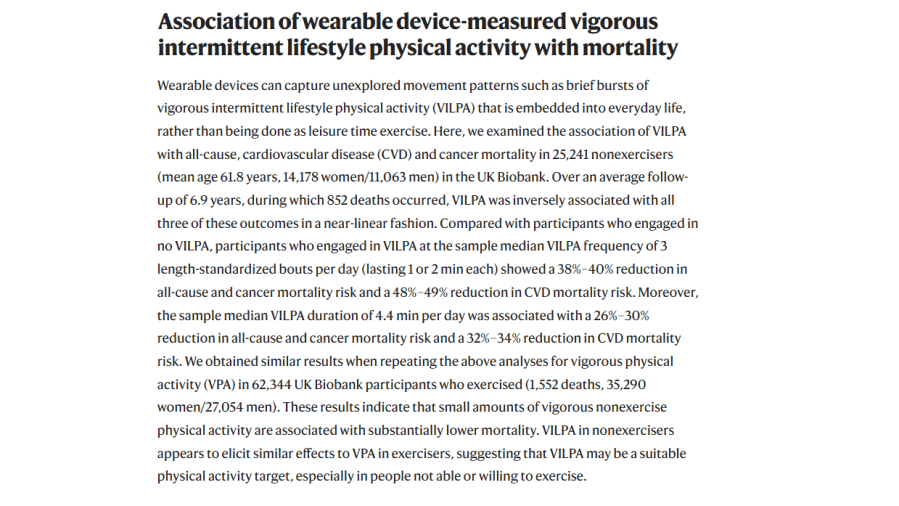
Association of wearable device-measured vigorous intermittent lifestyle physical activity with mortality
Can brief bursts of vigorous activity, like running up stairs, or walking quickly through the shops, reduce all-cause mortality? Yes according to this study. This paper was discussed on a YT channel I follow called Physionic (link to YT and paper in comments). Physical activity was measured via wearables from 25k non-exercisers (UK Biobank data)… Continue reading Association of wearable device-measured vigorous intermittent lifestyle physical activity with mortality

Compendium: Rules / Procedures / Procedural Departure / Writing Procedures
This mini-compendium covers a range of papers talking generally about rules and procedures. This includes the role, benefits and risks of rules, writing better rules incorporating HF/E and human-centred design, some literature specifically on workarounds, and then papers on rule departures and more. Feel free to shout a coffee (one-off or recurring monthly) if you’d… Continue reading Compendium: Rules / Procedures / Procedural Departure / Writing Procedures
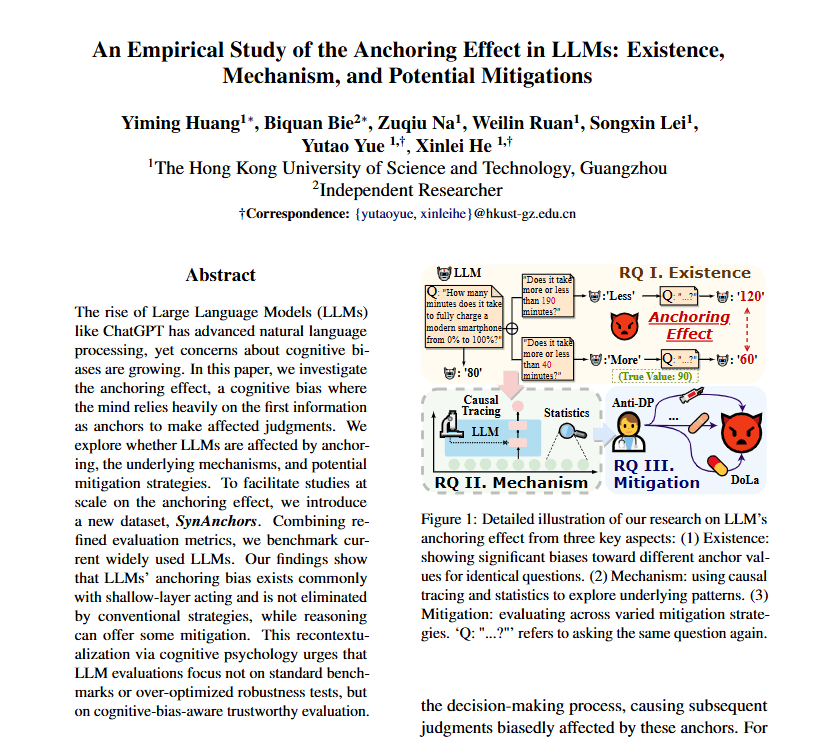
An Empirical Study of the Anchoring Effect in LLMs: Existence, Mechanism, and Potential Mitigations
This study found that several LLMs are fairly easily influenced by anchoring effects, consistent with human anchoring bias. Extracts: · “Although LLMs surpass humans in standard benchmarks, their psychological traits remain understudied despite their growing importance” · “The anchoring effect is a ubiquitous cognitive bias (Furnham and Boo, 2011) and influences decisions in many fields” · “Under uncertainty,… Continue reading An Empirical Study of the Anchoring Effect in LLMs: Existence, Mechanism, and Potential Mitigations
 SafetyInsights.org