
Really interesting discussion paper on the premise of ‘botshit’: the AI version of bullshit. I can’t do this paper justice – it’s 16 pages, so I can only cover a few extracts. Recommend reading the full paper. Tl;dr: generative chatbots predict responses rather than knowing the meaning of their responses, and hence, “produce coherent-sounding but… Continue reading BEWARE OF BOTSHIT: HOW TO MANAGE THE EPISTEMIC RISKSOF GENERATIVE CHATBOTS
A small favour: can you please help share the word on Safe As?
Hi friends – a small favour. If you find Safe As helpful can you please help share it on LinkedIn? And elsewhere. I think there’s more people that may find it useful, but who are outside of my network. Here’s a post you could share to help get Safe As noticed: Post: https://www.linkedin.com/posts/benhutchinson2_we-often-put-leadership-on-a-pedestal-the-activity-7360423613558108160-Mte0?utm_source=share&utm_medium=member_desktop&rcm=ACoAAAeWwekBvsvDLB8o-zfeeLOQ66VbGXbOpJU Thank you.

What type of leadership behaviors are functional in teams? A meta-analysis
Does leadership behaviour in teams matter? If so, what behaviours for effective teams? This meta-analysis of 50 studies (from 2006, so note the age) explored the above question, focused on task-focused and person-focused leader behaviours. It was meant to be a mini-post, but grew into a full post because I couldn’t be bothered cutting it… Continue reading What type of leadership behaviors are functional in teams? A meta-analysis
Safe As podcast #19: Leadership for safety – silver bullet or hype?
We often put leadership on a pedestal – the silver bullet for all organisational ills. But what does the evidence suggest? What influence does various aspects of leadership have on various organisational safety measures? This episode explores the research behind leadership, before we move into a couple of more critical leadership studies next week. Today’s… Continue reading Safe As podcast #19: Leadership for safety – silver bullet or hype?
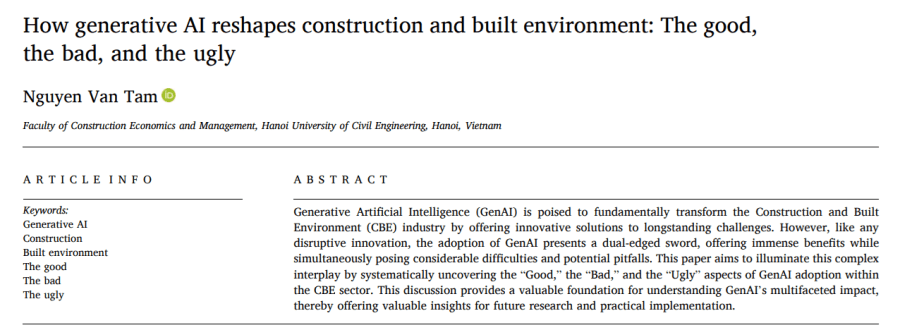
How generative AI reshapes construction and built environment: The good, the bad, and the ugly
This paper discusses some of the good, bad and ugly of GenAI use in construction. GenAI “poised to fundamentally transform the Construction and Built Environment (CBE) industry” but also is a “dual-edged sword, offering immense benefits while simultaneously posing considerable difficulties and potential pitfalls” Not a summary – just a few extracts: The Good: · GenAI… Continue reading How generative AI reshapes construction and built environment: The good, the bad, and the ugly
Safe As week in review: E17 on critical decisions and local rationality and E18 on affect and risk as feelings
Safe As podcast covered two topics this week: 1) Unpacking local rationality and decisions prior to incidents 2) Risk as feelings, not just numbers Ep 17: Discussed two different techniques – first the Critical Decision Method (image 1), the classic technique used widely for probing cues that contributed to decisions. Image 2 are two extracts from Louise… Continue reading Safe As week in review: E17 on critical decisions and local rationality and E18 on affect and risk as feelings

‘Reasonably practicable’ in the context of an Australian workplace fatality prosecution
What’s reasonably practicable? Some extracts from a legal appeal concerning a workplace fatality prosecution, with a focus on the interpretation of ‘reasonably practicable’. The prosecution related to a tow truck tilt tray which had been modified so that the headboard no longer tilted with the tray, but remained in place. Some toolboxes were then placed… Continue reading ‘Reasonably practicable’ in the context of an Australian workplace fatality prosecution

Large language models powered system safety assessment: applying STPA and FRAM
An AI, STPA and FRAM walk into a bar…ok, that’s all I’ve got. This study used ChatGPT-4o and Gemini to apply STPA and FRAM to analyse: “liquid hydrogen (LH2) aircraft refuelling process, which is not a well- known process, that presents unique challenges in hazard identification”. One of several studies applying LLMs to safety… Continue reading Large language models powered system safety assessment: applying STPA and FRAM

Call Me A Jerk: Persuading AI to Comply with Objectionable Requests
Can LLMs be persuaded to act like d*cks? A really interesting study from Meincke et al. found human persuasion techniques also worked on LLMs. They tested how “classic persuasion principles like authority, commitment, and unity can dramatically increase an AI’s likelihood to comply with requests they are designed to refuse”. I’m drawing from their study… Continue reading Call Me A Jerk: Persuading AI to Comply with Objectionable Requests
In safety law: is risk & safety the same? What role of injury causation needs to be proven?
In law, is safety & risk the same? Is causation a factor? I knocked this quickly up over the weekend (so expect mistakes…). It’s a legal appeal case – they explore whether, in the legal sense, safety and risk are different, if the Crown has to prove the causative agents, and the extent to which… Continue reading In safety law: is risk & safety the same? What role of injury causation needs to be proven?

