
Want to add a garnish of Safety-II inspired thinking into debriefs? Check out this 4 min quickisode. Today’s article is: Bentley, S. K., McNamara, S., Meguerdichian, M., Walker, K., Patterson, M., & Bajaj, K. (2021). Debrief it all: a tool for inclusion of Safety-II. Advances in Simulation, 6(1), 9. Spotify: https://open.spotify.com/episode/54H6o9h4ZiSSlgVFOjAqC6?si=kY5uaG1sRlyCW10ylAsmgw Apple: https://spotifycreators-web.app.link/e/ukQV4y4RRVb Make sure to subscribe… Continue reading Safe As ep 23 (quickisode 2): Safety-II debrief tool
Safe As 22: Zombie ideas of leadership – time to exorcise the deceased concepts?
What if many of the ideas we cling to about leaders, are more zombie ideas – outdated concepts that refuse to die? What if some of these ideas are holding back progress in moving forward with more calibrated and effective principles of leadership? Today’s study is: Haslam, S. A., Alvesson, M., & Reicher, S. D.… Continue reading Safe As 22: Zombie ideas of leadership – time to exorcise the deceased concepts?
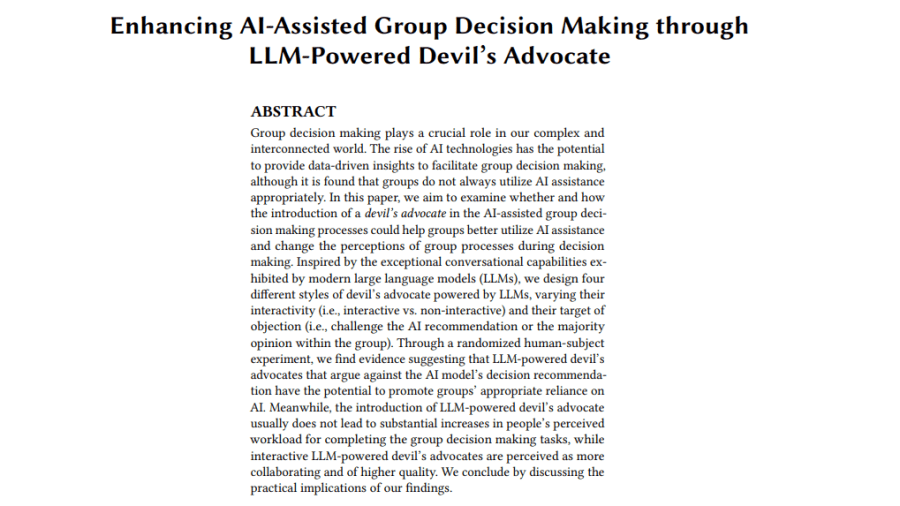
Enhancing AI-Assisted Group Decision Making through LLM-Powered Devil’s Advocate
Can LLM’s effectively play as devil’s advocate, enhancing group decisions? Something I’ve been working on lately is AI as a co-agent for cognitive diversity / requisite imagination. Here’s a study which explored an LLM as a devil’s advocate, and I’ll post another study next week on AI and red teaming. [Though this study relied on… Continue reading Enhancing AI-Assisted Group Decision Making through LLM-Powered Devil’s Advocate
Safe As week in review – eps 19-21: Safety leadership, ISO certification, and Haddon’s 10 energy countermeasures
Safe As week in review. This week covered three episodes: 1. Ep 19: What is the evidence behind safety leadership – silverbullet or hype? They analysed 175 articles for the effects of different leadership categories on various safety elements (image 1). They found leadership behaviours were associated with various workplace safety elements in varying degrees,… Continue reading Safe As week in review – eps 19-21: Safety leadership, ISO certification, and Haddon’s 10 energy countermeasures

Endoscopist De-Skilling after Exposure to Artificial Intelligence in Colonoscopy: A Multicenter Observational Study
Does AI use contribute to de-skilling? Probably, according to this study of endoscopists. This study compared >1.4k patient outcomes who underwent non-AI assisted colonoscopy before and after AI implementation. Background: · A recent meta-analysis of 20 randomised trials “showed an absolute 8.1 % increase in ADR [Adenoma detection rate] with the use of AI during colonoscopy.5… Continue reading Endoscopist De-Skilling after Exposure to Artificial Intelligence in Colonoscopy: A Multicenter Observational Study

Safe As (quickisode) 21: Beyond the Hierarchy – Haddon’s energy countermeasures
This special quickisode frantically unpacks Haddon’s 10 energy countermeasures. This approach provides an alternative or compliment to the hierarchy of control, and focuses directly on eliminating, minimising or marshalling the exchange of hazardous energy. Applied to falls from height as an example, but it works for most energy exchange scenarios. No specific reference – except… Continue reading Safe As (quickisode) 21: Beyond the Hierarchy – Haddon’s energy countermeasures

The impact of generative AI on critical thinking skills: a systematic review, conceptual framework and future research directions
The impact of generative AI on critical thinking skills: a systematic review, conceptual framework and future research directions How do generative AI (GenAI) models affect critical thinking skills? This systematic review unpacked 68 studies to explore the good and the bad. GenAI are “machine-learning algorithms, usually transformer-based large-language models (LLMs), that generate new text, code… Continue reading The impact of generative AI on critical thinking skills: a systematic review, conceptual framework and future research directions

“Punishing is about keeping our beliefs in a basically safe system intact. Learning is about changing these beliefs, and changing the system”
“Punishing is about keeping our beliefs in a basically safe system intact. Learning is about changing these beliefs, and changing the system” An interesting extract from Sid Dekker’s 2001 article ‘Disinheriting Fitts and Jones `47’. Summary in a week or two – but if you’ve read his later SafetyDifferently article ‘Is it 1947 yet?’, then… Continue reading “Punishing is about keeping our beliefs in a basically safe system intact. Learning is about changing these beliefs, and changing the system”

Safe As podcast #20: How does safety system certification affect organisational performance?
We chase certifications, implement systems, but what impact are we really having on operational performance? Is achieving certification, like ISO 18001 or 45001, really about improving the governance, assurance, or performance of systems? Or is it more about window dressing and legitimacy, being seen to be doing the right thing? Today’s pod covers: Dyreborg, J.,… Continue reading Safe As podcast #20: How does safety system certification affect organisational performance?

Working Too Hard to Advise You Not to Work Too Hard: Psychosocial Risk Factors and Quality of Life Among Occupational Health and Safety Experts
OHS professionals exposed to several psychosocial risks in the course of their work, according to this study, amplified by the social interactivity of their role. This Turkish study surveyed 101 OHS experts (65 male, 36 female) on psychosocial factors, quality of life and more. Key findings: · While OHS professionals may help others with eliminating or… Continue reading Working Too Hard to Advise You Not to Work Too Hard: Psychosocial Risk Factors and Quality of Life Among Occupational Health and Safety Experts

