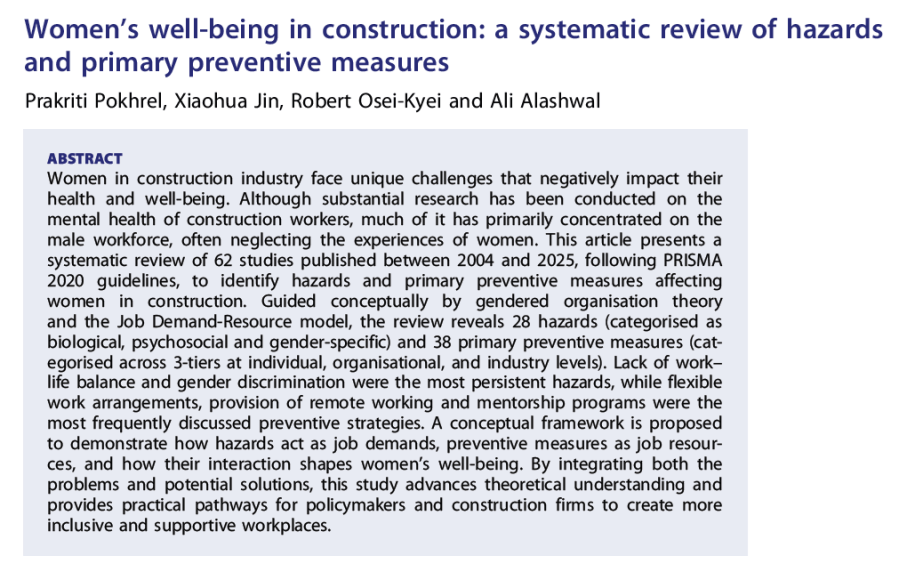
This systematic review unpacked 62 studies looking at women’s well-being in construction, and key hazards and prevention measures. ** Check out my YouTube channel: https://www.youtube.com/@safe_as_pod Background: · “construction industry is often shaped by a macho work culture marked by aggression, bullying, and job insecurity due to the nomadic and cyclical nature of projects” · “women face not… Continue reading Women’s well-being in construction: a systematic review of hazards and primary preventive measures
Tag: mental-health
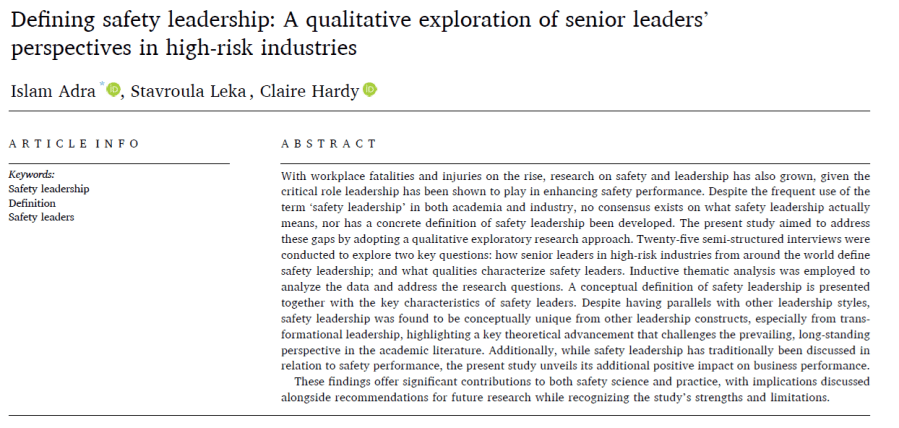
Defining safety leadership: A qualitative exploration of senior leaders’ perspectives in high-risk industries
How do senior leaders in high-risk industries define safety leadership? And what qualities characterise them? This interview study of 25 leaders unpack these questions. Note. Those cynics which moan about why safety needs to take concepts like leadership or culture and whack ‘safety’ on the front should read this. Once again, another study highlighting domain-specificity.… Continue reading Defining safety leadership: A qualitative exploration of senior leaders’ perspectives in high-risk industries
There is nothing authentic about authentic leadership: Forbes article
This article about authentic leadership may be of interest – in part arguing it may perpetuate a “childish, romantic, and ultimately toxic idea”. They argue: · Authentic leadership is said to be a popular but is rather conceptually vague · It’s said to stem from “self-awareness, internalized moral perspective, balanced processing of information, and relational transparency — in short, being “true… Continue reading There is nothing authentic about authentic leadership: Forbes article
The Critical Role of Psychological Risk and Safety in Eliciting Worker Well-Being
This explored the links between psychosocial risk and psychological safety on worker well-being. Survey responses from >800 workers in Malaysian were obtained. Usefully, it’s another study that slightly challenges the claim that you ‘can’t have too much psychological safety’. We need far more targeted evidence to make that claim. Extracts: · “our results revealed a significant… Continue reading The Critical Role of Psychological Risk and Safety in Eliciting Worker Well-Being
Psychological Distress and Post-Traumatic Symptoms Following Occupational Accidents
What are the psychological consequences of physical work incidents? 38 occupationally injured persons matched against 38 none injured. Background: · Prior work “reported that 34.7% of injured workers with chronic pain achieved full criteria for PTSD, and 18.2% had partial PTSD” · “victims of work-related accidents showed clinically relevant psychopathological symptoms, including post-traumatic symptoms, anxiety, depression, anger, and… Continue reading Psychological Distress and Post-Traumatic Symptoms Following Occupational Accidents
Can chatbots provide more social connection than humans?
Can chatbots provide more social connection than humans? Possibly, providing that they don’t “claim too much humanity”. Three study protocols with 801, 201 and 401 had participants engage with AI social chatbots. They note that the long-term consequences of social chatbot use is unknown, but is important to study since “hundreds of millions of people… Continue reading Can chatbots provide more social connection than humans?

Sleep Problems and Workplace Violence: A Systematic Review and Meta-Analysis
Are sleep problems (SP) and workplace violence (WV) related? Quite possibly. This meta-analysis and systematic review unpacked 34 studies exploring the links. Extracts: VW can be classified into four types: · “Type 1, Criminal Intent, when no legitimate relationship exists between the perpetrator and the business or its employees and the perpetrator commits a crime (robbery,… Continue reading Sleep Problems and Workplace Violence: A Systematic Review and Meta-Analysis

Working Too Hard to Advise You Not to Work Too Hard: Psychosocial Risk Factors and Quality of Life Among Occupational Health and Safety Experts
OHS professionals exposed to several psychosocial risks in the course of their work, according to this study, amplified by the social interactivity of their role. This Turkish study surveyed 101 OHS experts (65 male, 36 female) on psychosocial factors, quality of life and more. Key findings: · While OHS professionals may help others with eliminating or… Continue reading Working Too Hard to Advise You Not to Work Too Hard: Psychosocial Risk Factors and Quality of Life Among Occupational Health and Safety Experts

What type of leadership behaviors are functional in teams? A meta-analysis
Does leadership behaviour in teams matter? If so, what behaviours for effective teams? This meta-analysis of 50 studies (from 2006, so note the age) explored the above question, focused on task-focused and person-focused leader behaviours. It was meant to be a mini-post, but grew into a full post because I couldn’t be bothered cutting it… Continue reading What type of leadership behaviors are functional in teams? A meta-analysis

Safe As podcast ep15: Root Cause Analyses (RCA) and incident prevention – do they ‘work’?
Many organisations rely on their root cause analyses (RCA) to help learn about incidents, and, ideally, prevent incident reoccurrences. So the logic goes. But does the published evidence support RCA approaches as effective means for preventing incident reoccurrences? Today’s paper is Martin-Delgado, J., Martínez-García, A., Aranaz, J. M., Valencia-Martín, J. L., & Mira, J. J.… Continue reading Safe As podcast ep15: Root Cause Analyses (RCA) and incident prevention – do they ‘work’?
 SafetyInsights.org