Can chatbots provide more social connection than humans? Possibly, providing that they don’t “claim too much humanity”. Three study protocols with 801, 201 and 401 had participants engage with AI social chatbots. They note that the long-term consequences of social chatbot use is unknown, but is important to study since “hundreds of millions of people… Continue reading Can chatbots provide more social connection than humans?
Tag: mental-health

Sleep Problems and Workplace Violence: A Systematic Review and Meta-Analysis
Are sleep problems (SP) and workplace violence (WV) related? Quite possibly. This meta-analysis and systematic review unpacked 34 studies exploring the links. Extracts: VW can be classified into four types: · “Type 1, Criminal Intent, when no legitimate relationship exists between the perpetrator and the business or its employees and the perpetrator commits a crime (robbery,… Continue reading Sleep Problems and Workplace Violence: A Systematic Review and Meta-Analysis

Working Too Hard to Advise You Not to Work Too Hard: Psychosocial Risk Factors and Quality of Life Among Occupational Health and Safety Experts
OHS professionals exposed to several psychosocial risks in the course of their work, according to this study, amplified by the social interactivity of their role. This Turkish study surveyed 101 OHS experts (65 male, 36 female) on psychosocial factors, quality of life and more. Key findings: · While OHS professionals may help others with eliminating or… Continue reading Working Too Hard to Advise You Not to Work Too Hard: Psychosocial Risk Factors and Quality of Life Among Occupational Health and Safety Experts

What type of leadership behaviors are functional in teams? A meta-analysis
Does leadership behaviour in teams matter? If so, what behaviours for effective teams? This meta-analysis of 50 studies (from 2006, so note the age) explored the above question, focused on task-focused and person-focused leader behaviours. It was meant to be a mini-post, but grew into a full post because I couldn’t be bothered cutting it… Continue reading What type of leadership behaviors are functional in teams? A meta-analysis

Safe As podcast ep15: Root Cause Analyses (RCA) and incident prevention – do they ‘work’?
Many organisations rely on their root cause analyses (RCA) to help learn about incidents, and, ideally, prevent incident reoccurrences. So the logic goes. But does the published evidence support RCA approaches as effective means for preventing incident reoccurrences? Today’s paper is Martin-Delgado, J., Martínez-García, A., Aranaz, J. M., Valencia-Martín, J. L., & Mira, J. J.… Continue reading Safe As podcast ep15: Root Cause Analyses (RCA) and incident prevention – do they ‘work’?
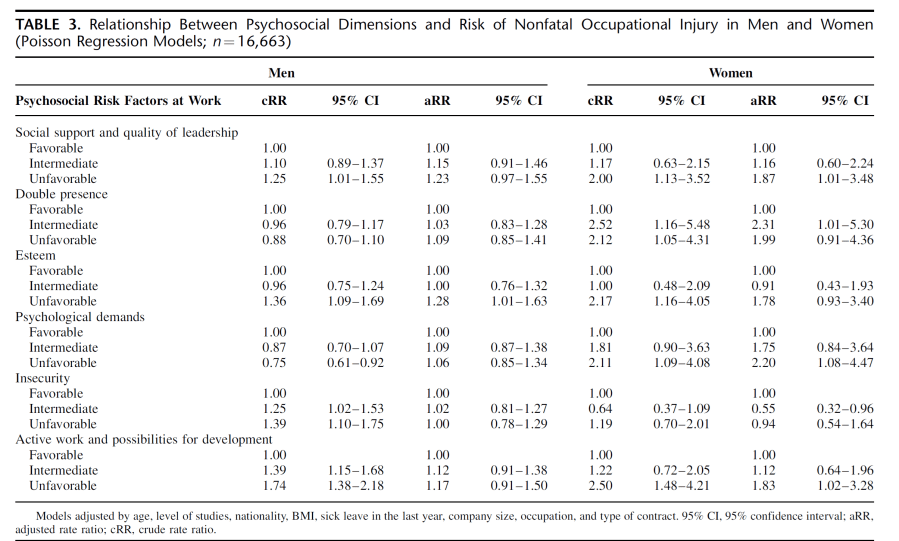
Exposure to Psychosocial Risk Factors at Work and the Incidence of Occupational Injuries: A Cohort Study in Spain
This study explored the links between psychosocial risk factors (PRF) on the incident of occupational injuries (OIs). Compared to many other studies, they used a dynamic cohort longitudinal design (>16k) participants over 1 year follow-up. The Copenhagen Psychosocial Questionnaire was used. For background: Findings: Why are PRF and OI potentially linked? They suggest: Limitations were… Continue reading Exposure to Psychosocial Risk Factors at Work and the Incidence of Occupational Injuries: A Cohort Study in Spain

Physical and Psychosocial Correlates of Occupational Physical Injury in the Global Construction Industry: A Scoping Review
This recent scoping review evaluated 77 construction studies covering various geographical regions on the physical and psychosocial correlates of physical injury. They stratified the correlates into three domains: 1. workplace physical environment (eg, exposure to physical hazards, PPE, company size & more) 2. workplace culture (eg, psychosocial stressors, gender-related barriers, migrant and ethnic disparities, educational background) 3. physical… Continue reading Physical and Psychosocial Correlates of Occupational Physical Injury in the Global Construction Industry: A Scoping Review
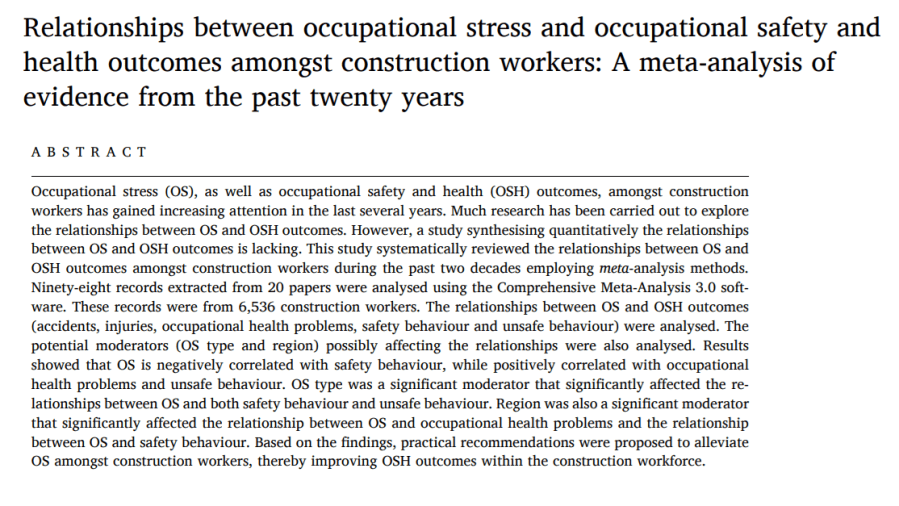
Relationships between occupational stress and occupational safety and health outcomes amongst construction workers: A meta-analysis of evidence from the past twenty years
This meta-analysis investigated the effects of occupational stress (OS) on safety and health outcomes in construction. 20 studies over 20 years, including >6k construction workers was included (not such a big sample given all of the research in construction safety, indicative of the relatively poorer quality of research that didn’t meet their inclusion criteria). [Trigger… Continue reading Relationships between occupational stress and occupational safety and health outcomes amongst construction workers: A meta-analysis of evidence from the past twenty years

The Impact of Physical Hazards on Workers’ Job Satisfaction in the Construction Industry: A Case Study of Korea
This study explored how physical workplace hazards influence job satisfaction in construction, and how mental threats mediate the relationship, and how perceived job quality and security moderate the effects. 2,202 construction workers in Korea were surveyed. Key findings: · “exposure to physical hazards significantly contributes to mental stress, leading to reduced job satisfaction” · And “a heightened… Continue reading The Impact of Physical Hazards on Workers’ Job Satisfaction in the Construction Industry: A Case Study of Korea
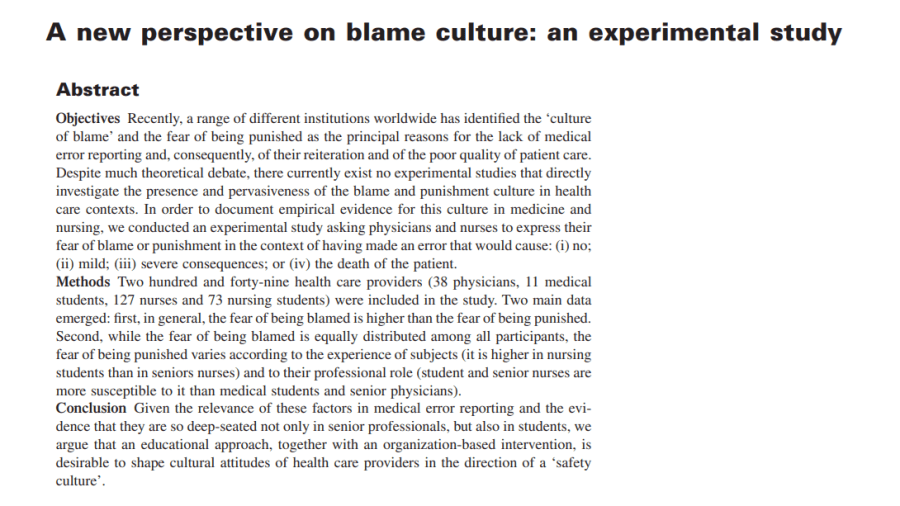
A new perspective on blame culture: an experimental study
This study explored how fear of blame and punishment affects different healthcare professions, experience levels and gender. 249 healthcare practitioners were involved, and were asked how fear of blame or punishment resulting from an error which caused no, mild, severe or death of a patient. Extracts: · “blame culture can be defined as a set of… Continue reading A new perspective on blame culture: an experimental study
 SafetyInsights.org