
“Punishing is about keeping our beliefs in a basically safe system intact. Learning is about changing these beliefs, and changing the system” An interesting extract from Sid Dekker’s 2001 article ‘Disinheriting Fitts and Jones `47’. Summary in a week or two – but if you’ve read his later SafetyDifferently article ‘Is it 1947 yet?’, then… Continue reading “Punishing is about keeping our beliefs in a basically safe system intact. Learning is about changing these beliefs, and changing the system”
Tag: punishment
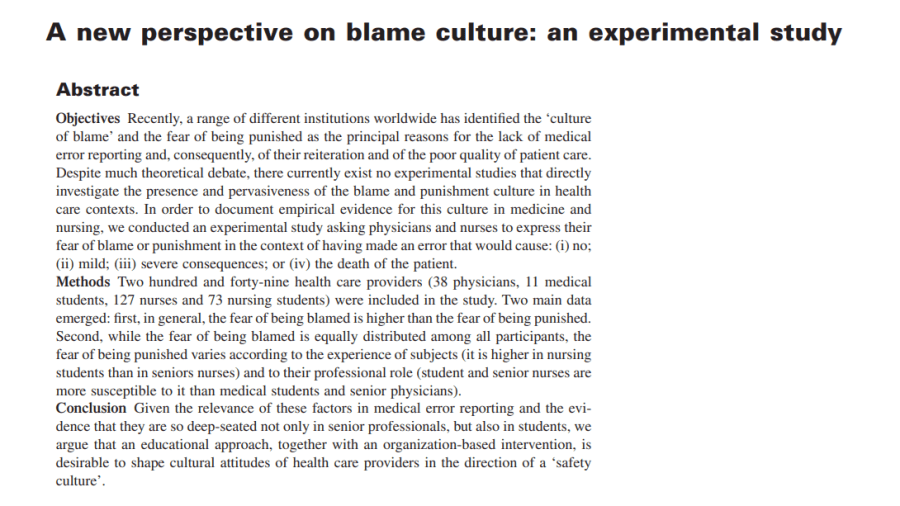
A new perspective on blame culture: an experimental study
This study explored how fear of blame and punishment affects different healthcare professions, experience levels and gender. 249 healthcare practitioners were involved, and were asked how fear of blame or punishment resulting from an error which caused no, mild, severe or death of a patient. Extracts: · “blame culture can be defined as a set of… Continue reading A new perspective on blame culture: an experimental study

Avoiding ‘second victims’ in healthcare: what support do staff want for coping with patient safety incidents, what do they get and is it effective? A systematic review
This systematic review evaluated evidence for what support staff want vs what they receive, and whether the support is effective. 99 studies were included. Some extracts: · PSI (patient safety incident) lead to emotional shame, guilt, anger, shock, depression, fear, flashbacks, helplessness, fatigue, withdrawal and more · The three most desired support types staff want before and… Continue reading Avoiding ‘second victims’ in healthcare: what support do staff want for coping with patient safety incidents, what do they get and is it effective? A systematic review
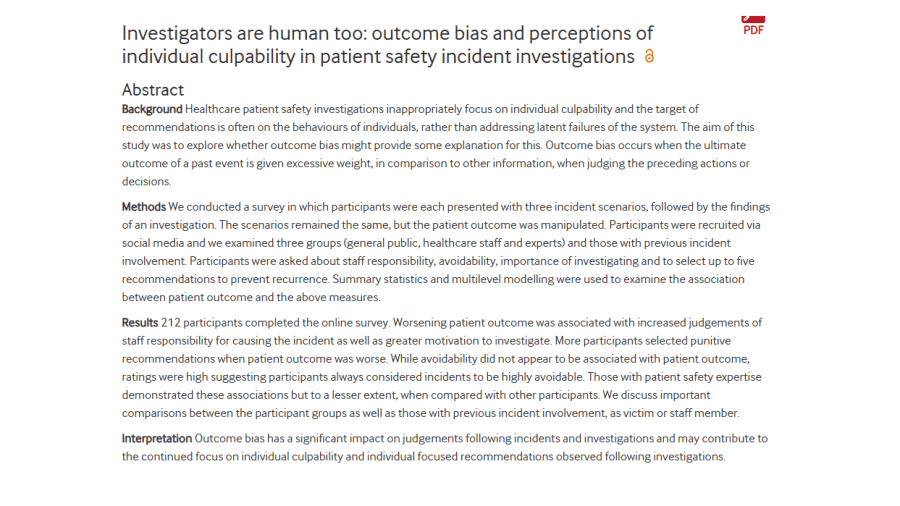
Investigators are human too: outcome bias and perceptions of individual culpability in patient safety incident investigations
This study explored whether outcome bias might explain why healthcare investigations focus on individual culpability over addressing latent conditions in the system. 212 participants were allocated to one of three scenarios followed by the findings of an investigation (see scenario overviews below). For background: · Prior work has identified that the “overwhelming majority of recommendations… Continue reading Investigators are human too: outcome bias and perceptions of individual culpability in patient safety incident investigations
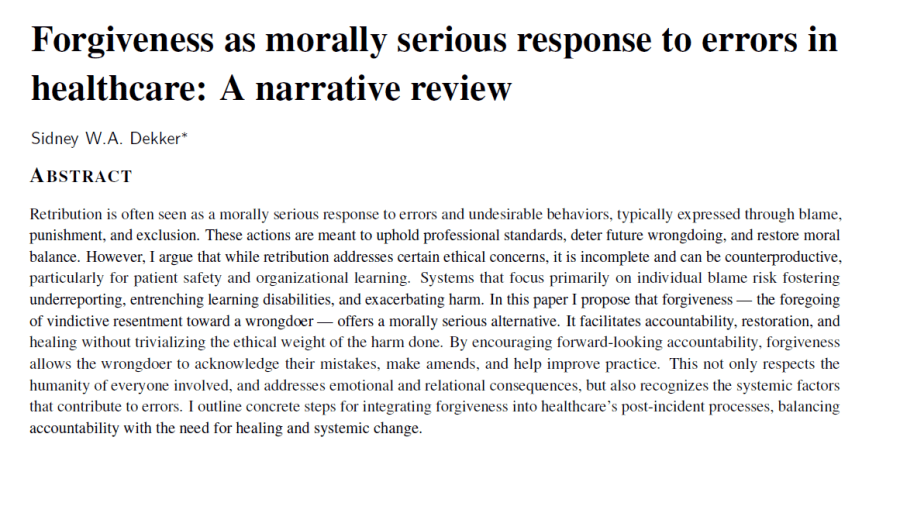
Forgiveness as morally serious response to errors in healthcare: A narrative review
An interesting and recent discussion paper from Sidney Dekker, exploring forgiveness as a ‘morally serious response’ to incidents, as opposed to retributive approaches. Tl;dr: · “while retribution addresses certain ethical concerns, it is incomplete and can be counterproductive, particularly for patient safety and organizational learning” · “Systems that focus primarily on individual blame risk fostering… Continue reading Forgiveness as morally serious response to errors in healthcare: A narrative review
 SafetyInsights.org