A 2018 presentation from Sid Dekker on success and drift into failure. One of many such, and no particular reason why this one over any other. Sid starts with an example he heard, supporting the bad apple thesis: “just get rid of the nurses who make mistakes and all will be a lot safer” “Now… Continue reading The human factor: Pursuing success and averting drift into failure – YT video, Sidney Dekker
Tag: safety-science
Leverage points to intervene in a system – Donella Meadows
In the lead up to next week’s compendium on systems thinking, here’s a banger from Donella Meadows. She explores system leverage points. Not a summary, but some extracts: · Leverage points are “places within a complex system .. where a small shift in one thing can produce big changes in everything” · The “state of the system”… Continue reading Leverage points to intervene in a system – Donella Meadows
“there is no such thing as a root cause [and therefore] there is technically no such thing as the beginning of a mishap” — Dekker
Extracts from Dekker’s work about the ontological and empirical shakiness of ‘root causes’. I’ve taken material from two versions of The Field Guide to Understanding Human Error (Investigations). In Dekker’s view: · “There is no ‘root’ cause” (or ‘root causes’) · Given the multiple angles and interactions in complex systems, you “can really construct “causes” from everywhere”… Continue reading “there is no such thing as a root cause [and therefore] there is technically no such thing as the beginning of a mishap” — Dekker

Compendium: Sleep & Fatigue Risk Management
Here’s an assortment of papers on sleep and occupational fatigue. Focus is on articles I’ve summarised or full-text I could locate. A few themes are covered: Feel free to shout a coffee if you’d like to support the growth of my site: Sleep & Fatigue https://www.academia.edu/30709111/Fatigue_proofing_A_new_approach_to_reducing_fatigue_related_risk_using_the_principles_of_error_management https://jcsm.aasm.org/doi/pdf/10.5664/jcsm.9512 https://www.academia.edu/7558212/A_Model_to_Predict_Work_Related_Fatigue_Based_on_Hours_of_Work https://doi.org/10.1016/j.aap.2021.106398 https://www.academia.edu/115005821/Effects_of_fatigue_on_surgeon_performance_and_surgical_outcomes_a_systematic_review https://www.researchgate.net/publication/6495463_The_dynamics_of_neurobehavioural_recovery_following_sleep_loss https://academic.oup.com/sleep/article-abstract/20/4/267/2732104?redirectedFrom=PDF https://www.researchgate.net/publication/49656992_Research_needs_and_opportunities_for_reducing_the_adverse_safety_consequences_of_fatigue https://www.degruyter.com/document/doi/10.1515/eng-2022-0411/pdf https://www.jstage.jst.go.jp/article/indhealth/47/5/47_5_518/_pdf… Continue reading Compendium: Sleep & Fatigue Risk Management

1912 article discussing the role of fatigue in industrial accidents and arguing against ‘carelessness’ as an “ultimate cause”
This was an interesting article from 1912 highlighting the role that fatigue has in industrial accidents. Also challenges ‘carelessness’, saying it doesn’t account for the effects of fatigue. While scientific knowledge has progressed over the century, it’s cool how well they articulated the issue. · Image 1 top panel shows a breakdown of accidents per time… Continue reading 1912 article discussing the role of fatigue in industrial accidents and arguing against ‘carelessness’ as an “ultimate cause”

What Control Measures Should I Use? Applying the Total Worker Health Hierarchy of Controls to Manage Workplace Fatigue
This new paper from Drew Dawson and others reconceptualised fatigue risk management within Total Worker Health (TWH) Hierarchy of Controls (HOC). THW HOC works as an extension to the traditional HOC, and “presents strategies in order of effectiveness, ranging from “eliminate,” “substitute,” “redesign,” “educate,” and “encourage” categories” They say that while is mostly associated with… Continue reading What Control Measures Should I Use? Applying the Total Worker Health Hierarchy of Controls to Manage Workplace Fatigue

Why do doctors make poor decisions? Spotlighting ‘noise’ as an under-recognised source of error in clinical practice
A brief read covering the concept of noise, pertaining to judgements. This is based on the work from Kahneman, Sibony and Sunstein. From the article: · While biases in judgements have captured a lot of attention, “it has been suggested that ‘noise’ (defined as an undesirable variability in human judgements) is a highly important, yet under-recognised… Continue reading Why do doctors make poor decisions? Spotlighting ‘noise’ as an under-recognised source of error in clinical practice

Human factor analysis of cockpit work incidents in high-speed workboats: the mystery hidden between the lines
This study unpacked what investigators look at and how they construct causes in high-speed workboats. It employed a Safety-II / HOP / HF perspective. Tl;dr: human factors are poorly evaluated and largely seen as individual-level factors. Some extracts: · “Although the analysis focused on negative observations, it also identified HFs that supported the activity” · “Many pivotal… Continue reading Human factor analysis of cockpit work incidents in high-speed workboats: the mystery hidden between the lines
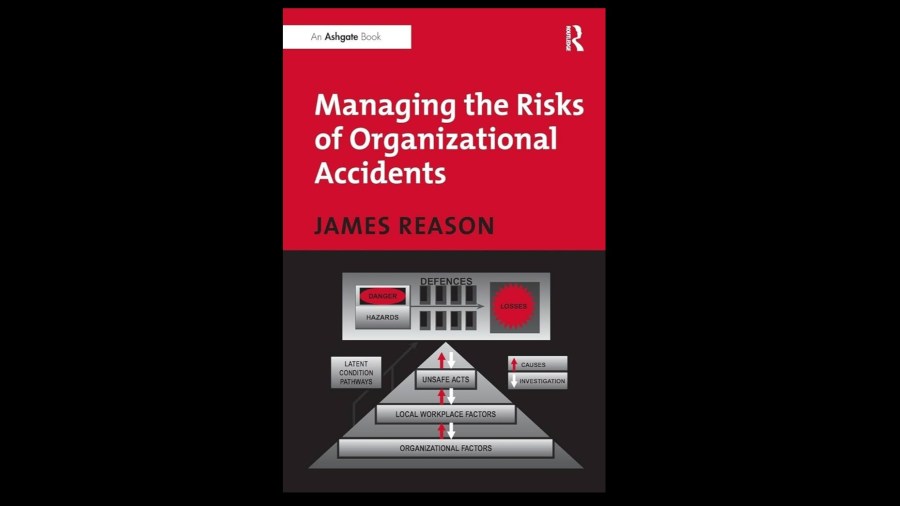
The mixed blessing of risk defences and redundancy: James Reason
A few random extracts from James Reason’s timelessly awesome Managing the Risks of Organizational accidents. (Note: This isn’t an endorsement of the somewhat linearity of defences-in-depth, since we have evidence that emergent behaviour can playout in reality and with equifinality etc) There’s hundreds of things I could extract (and maybe will in time), but here’s… Continue reading The mixed blessing of risk defences and redundancy: James Reason

Efficacy and Understanding of the Safety Hierarchy of Controls
This PhD thesis from Stephen Young was interesting. They studied evidence supporting the hierarchy of control (HOC), constraints on its efficacy, and more. Way too much to cover. Some extracts: · There isn’t a lot of evidence supporting the efficacy of the HOC · One reason is: “An unequivocal demonstration of efficacy [of the HOC] is problematic,… Continue reading Efficacy and Understanding of the Safety Hierarchy of Controls
 SafetyInsights.org