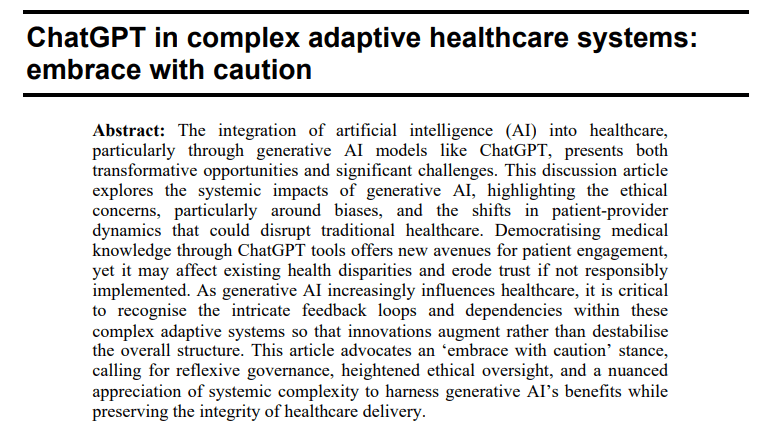
This discussion paper explored the introduction of AI systems into healthcare. It covers A LOT of ground, so just a few extracts. Extracts: · “This article advocates an ‘embrace with caution’ stance, calling for reflexive governance, heightened ethical oversight, and a nuanced appreciation of systemic complexity to harness generative AI’s benefits while preserving the integrity of… Continue reading ChatGPT in complex adaptive healthcare systems: embrace with caution
Tag: systems thinking
“Indicators are partial reflections of reality, based on uncertain and imperfect models” – Part 2 Donella Meadows sustainable indicators
Part 2 of Meadow’s banger ‘Indicators and Information Systems for Sustainable Development’. Extracts: · “Indicators are partial reflections of reality, based on uncertain and imperfect models” · “The stock market price is not the value of the company. No indicator is the real system. Indicators are abstractions from systems” · And are “are abstractions from abstractions, from models,… Continue reading “Indicators are partial reflections of reality, based on uncertain and imperfect models” – Part 2 Donella Meadows sustainable indicators

“Measuring what’s measurable rather than what’s important” – Better indicators part 1: Donella Meadows
A banger report from the late, great Donella Meadows, talking about sustainable indicators. WAY too much to cover, so extracts over 3-4 separate posts. Today is background on indicators before the specific and meatier stuff. Extracts: (** Part 2 in comments **) · “We have many words for indicator— sign, symptom, omen, signal, tip, clue, grade,… Continue reading “Measuring what’s measurable rather than what’s important” – Better indicators part 1: Donella Meadows

Compendium of Nancy Leveson: STAMP, STPA, CAST and Systems Thinking
Although I don’t often mention or post about Leveson’s work, she’s probably been the most influential thinker on my approach after Barry Turner. So here is a mini-compendium covering some of Leveson’s work. Feel free to shout a coffee if you’d like to support the growth of my site: https://direct.mit.edu/books/oa-monograph/2908/Engineering-a-Safer-WorldSystems-Thinking-Applied https://doi.org/10.1177/0170840608101478 https://doi.org/10.1145/7474.7528 http://therm.ward.bay.wiki.org/assets/pages/documents-archived/safety-3.pdf http://sunnyday.mit.edu/papers/Rasmussen-Legacy.pdf https://www.tandfonline.com/doi/pdf/10.1080/00140139.2015.1015623… Continue reading Compendium of Nancy Leveson: STAMP, STPA, CAST and Systems Thinking
Resilience terminology and a visualisation of resilience/robustness in practice
This may interest people. It covers concepts of resilient performance within seaports. It’s a bit random (seaports), but otherwise gives a handy overview of resilience terms and applications. The first two images are just basic definitions. Extracts: · Image 3 represents resilience elements during disruptions – from pre-disruption, to the disruption, then post-disruption. · During pre-disruption, the… Continue reading Resilience terminology and a visualisation of resilience/robustness in practice

The systems approach to medicine: controversy and misconceptions — Dekker & Leveson
This was a really brief discussion paper from Dekker and Leveson, covering systems thinking in medicine. Three parts – see comments. Nothing new for most, but they cover: · “The ‘systems approach’ to patient safety has recently led to questions about its ethics and practical utility” · E.g. A recent paper from a retired neurosurgeon questioned systems… Continue reading The systems approach to medicine: controversy and misconceptions — Dekker & Leveson

On Some Statistical Aids Toward Economic Production
A banger from Deming in 1975, talking about applying statistical control to manufacturing and production variability. He says that much of this paper is based on “principles taught in Japan since 1950”. Don’t let the topic fool you – you’ll find a lot of similarities and overlaps with principles of HF/E, work design, New View… Continue reading On Some Statistical Aids Toward Economic Production

Attributing Cause for Occupational Accidents in Construction: A Descriptive Single Case Study
This thesis from Jennifer Serne explored how construction safety professionals attribute accident causes. 37 participants were included with 20 accident scenarios, 13 individual semi-structured interviews and 8 summative focus groups. For background: · Originally proposed by Heider in 1958, it’s said that people are “psychologically driven to determine the causes of others’ behavior” · And… Continue reading Attributing Cause for Occupational Accidents in Construction: A Descriptive Single Case Study

“Those found responsible have been sacked”: some observations on the usefulness of error
Another interesting paper co-authored by the late Richard Cook. This paper discusses the usefulness of error. It’s a larger post with a lot of quotes – I just can’t do a better or more succinct job of restating what they’ve already written. Providing background, they argue that while some see “error” as a dead-end, others… Continue reading “Those found responsible have been sacked”: some observations on the usefulness of error
 SafetyInsights.org