
Conventional logic suggests that we fix the gaps that we find in investigations. But is this the case? Is the investigation process more a game of sociopolitical whack-a-mole, finding and fixing the things that are easily solved or understandable, or tolerable to the organisation? Ref: Lundberg, J., Rollenhagen, C., & Hollnagel, E. (2010). What you… Continue reading Safe AF ep #5: Is what we find in investigations, what we fix?
Year: 2025
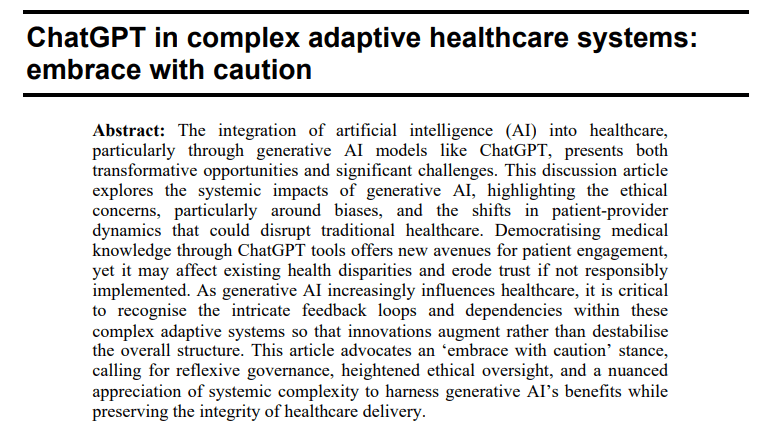
ChatGPT in complex adaptive healthcare systems: embrace with caution
This discussion paper explored the introduction of AI systems into healthcare. It covers A LOT of ground, so just a few extracts. Extracts: · “This article advocates an ‘embrace with caution’ stance, calling for reflexive governance, heightened ethical oversight, and a nuanced appreciation of systemic complexity to harness generative AI’s benefits while preserving the integrity of… Continue reading ChatGPT in complex adaptive healthcare systems: embrace with caution

Who should manage worker safety to reduce occupational accidents?
This study investigated how workplace accidents are affected by who manages occupational safety – owner/partner, managing directors, branch managers, OHS officers or safety representatives. They control for company size. Survey data was collected was across the EU (at least 32 countries and >44k companies). For context: Results They found: · “evidence that it is not… Continue reading Who should manage worker safety to reduce occupational accidents?

Safe AF ep #4: Relationship between fatal and non-fatal accidents based on 23k accidents
Is there a connection between fatal and non-fatal accidents, or is it a fallacy to focus on the minor potential events with the hope of managing the major events? Today’s study explores these relationships based on 23k reported serious accidents in the Netherlands. Ref: Bellamy, L. J. (2015). Exploring the relationship between major hazard, fatal… Continue reading Safe AF ep #4: Relationship between fatal and non-fatal accidents based on 23k accidents
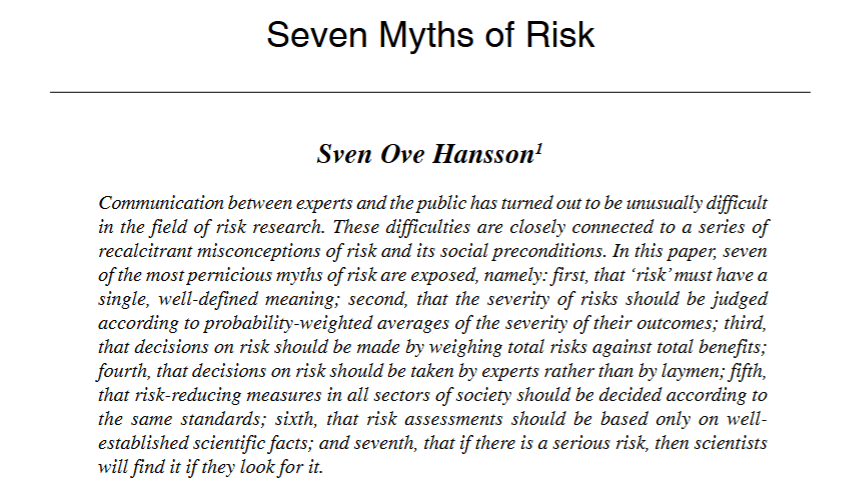
Seven Myths of Risk
This discussion paper explored some myths of the risk construct. Way too much to cover, so just a few extracts. Myth 1: Risk. must have a single, well-defined meaning Risk has many common definitions. An example is provided about lung cancer being one of the major risks that affect smokers. In this sense, 1) risk… Continue reading Seven Myths of Risk

Safety climate and fatigue have differential impacts on safety issues: Safety climate, fatigue, and safety issues
This study explored the links between safety climate, fatigue and several safety issues (actual safety incidents reported, near-misses experienced, safety underreporting). >11k navy personnel were surveyed (survey/self-declared, so consider limitations). Key findings: · “Safety climate affected underreporting the most, followed by likelihood of experiencing a near-miss, but had the weakest impact on actual safety reporting” · “Conversely,… Continue reading Safety climate and fatigue have differential impacts on safety issues: Safety climate, fatigue, and safety issues
EXTRA EXTRA: Safe AF podcast recently launched…please help share and rate/review on Spotify/Apple
Have you checked out my new pod Safe AF? So far we’ve covered accident underreporting, links between fatal vs non-fatal accidents, and learning teams vs RCAs. If you find it useful, then please help share on LinkedIn, and subscribe, rate and review the podcast on Spotify/Apple. Links: Spotify: https://open.spotify.com/show/7y8PySyHoIrAHsCrIxqSJ0?si=86d58e23bf7641b2 Apple: https://podcasts.apple.com/us/podcast/safe-af-podcast/id1819811788 New recoded episodes include:… Continue reading EXTRA EXTRA: Safe AF podcast recently launched…please help share and rate/review on Spotify/Apple
Designing for resilient performance & worker participation: design principles
This review explored how to design for worker participation, drawing on the design of resilient systems. Not much to say – the extracts cover core resilient design principles. Some extracts to contextualise the images: · Participation refers to “the worker’s influence in decision-making related to safety, involving information sharing between people” · “Design for resilient performance Design… Continue reading Designing for resilient performance & worker participation: design principles

Stop rules in investigations
I recorded a new ep on my podcast Safe AF, looking at factors which influence what investigations find, or more precisely, ‘construct’ as causal, and the factors which influence what gets fixed. One set of factors are ‘stop rules. So, here are some examples of different authors discussing investigation stop rules. Not systematic, and no… Continue reading Stop rules in investigations
Known risks = risk and unknown risks = uncertainty; some definitions of risk
Just recorded a pod on a paper discussing different notions of ‘risk’. Paul Slovic discusses risk as analysis vs risk as feelings (affect/emotion). It reminded me of these constructs of risk vs uncertainty based on Knights work – discussed by Gigerenzer and colleagues in the two attached extracts. Simply, for Knight, ‘risk’ is represented by… Continue reading Known risks = risk and unknown risks = uncertainty; some definitions of risk
 SafetyInsights.org