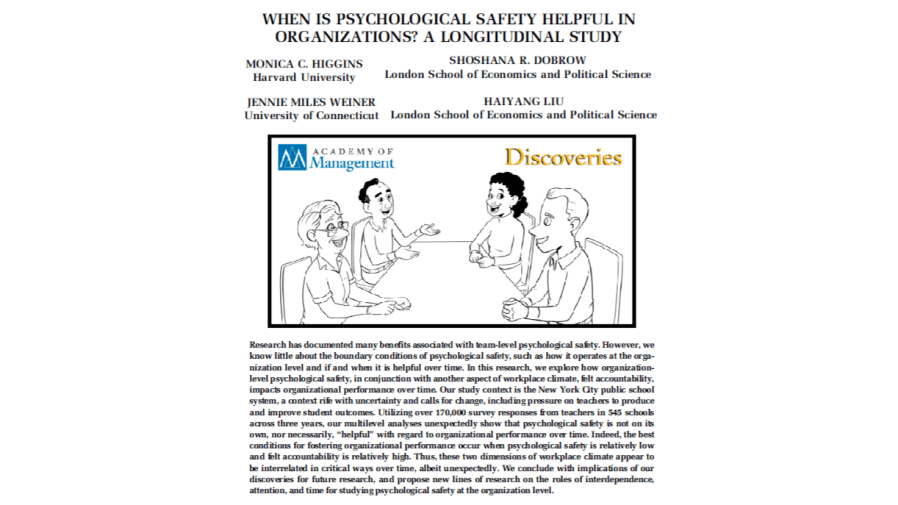
When is psychological safety helpful in organisations? When are higher perceived levels not? This investigated New York City public score responses (545 schools) and 170k survey responses to explore the boundary conditions. They contrast the effects of PS with both psychological empowerment (the extent individuals see their work as having impact or being important) and… Continue reading WHEN IS PSYCHOLOGICAL SAFETY HELPFUL IN ORGANIZATIONS? A LONGITUDINAL STUDY
Tag: psychological safety
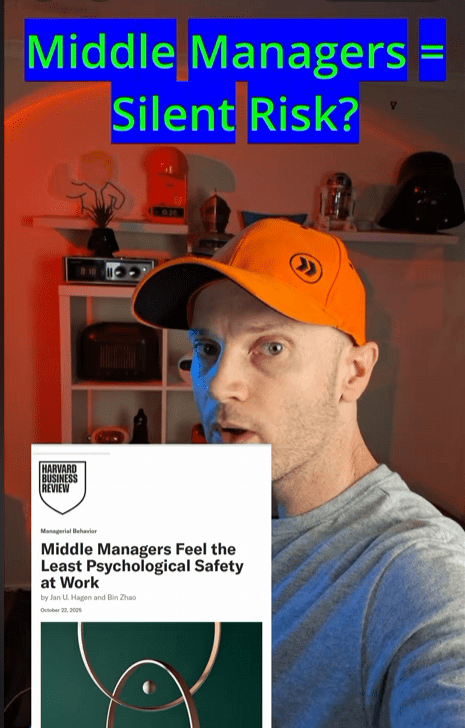
YT vid: Why Psychological Safety Fails Middle Managers
What if the people in the middle of an organisation are the least safe to speak honestly or take necessary interpersonal risks? Research has suggested that in an ongoing study of over 1000 managers, middle managers felt the least safe psychologically safe compared with c-suite executives and their direct reports. (** Though, as some have… Continue reading YT vid: Why Psychological Safety Fails Middle Managers
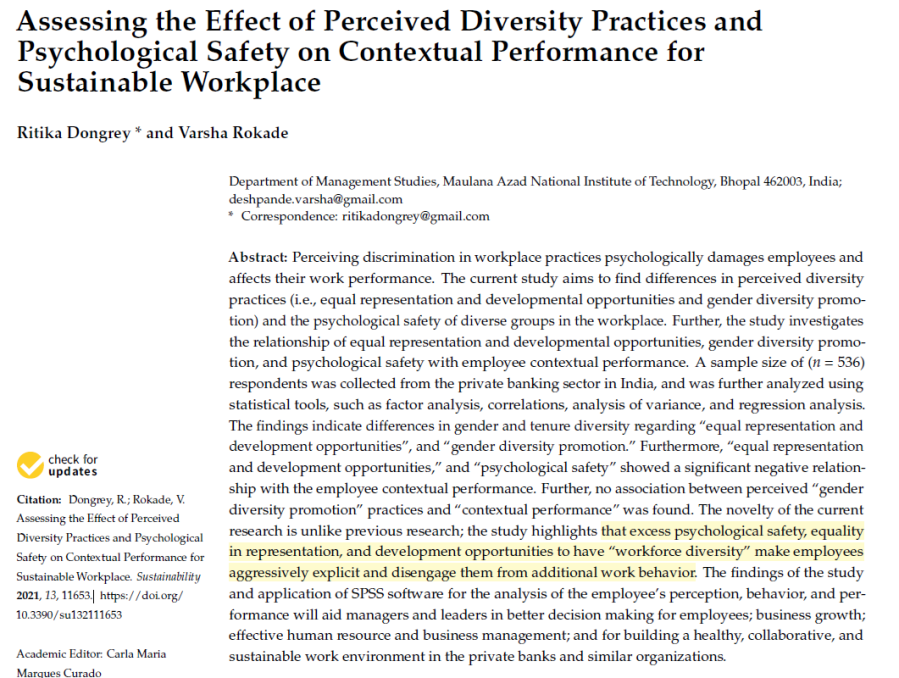
High Psychological Safety suggested to contribute to people being “aggressively expressive” and impacting work performance
I found this interesting – higher psychological safety was linked with people being “aggressively expressive” and may contribute to anti-organisational behaviour, among other factors. They investigated perceived diversity practices and representation and the links with psychological safety and gender diversity promotion in >500 private banking employees in India. PS. Check out my YouTube: https://youtube.com/@safe_as_pod?si=iUaDPJynPemQRZhY A… Continue reading High Psychological Safety suggested to contribute to people being “aggressively expressive” and impacting work performance

Why your leader’s apology failed and what the research says
What happens when a leader messes up, and says sorry? This explores different types of leader apologies, and how they’re not all made equal. It found the sincere apologies drove the largest changes in forgiveness and trust – more than just saying sorry, or taking responsibility to fix the issue. It appears that sincerity equals,… Continue reading Why your leader’s apology failed and what the research says
Role overload and safety incidents: An examination of the individual-and team-level buffering effects of psychological safety
This study explored the buffering effects of psychological safety on role overload and safety incidents. Data from online survey of 841 employees. Shared under an open access licence. PS. Check out my YouTube: https://www.youtube.com/@safe_as_pod Extracts: · “Role overload is a form of work-related stress … Qualitative role overload occurs when an individual lacks the skills required… Continue reading Role overload and safety incidents: An examination of the individual-and team-level buffering effects of psychological safety
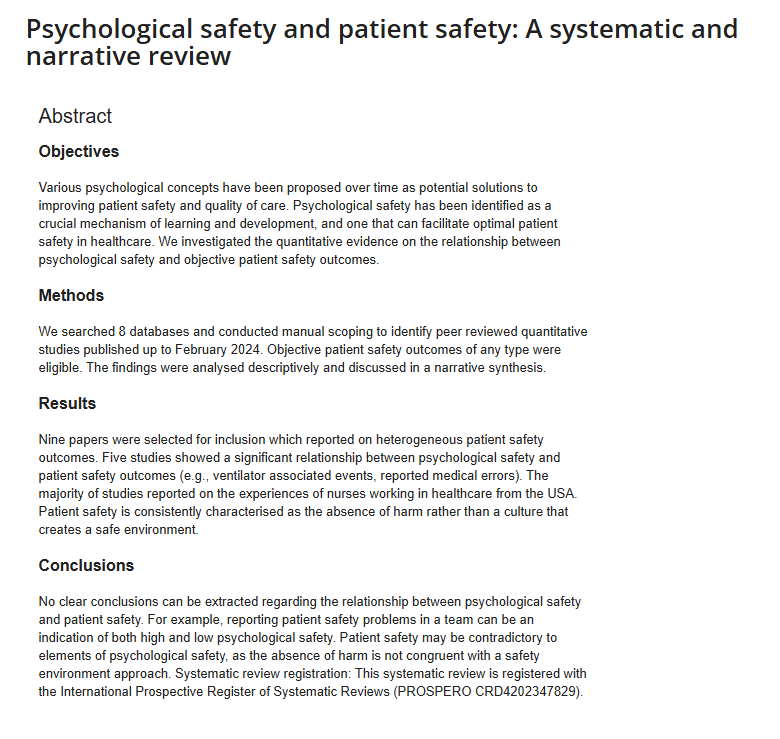
Psychological safety and patient safety: A systematic and narrative review
This explored the links between psychological safety and objective patient safety outcomes: · “No clear conclusions can be extracted regarding the relationship between psychological safety and patient safety” · “The evidence linking psychological and patient safety is equivocal” · “Overall, there is relatively little hard data to link PS and patient safety outcomes” · “Only nine studies fit the… Continue reading Psychological safety and patient safety: A systematic and narrative review

Working Too Hard to Advise You Not to Work Too Hard: Psychosocial Risk Factors and Quality of Life Among Occupational Health and Safety Experts
OHS professionals exposed to several psychosocial risks in the course of their work, according to this study, amplified by the social interactivity of their role. This Turkish study surveyed 101 OHS experts (65 male, 36 female) on psychosocial factors, quality of life and more. Key findings: · While OHS professionals may help others with eliminating or… Continue reading Working Too Hard to Advise You Not to Work Too Hard: Psychosocial Risk Factors and Quality of Life Among Occupational Health and Safety Experts

The relationship between humble leadership and team adaptation: two paths model perspective
This study investigated how humble leadership fosters team outcomes, like team adaptation. Psychological safety climate and reflexivity were explored as mediating pathways. Surveys at two time points across 56 work teams (233 members) were collected. Background: · The word humility derives from the Latin humilitas, meaning from the earth/grounded · Humility has a long history and is… Continue reading The relationship between humble leadership and team adaptation: two paths model perspective
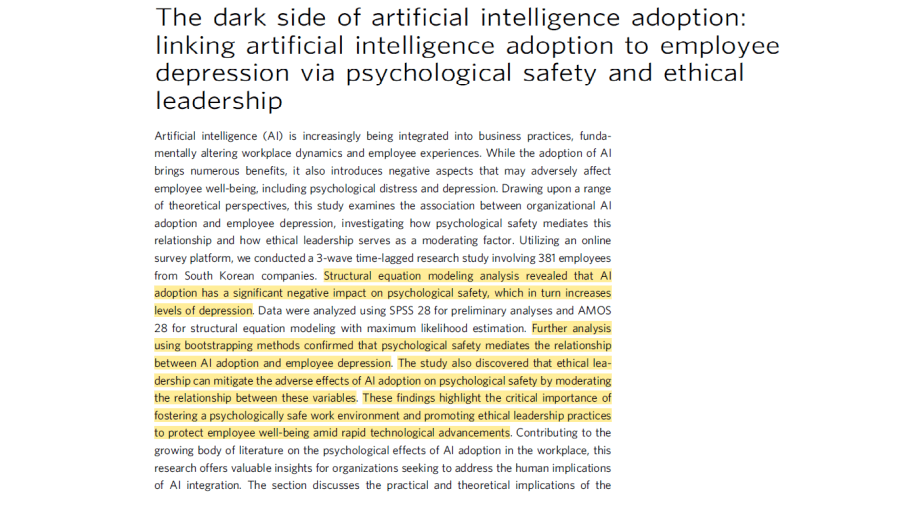
The dark side of artificial intelligence adoption: linking artificial intelligence adoption to employee depression via psychological safety and ethical leadership
Can adopting workplace AI technologies adversely affect employee psychological distress and depression? Yes according to this study. Online surveys of 381 employees in S.Korean companies was used. Background: · “In AI-centric environments .. AI reshapes jobs and workflows, affecting workers’ psychological health, satisfaction, commitment, and performance, as well as broader organizational outcomes” · “While AI adoption affects… Continue reading The dark side of artificial intelligence adoption: linking artificial intelligence adoption to employee depression via psychological safety and ethical leadership

Failing to learn and learning to fail (intelligently): How great organizations put failure to work to innovate and improve
An interesting paper from Mark Cannon & Amy Edmondson about failing intelligently. Opening the paper they argue that while the idea of organisations learning from their failures is obvious – “yet organizations that systematically learn from failure are rare”. They’ve also found that few organisations effectively experiment to learn, which requires by necessity generating failures… Continue reading Failing to learn and learning to fail (intelligently): How great organizations put failure to work to innovate and improve
 SafetyInsights.org