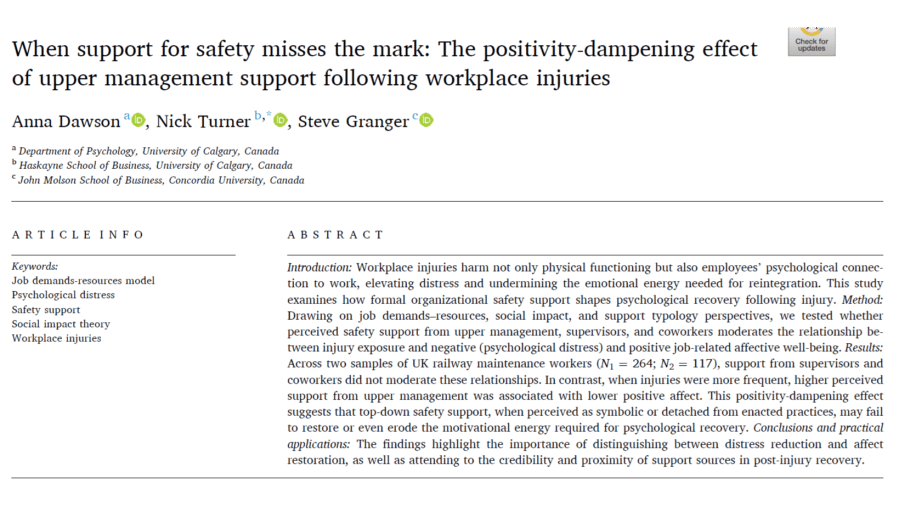
Can well-intended safety support from leaders undermine recovery after injury? This explores how formal organisational safety support influences psychological recovery after injury via two samples from UK railway maintenance workers. PS. Check out my YouTube: https://youtube.com/@safe_as_pod?si=V2dbdmW–WbnhzA9 Shout a coffee: https://buymeacoffee.com/benhutchinson Background: • “Workplace injuries disrupt not only physical functioning but also employees’ psychological connection to… Continue reading When support for safety misses the mark: The positivity-dampening effect of upper management support following workplace injuries
Tag: psychosocial
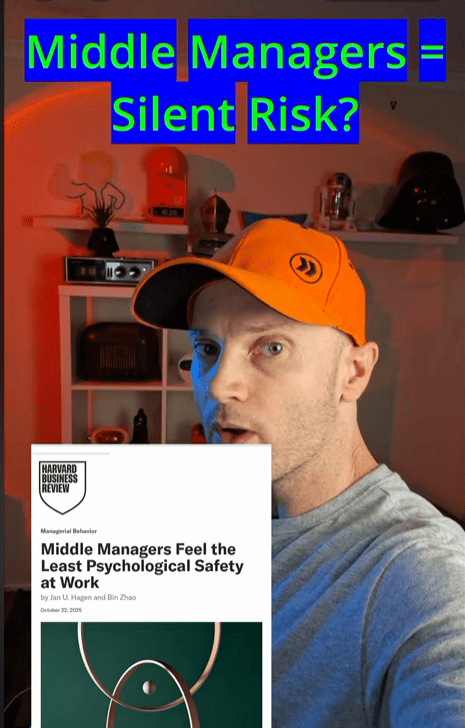
YT vid: Why Psychological Safety Fails Middle Managers
What if the people in the middle of an organisation are the least safe to speak honestly or take necessary interpersonal risks? Research has suggested that in an ongoing study of over 1000 managers, middle managers felt the least safe psychologically safe compared with c-suite executives and their direct reports. (** Though, as some have… Continue reading YT vid: Why Psychological Safety Fails Middle Managers
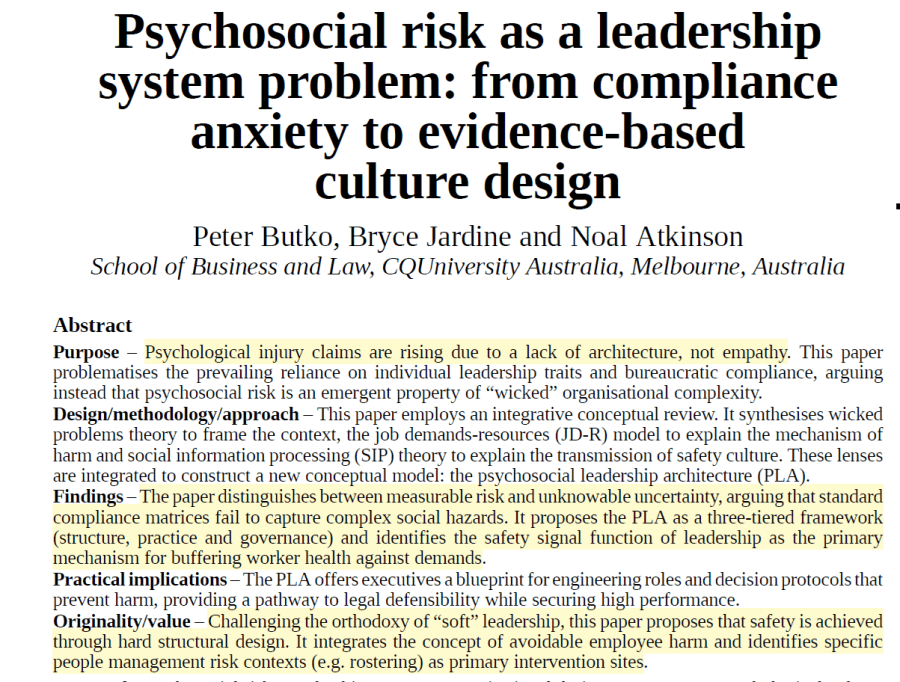
Psychosocial risk as a leadership system problem: from compliance anxiety to evidence-based culture design
“Psychological injury claims are rising due to a lack of architecture, not empathy” An interesting ‘integrative conceptual review’ of the traps of current compliance-driven approaches to psychosocial challenges, and a way forward. They argue that the current approach places “reliance on individual leadership traits and bureaucratic compliance” over recognising the emergent/wicked nature of psychosocial risk.… Continue reading Psychosocial risk as a leadership system problem: from compliance anxiety to evidence-based culture design
Is your workplace making you sick? Impact of psychosocial risks on health
Is your work making you physically or mentally sick? This video unpacks a meta-analysis which analysed 72 studies on the links between psychosocial risks on health. Among other findings – established links were found between job strain and cardiovascular diseases and mental ill health. #psychosocial #risk #health #safety #hse #mentalhealth
Psychological Distress and Post-Traumatic Symptoms Following Occupational Accidents
What are the psychological consequences of physical work incidents? 38 occupationally injured persons matched against 38 none injured. Background: · Prior work “reported that 34.7% of injured workers with chronic pain achieved full criteria for PTSD, and 18.2% had partial PTSD” · “victims of work-related accidents showed clinically relevant psychopathological symptoms, including post-traumatic symptoms, anxiety, depression, anger, and… Continue reading Psychological Distress and Post-Traumatic Symptoms Following Occupational Accidents

Working Too Hard to Advise You Not to Work Too Hard: Psychosocial Risk Factors and Quality of Life Among Occupational Health and Safety Experts
OHS professionals exposed to several psychosocial risks in the course of their work, according to this study, amplified by the social interactivity of their role. This Turkish study surveyed 101 OHS experts (65 male, 36 female) on psychosocial factors, quality of life and more. Key findings: · While OHS professionals may help others with eliminating or… Continue reading Working Too Hard to Advise You Not to Work Too Hard: Psychosocial Risk Factors and Quality of Life Among Occupational Health and Safety Experts
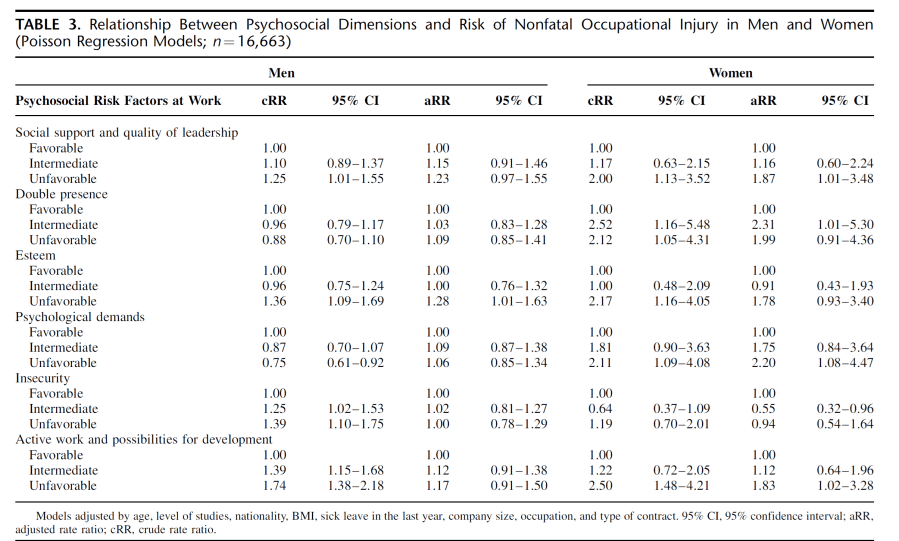
Exposure to Psychosocial Risk Factors at Work and the Incidence of Occupational Injuries: A Cohort Study in Spain
This study explored the links between psychosocial risk factors (PRF) on the incident of occupational injuries (OIs). Compared to many other studies, they used a dynamic cohort longitudinal design (>16k) participants over 1 year follow-up. The Copenhagen Psychosocial Questionnaire was used. For background: PRF have been “associated with many health problems, including cardiovascular diseases,3 depression,4… Continue reading Exposure to Psychosocial Risk Factors at Work and the Incidence of Occupational Injuries: A Cohort Study in Spain
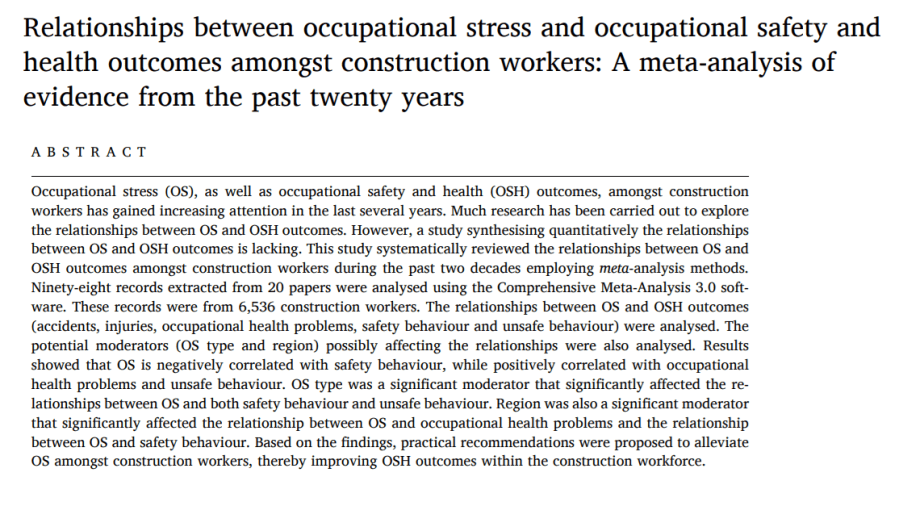
Relationships between occupational stress and occupational safety and health outcomes amongst construction workers: A meta-analysis of evidence from the past twenty years
This meta-analysis investigated the effects of occupational stress (OS) on safety and health outcomes in construction. 20 studies over 20 years, including >6k construction workers was included (not such a big sample given all of the research in construction safety, indicative of the relatively poorer quality of research that didn’t meet their inclusion criteria). [Trigger… Continue reading Relationships between occupational stress and occupational safety and health outcomes amongst construction workers: A meta-analysis of evidence from the past twenty years
How certification shifts work away from functional issues to rustling paperwork
Does certification, like under ISO 18001, or likely 45001, only have positive effects, or does it also introduce unintended byproducts, like a focus on managing the paperwork and not ‘real’ issues, and oversimplifying psychosocial issues? Safe AF podcast #9 explored the byproducts of certification – just 9 mins of your life. Links below. They observed… Continue reading How certification shifts work away from functional issues to rustling paperwork
Safe AF #9: How certified systems & auditing mask psychosocial factors
We design, implement and ISO-certify our safety systems with best intentions. We hope these systems help us to identify and address workplace hazards. However, is it possible that certified management systems can instead mask particular complex sociotechnical issues, simplifying psychosocial matters into neat, auditable matters, devoid of their depth and nuance? Can auditing transform functional… Continue reading Safe AF #9: How certified systems & auditing mask psychosocial factors

