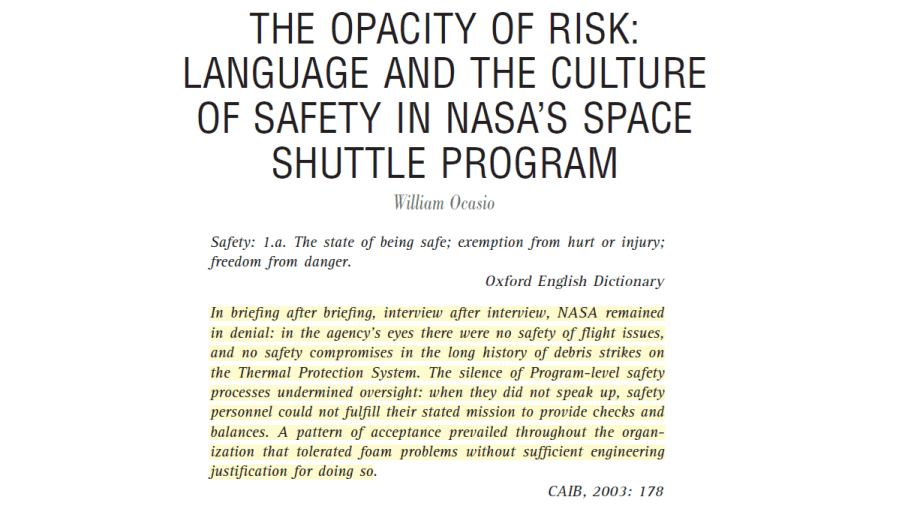
Really interesting book chapter about the vocabulary of safety at NASA prior to the 2003 Columbia shuttle disaster. WAY too much to cover, so a few extracts. The vocabulary of safety means “the interrelated set of words used to guide organizational communications regarding known and unknown risks and danger to the mission, vehicle, and crew… Continue reading The opacity of risk: language and the culture of safety in NASA’s space shuttle program
Safe As 44: Human-centred design – some terms from Don Norman
This quickisode dives into some key human-centred design terms from the GOAT, Don Norman. The source is: Norman, D. (2013). The design of everyday things. Spotify: https://open.spotify.com/episode/2aOZLiHpZpX4vfFq4bVYQ4?si=d37krBKhRKivbag9yyjtag Make sure to subscribe to Safe As on Spotify/Apple, and if you find it useful then please help share the news, and leave a rating and review on… Continue reading Safe As 44: Human-centred design – some terms from Don Norman
Safety culture maturity models in occupational safety and health: An updated scoping review
Review study of the evidence underpinning ‘safety culture’ maturity models. 17 studies were included. Tl;dr: the evidence supporting that they actually do what they purport to do, is limited. Note: I’m not a fan of SC maturity models, but good to see efforts to describe the empirical landscape. Extracts: · “The vast majority of included studies… Continue reading Safety culture maturity models in occupational safety and health: An updated scoping review
Safe As 43: How ‘no blame’ can potentially subvert learning and improvement
Few would disagree that blame negatively impacts learning. However, can efforts to promote ‘no blame’ approaches also carry their own negative and unintended impacts on learning and improvement? Today’s article is: Sherratt, F., Thallapureddy, S., Bhandari, S., Hansen, H., Harch, D., & Hallowell, M. R. (2023). The unintended consequences of no blame ideology for incident… Continue reading Safe As 43: How ‘no blame’ can potentially subvert learning and improvement

Large Language Models in Lung Cancer: Systematic Review
This systematic review of 28 studies explored the application of LLMs for lung cancer care and management. Probably few surprises here. And it’s focused mostly on LLMs, rather than specialised AI models. Extracts: · The review identified 7 primary application domains of LLMs in LC: auxiliary diagnosis, information extraction, question answering, scientific research, medical education, nursing… Continue reading Large Language Models in Lung Cancer: Systematic Review

From transcript to insights: Summarizing safety culture interviews with LLMs
From transcript to insights: summarizing safety culture interviews with LLMs How well does OpenAI o1 work for summarising ‘safety culture’ interviews, and how does it compare to human notes? This study did just that. Extracts: · They assessed correctness via exhaustiveness (comparison of LLM claims vs human interviewer notes), consistency (comparison of LLM claims between subsequent… Continue reading From transcript to insights: Summarizing safety culture interviews with LLMs
Safe As 42: The blindspots of incident reporting approaches
Are our incident reporting systems providing accurate reflections of incidents and severity, or blinkered, highly selective views disconnected from actual injury severities? Today’s article: Geddert, K., Dekker, S., & Rae, A. (2021). How does selective reporting distort understanding of workplace injuries?. Safety, 7(3), 58. Spotify: https://open.spotify.com/episode/23vTcFiHIAO1FDeml1gyHY?si=SZUz3GofTL6zeyfY2-RF7w Make sure to subscribe to Safe As on Spotify/Apple, and if… Continue reading Safe As 42: The blindspots of incident reporting approaches
Safe As 41: Writing better procedures with the dark arts of human factors (quickisode)
How can we apply the dark arts of Human Factors to write better procedures? Let’s find out. Today’s source is: HPOG (2021). Best Practice in Procedure Formatting. Make sure to subscribe to Safe As on Spotify/Apple, and if you find it useful then please help share the news, and leave a rating and review on… Continue reading Safe As 41: Writing better procedures with the dark arts of human factors (quickisode)
Safe As 40: Types and mechanisms of investigator bias
What are the types and mechanisms of investigator bias, and what are some proposed debiasing methods and improvements? Today’s article: MacLean, C. L. (2022). Cognitive bias in workplace investigation: Problems, perspectives and proposed solutions. Applied Ergonomics, 105, 103860. Spotify: https://open.spotify.com/episode/5J7wRxN7XlAPmDvmY7QBAY?si=0OtWqnJ4TDOHGKMVQHsCpQ Make sure to subscribe to Safe As on Spotify/Apple, and if you find it useful then please… Continue reading Safe As 40: Types and mechanisms of investigator bias
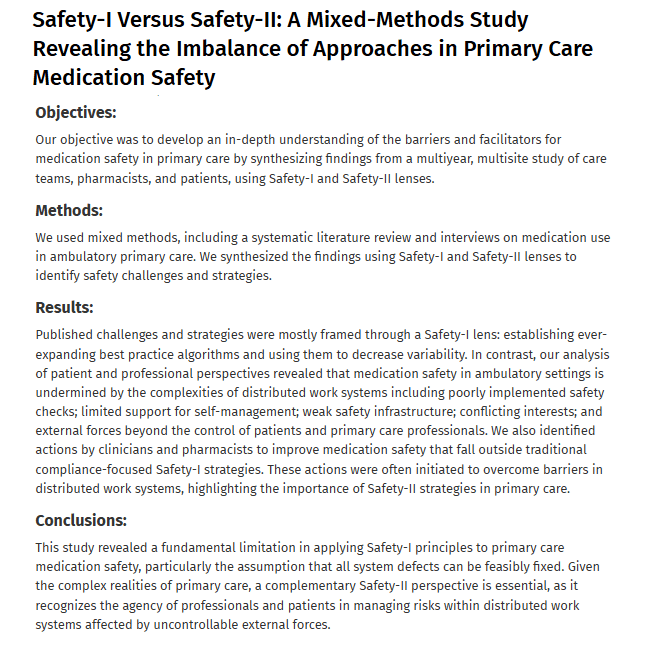
Safety-I Versus Safety-II: A Mixed-Methods Study Revealing the Imbalance of Approaches in Primary Care Medication Safety
Extracts from a paper that studied medication safety in primary care from both a Safety-I and Safety-II lens – using “medication management in the wild” as their data. · 2 decades after the ‘To Err is Human’ report has “given way to hard bitten realism that there has been little measurable improvement in the overall rates… Continue reading Safety-I Versus Safety-II: A Mixed-Methods Study Revealing the Imbalance of Approaches in Primary Care Medication Safety

