This guidance note shared recently by Maureen Hassall covers the critical control framework integration into Qld coal mines. But, it may interest others, too. Just a few extracts: · “Industry experience suggests that it is possible to identify a number of plans, processes and tools that can be inappropriately classified as controls” · Image 1 provides the… Continue reading Critical Control framework guidance for coal mining
Safe As future release schedule: 40 eps recorded
So, I’ve gone a bit silly and have recorded another 40 eps of Safe As. Check out the upcoming schedule (the order will change). If there’s anything you want to see, then leave a comment and I’ll see about recording a pod. Please help share with your network, and subscribe/rate/review on your podcast app. Spotify:… Continue reading Safe As future release schedule: 40 eps recorded
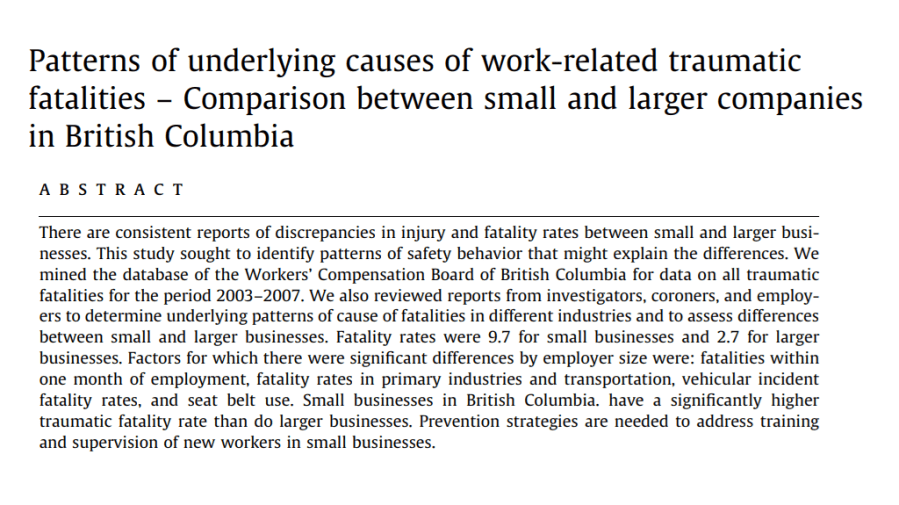
Patterns of underlying causes of work-related traumatic fatalities – Comparison between small and larger companies in British Columbia
This study mined the Workers’ Compensation Board of British Columbia (WCB) to compare discrepancies in injury and fatalities between small and large businesses. I’ve skipped a lot. For background: · Data from 2003-07 found the traumatic fatality rate among workers in small businesses (<20 person-years) was 9.7 per 100k person-years vs 2.7 per 100k in… Continue reading Patterns of underlying causes of work-related traumatic fatalities – Comparison between small and larger companies in British Columbia

Safe As podcast #13: Do near misses increase risky decision making?
Conventional wisdom suggests investigating and circulating knowledge of near misses. These ‘free lessons’, so it goes, are supposed to help us learn without the need for injury or damage. But can near misses also lead to a desensitisation of risk over time, focusing on the achieved success, rather than the near loss? Today’s paper is… Continue reading Safe As podcast #13: Do near misses increase risky decision making?
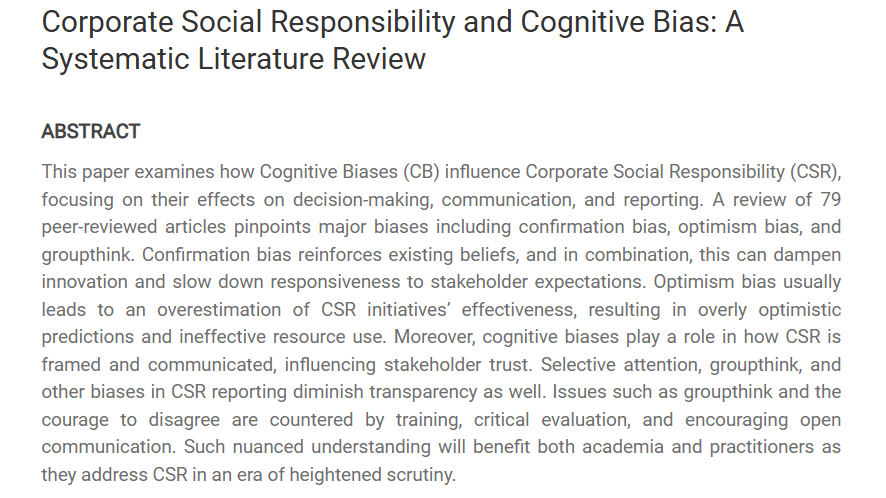
Corporate Social Responsibility and Cognitive Bias: A Systematic Literature Review
This paper explored how Cognitive Biases (CB) influence Corporate Social Responsibility (CSR) via review of 79 studies. Have skipped a lot. Findings: · CB “have a significant impact on three key areas of CSR: decision-making, communication and perception, and reporting and evaluation” · In decision-making, confirmation bias and optimism are important where decision makers “seek information that… Continue reading Corporate Social Responsibility and Cognitive Bias: A Systematic Literature Review
Barriers, critical controls and the problems of seeing people as a threat rather than a strength of barrier systems
Did you check out ep 12 of Safe As? This explored how human performance is considered within barrier / critical control frameworks. Based on a paper from McLeod 2012 – some of the issues with current practices is that: 1) Both too many barriers are identified, and they rarely take a systems view 2) The complexity and… Continue reading Barriers, critical controls and the problems of seeing people as a threat rather than a strength of barrier systems
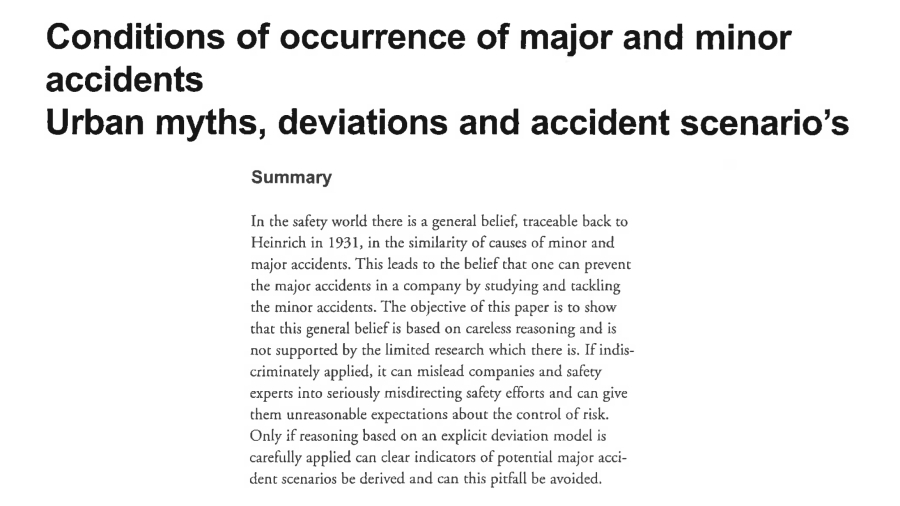
Conditions of occurrence of major and minor Accidents: Urban myths, deviations and accident scenarios
A 2002 paper from Andrew Hale talking about fatal vs non-fatal, minor vs major incidents, and the (then-known) links between them, if any. A lot of this paper focuses on Heinrich’s work and the jank interpretations and myths that have developed over time, inconsistent with Heinrich’s intentions. There’s newer and more thorough discussions of these… Continue reading Conditions of occurrence of major and minor Accidents: Urban myths, deviations and accident scenarios
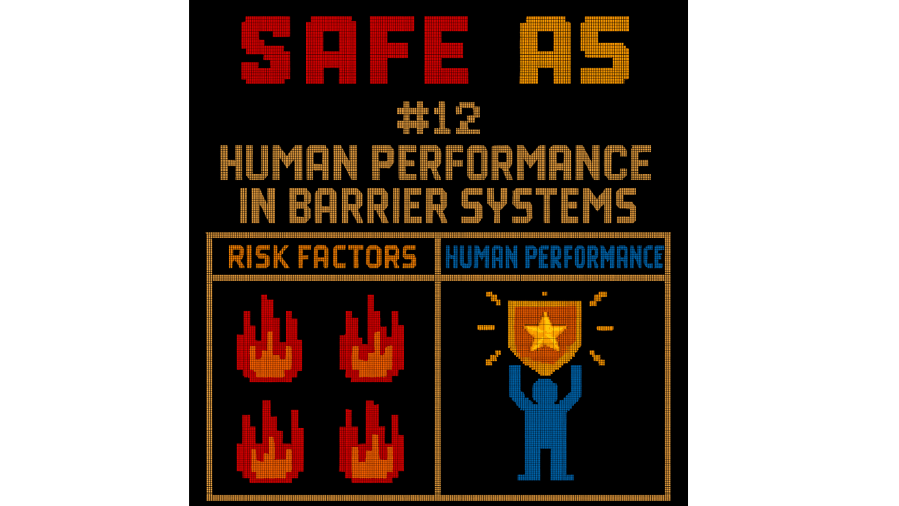
Safe As podcast ep 12: Human performance in barrier/critical control systems
How do you consider the role of people within your barrier or critical control system – threat or adaptable element? What are some fallacies of human performance, like being unreliable bad apples, and how best to incorporate the strengths of people, while limiting performance variability? Today’s paper is from McLeod, R. W. (2017). Human factors… Continue reading Safe As podcast ep 12: Human performance in barrier/critical control systems
Doing the right things wronger and moving on from first stories to second stories in investigations
Just recorded a pod exploring the “alluring first stories”. That is, explaining incidents and performance focused on the actions and behaviour of people, rather than contextualising within the environment they operate (second stories). I worked in this beautiful quote from Russel Ackoff (who was quoting Peter Drucker), see image 1, in describing how we get… Continue reading Doing the right things wronger and moving on from first stories to second stories in investigations

Implications of sleep loss or sleep deprivation on muscle strength: a systematic review
Does sleep deprivation (SD) affect various indices of muscle strength? To Jack’s complete lack of surprise: probably yes. This systematic review investigated 13 studies on the links. Tl;dr: Drop setting those Z’s may be eating into sick gainz bro For background: · 7-9 hrs sleep per night is recommended for most people · Poor quality and duration… Continue reading Implications of sleep loss or sleep deprivation on muscle strength: a systematic review

