
This study investigated how humble leadership fosters team outcomes, like team adaptation. Psychological safety climate and reflexivity were explored as mediating pathways. Surveys at two time points across 56 work teams (233 members) were collected. Background: · The word humility derives from the Latin humilitas, meaning from the earth/grounded · Humility has a long history and is… Continue reading The relationship between humble leadership and team adaptation: two paths model perspective
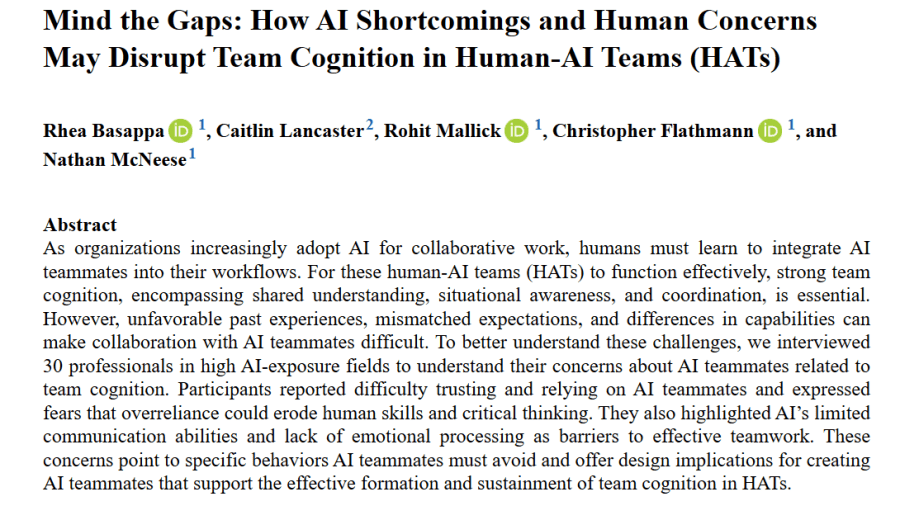
Mind the Gaps: How AI Shortcomings and Human Concerns May Disrupt Team Cognition in Human-AI Teams (HATs)
This study explored the integration and hesitations of AI embedded within human teams (Human-AI Teams, HATs). 30 professionals were interviewed. Not a summary, but some extracts: · “As AI takes on more complex roles in the workplace, it is increasingly expected to act as a teammate rather than just a tool” · HATs “must develop a shared… Continue reading Mind the Gaps: How AI Shortcomings and Human Concerns May Disrupt Team Cognition in Human-AI Teams (HATs)

Safe As podcast ep16: Systems thinking and investigations
Do construction investigations take broader systems perspectives of accident causation, or stuck in the mud focused on local factors, people and behaviour? Further, do investigations help organisations navigate complex, often entangled sociotechnical matters, or hinder progress in safety capacities? Today’s paper is from Woolley, M. J., Goode, N., Read, G. J., & Salmon, P. M.… Continue reading Safe As podcast ep16: Systems thinking and investigations
Audit failures and the Maritime NZ due diligence prosecution
One extract from the Maritime NZ due diligence prosecution that I’ve posted before – but worth reposting. I like the emphasis that the audits were configured to inform leadership that, on paper, the “management system looked solid” (emphasis added). We argued similarly in my published research on auditing – we need to critically interrogate our… Continue reading Audit failures and the Maritime NZ due diligence prosecution

Safe As podcast ep15: Root Cause Analyses (RCA) and incident prevention – do they ‘work’?
Many organisations rely on their root cause analyses (RCA) to help learn about incidents, and, ideally, prevent incident reoccurrences. So the logic goes. But does the published evidence support RCA approaches as effective means for preventing incident reoccurrences? Today’s paper is Martin-Delgado, J., Martínez-García, A., Aranaz, J. M., Valencia-Martín, J. L., & Mira, J. J.… Continue reading Safe As podcast ep15: Root Cause Analyses (RCA) and incident prevention – do they ‘work’?

Insight from hindsight: A practitioner’s perspective on a causal approach to performance improvement
This discussion paper explores some of the author’s thoughts around performance problems in high hazard industries. Overall, they argue that due to a few repeating impediments, organisations have a limited ability to “effectively find, learn, and eliminate the causes” and “are left with repeating periods of performance problems despite well-intended efforts to improve”. 1. We… Continue reading Insight from hindsight: A practitioner’s perspective on a causal approach to performance improvement
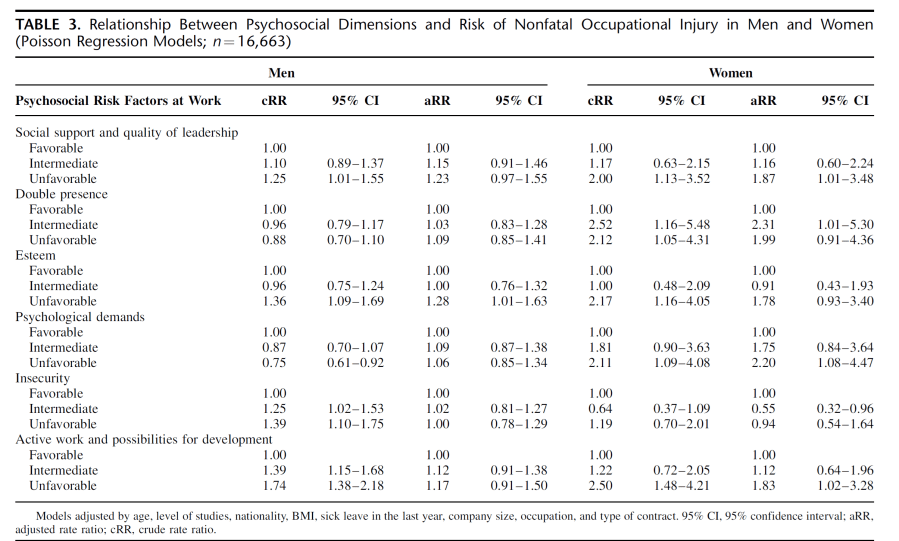
Exposure to Psychosocial Risk Factors at Work and the Incidence of Occupational Injuries: A Cohort Study in Spain
This study explored the links between psychosocial risk factors (PRF) on the incident of occupational injuries (OIs). Compared to many other studies, they used a dynamic cohort longitudinal design (>16k) participants over 1 year follow-up. The Copenhagen Psychosocial Questionnaire was used. For background: Findings: Why are PRF and OI potentially linked? They suggest: Limitations were… Continue reading Exposure to Psychosocial Risk Factors at Work and the Incidence of Occupational Injuries: A Cohort Study in Spain
Safe As podcast ep 14: Leadership walkarounds – ritualistic peacocking or solid trust building?
We’ve all heard about or been part of them – leader walkarounds. Are walkarounds backed by solid evidence – do they break down silos, enhance trust, and foster psychological safety, or more symbolic peacocking activities to be *seen* to care, rather than *actually* caring? Today’s article is Foster, M., & Mazur, L. (2023). Impact of… Continue reading Safe As podcast ep 14: Leadership walkarounds – ritualistic peacocking or solid trust building?

Physical and Psychosocial Correlates of Occupational Physical Injury in the Global Construction Industry: A Scoping Review
This recent scoping review evaluated 77 construction studies covering various geographical regions on the physical and psychosocial correlates of physical injury. They stratified the correlates into three domains: 1. workplace physical environment (eg, exposure to physical hazards, PPE, company size & more) 2. workplace culture (eg, psychosocial stressors, gender-related barriers, migrant and ethnic disparities, educational background) 3. physical… Continue reading Physical and Psychosocial Correlates of Occupational Physical Injury in the Global Construction Industry: A Scoping Review
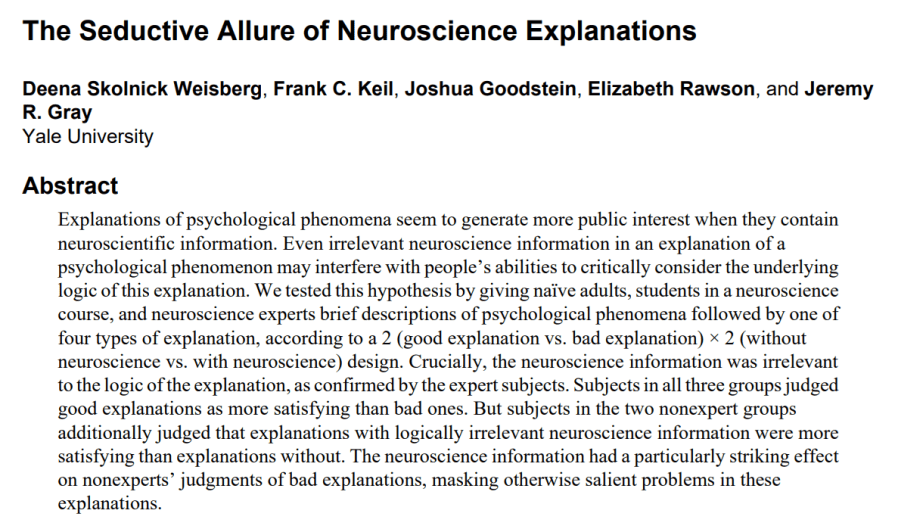
The Seductive Allure of Neuroscience Explanations
This was an interesting little study. It looked at the phenomenon of how psychological explanations seem to generate more public interest when they contain neuroscientific information. This includes even irrelevant info in an explanation may interfere with people’s abilities to comprehend the underlying logics of the information. The authors proposed that neuroscience information in explanations… Continue reading The Seductive Allure of Neuroscience Explanations

