Does certification, like under ISO 18001, or likely 45001, only have positive effects, or does it also introduce unintended byproducts, like a focus on managing the paperwork and not ‘real’ issues, and oversimplifying psychosocial issues? Safe AF podcast #9 explored the byproducts of certification – just 9 mins of your life. Links below. They observed… Continue reading How certification shifts work away from functional issues to rustling paperwork

The Folly of Safety-III
Hollnagel’s response to some of the recent (and somewhat bizarre) articles on ‘Safety-III’. Spoiler: It’s not charitable. I’m relying on a lot of direct quotes. Providing context, Hollnagel argues: · Introduction of Safety-I and Safety-II (SI / SII) to characterise two opposite means of safety was “met with surprisingly large interest” and “also with some… Continue reading The Folly of Safety-III
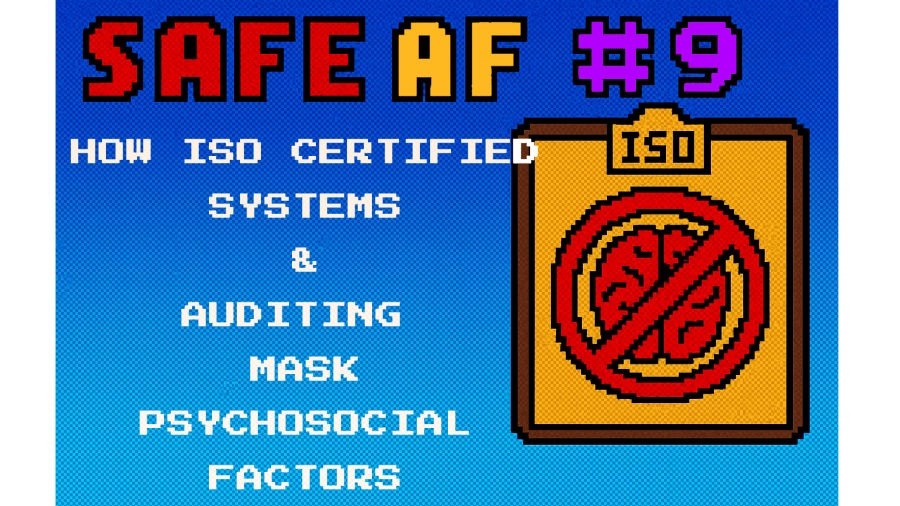
Safe AF #9: How certified systems & auditing mask psychosocial factors
We design, implement and ISO-certify our safety systems with best intentions. We hope these systems help us to identify and address workplace hazards. However, is it possible that certified management systems can instead mask particular complex sociotechnical issues, simplifying psychosocial matters into neat, auditable matters, devoid of their depth and nuance? Can auditing transform functional… Continue reading Safe AF #9: How certified systems & auditing mask psychosocial factors

Cut the crap: a critical response to “ChatGPT is bullshit”
Here’s a critical response paper to yesterday’s “ChatGPT is bullshit” article from Hicks et al. Links to both articles below. Some core arguments: · Hick’s characterises LLMs as bullshitters, since LLMs “”cannot themselves be concerned with truth,” and thus “everything they produce is bullshit” · Hicks et al. rejects anthropomorphic terms such as hallucination or confabulation, since… Continue reading Cut the crap: a critical response to “ChatGPT is bullshit”
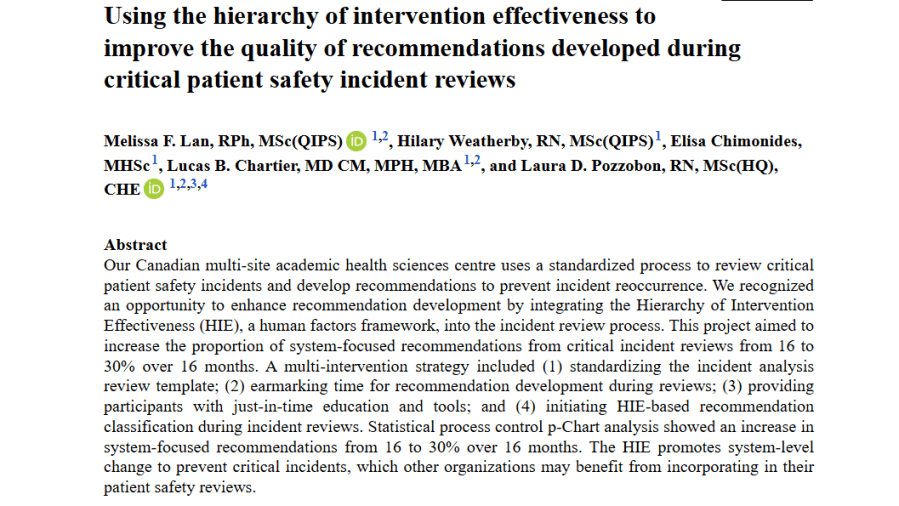
Using the hierarchy of intervention effectiveness to improve the quality of recommendations developed during critical patient safety incident reviews
This study evaluated the Hierarch of Intervention Effective (HIE) for improving patient safety incident recommendations. They were namely interested in increasing the proportion of system-focused recommendations. Data came from over 16 months. Extracts: Ref: Lan, M. F., Weatherby, H., Chimonides, E., Chartier, L. B., & Pozzobon, L. D. (2025, June). Using the hierarchy of intervention… Continue reading Using the hierarchy of intervention effectiveness to improve the quality of recommendations developed during critical patient safety incident reviews

ChatGPT is bullshit
This paper challenges the label of AI hallucinations – arguing instead that these falsehoods better represent bullshit. That is, bullshit, in the Frankfurtian sense (‘On Bullshit’ published in 2005), the models are “in an important way indifferent to the truth of their outputs”. This isn’t BS in the sense of junk data or analysis, but… Continue reading ChatGPT is bullshit
Safe AF #8: The harm in zero harm
Is Zero Harm a laudable approach or a misdirection–a utopian fantasy–associated with higher fatality rates? Safe AF episode #8 dives into a paper which compares safety injury and fatality performance between zero and non-zero construction company adopters in the UK. From: Sherratt, F., & Dainty, A. R. (2017). UK construction safety: a zero paradox?. Policy and… Continue reading Safe AF #8: The harm in zero harm
Is zero harm a utopian fantasy?
An interesting extract from Sherratt & Dainty’s much debated 2017 paper – covered in tomorrow’s Safe AF podcast ep #8. They argue that zero approaches are a utopia that: “was challenged and even derided by the construction workers themselves, for whom the lived realities of their working lives tells them Zero is, and is likely… Continue reading Is zero harm a utopian fantasy?
Do your investigations suck? Are you learning about the functionality of critical controls?
Do your investigations suck? Are they exploring the presence and functionality of risk controls? Check out Safe AF podcast #7 (just 9 mins of your life 😉 ) which dives into what investigations explore and ignore – critically, up to 60% of investigations may not evaluate whether risk controls actually functioned as intended. Spotify: https://open.spotify.com/episode/2uyLNSbLmBti5deKFzB630?si=PUipY6ooRUa7EmBBX0po4g… Continue reading Do your investigations suck? Are you learning about the functionality of critical controls?

Evaluating the Impact of Hazard Information on Fieldworkers’ Safety Risk Perception
This study investigated how 181 fieldworkers rate the severity and frequency of safety incidents for five construction work scenarios. The scenarios introduced new hazards into the scenarios, assessing how workers responded, if at all. Background: · Safety risk perception (SRP) is estimated using the participants’ perception of the safety hazards severity and frequency of occurrence… Continue reading Evaluating the Impact of Hazard Information on Fieldworkers’ Safety Risk Perception

