
Are our investigations blinded to the functioning and effectiveness of risk controls? Are our current approaches, and mental models about how safety events occur, defined less by what they unpack and more by what they leave in the dark? This study unpacks these questions, and evaluates how accident investigators consider, or not, the functioning of… Continue reading Safe AF #7: Limits of investigations and blindness to control effectiveness

The Impact of Physical Hazards on Workers’ Job Satisfaction in the Construction Industry: A Case Study of Korea
This study explored how physical workplace hazards influence job satisfaction in construction, and how mental threats mediate the relationship, and how perceived job quality and security moderate the effects. 2,202 construction workers in Korea were surveyed. Key findings: · “exposure to physical hazards significantly contributes to mental stress, leading to reduced job satisfaction” · And “a heightened… Continue reading The Impact of Physical Hazards on Workers’ Job Satisfaction in the Construction Industry: A Case Study of Korea
Building Resilience into Safety Management Systems: Precursors and Controls to Reduce Serious Injuries and Fatalities (SIFs)
This report, part of creative sentencing research, explored Serious Incidents and Fatalities (SIFs) in mining, and the causes, and the most effective controls for SIFs. Another aim was around the fallibility of people, and when they make mistakes, ensuring there are adequate capacities “so that they ‘fail safely’”, rather than “rather than ‘failing lucky”, or… Continue reading Building Resilience into Safety Management Systems: Precursors and Controls to Reduce Serious Injuries and Fatalities (SIFs)

Safe AF #6: Audit Masquerade – How audits provide comfort rather than treatment for serious risks
Are audits effective checks and verifications of our risk control systems? Are they diving deep into the functionality and effectiveness of systems and practices, and evaluating actual daily, hazardous work? Or, are they mostly rustling paperwork at the expense of operational hazards? Ref: Hutchinson, B., Dekker, S., & Rae, A. (2024). Audit masquerade: How audits… Continue reading Safe AF #6: Audit Masquerade – How audits provide comfort rather than treatment for serious risks

Do investigations mostly fix what’s easy rather than what’s necessary?
Did you check out #5 of Safe AF? This explored whether investigations actually fix relevant issues, or whether they’re more a game of sociopolitical whack-a-mole. For instance, investigations address what is easy–run a toolbox talk–rather than addressing more challenging, but important issues: lack of resourcing. Or, investigations tend to fix the things people wanted to… Continue reading Do investigations mostly fix what’s easy rather than what’s necessary?

Should risk matrices simply be abandoned because of their baked-in flaws?
Are risk matrices better than nothing? Should we use them because we don’t have a better alternative? Or, can matrices result in assessments **worse than random chance**, reward arbitrary calculations, and reinforce human perceptual filters and risk blindness? Are many of the issues of matrices baked into their design, rather than resulting from the users?… Continue reading Should risk matrices simply be abandoned because of their baked-in flaws?
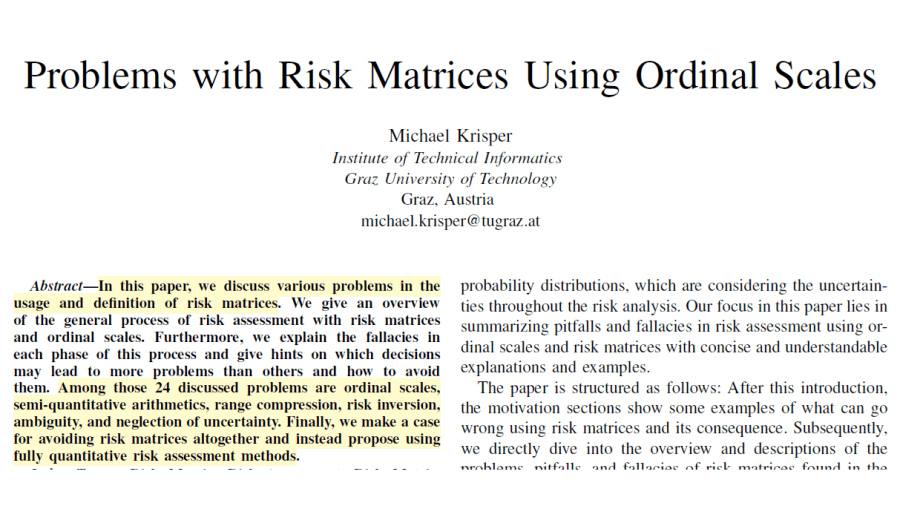
Problems with Risk Matrices Using Ordinal Scales
This covers some core problems with risk matrices. It’s argued that while they’re established tools, appearing to be “authoritative, and intellectually rigorous”, this “could be just an illusion …bred by the human bias of uncertainty aversion and authority bias”. Hence, matrices have “many flaws” that can “diminish their usefulness to the point where they become… Continue reading Problems with Risk Matrices Using Ordinal Scales
On folk models, ontological alchemy and other critical perspectives in risk
A few extracts with probably little to no links between them – but critical perspectives of techniques and their worldviews and applications. Not systematic. Refs at bottom of article. Dekker on ‘ontological alchemy’ Dekker argues that, just like alchemists tried to turn base metals into gold, practitioners and scholars perform ontological alchemy by trying to… Continue reading On folk models, ontological alchemy and other critical perspectives in risk

Safe AF ep #5: Is what we find in investigations, what we fix?
Conventional logic suggests that we fix the gaps that we find in investigations. But is this the case? Is the investigation process more a game of sociopolitical whack-a-mole, finding and fixing the things that are easily solved or understandable, or tolerable to the organisation? Ref: Lundberg, J., Rollenhagen, C., & Hollnagel, E. (2010). What you… Continue reading Safe AF ep #5: Is what we find in investigations, what we fix?
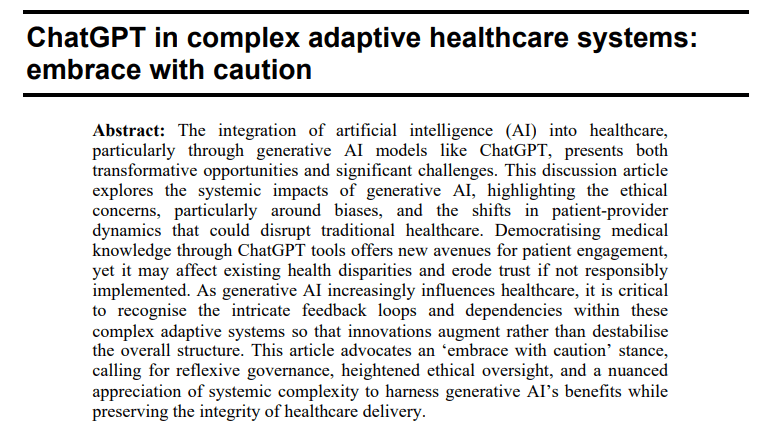
ChatGPT in complex adaptive healthcare systems: embrace with caution
This discussion paper explored the introduction of AI systems into healthcare. It covers A LOT of ground, so just a few extracts. Extracts: · “This article advocates an ‘embrace with caution’ stance, calling for reflexive governance, heightened ethical oversight, and a nuanced appreciation of systemic complexity to harness generative AI’s benefits while preserving the integrity of… Continue reading ChatGPT in complex adaptive healthcare systems: embrace with caution

