
This study explored the value and insights derived from investigation reports, comparing tabulated data vs extracted narratives. It was interested in what sorts of trends and insights about risk factors could be derived from either data stream. Their method to extract the info was tested against 400 OSHA reports. For context: · Tabular data is… Continue reading Unveiling Untapped Potential: Leveraging Accident Narratives for Enhanced Construction Safety Management
Tag: accident
1910 Pittsburgh Survey challenging worker ‘carelessness’ as main ’cause’ of accidents
Really interesting findings from 1910 challenging the concept of carelessness and workers as the main ‘cause’ of traumatic accidents. From Eastman’s book 2 of the Pittsburgh’s Survey. Was meant to be a mini-post. But, too many interesting statements. Extracts: · Eastman starts with “So you’ve come to Pittsburgh to study accidents, have you?” says the… Continue reading 1910 Pittsburgh Survey challenging worker ‘carelessness’ as main ’cause’ of accidents
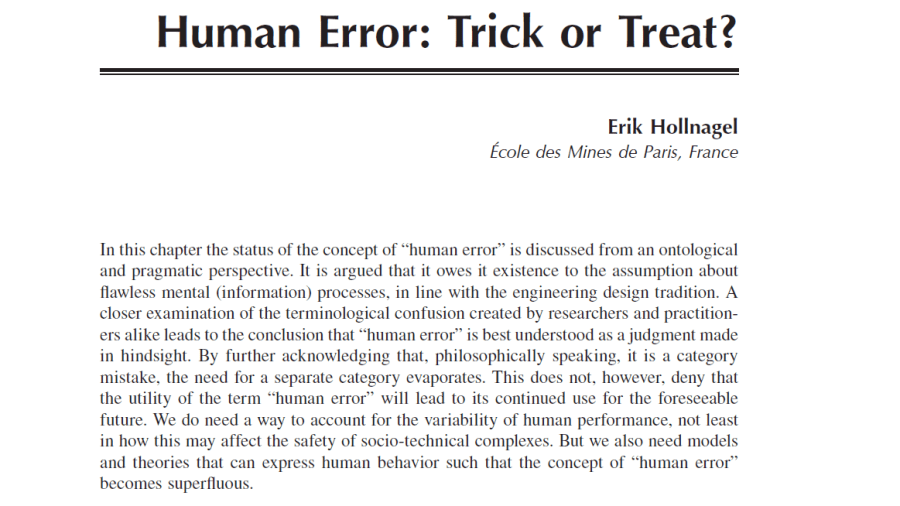
Human Error: Trick or Treat?
This 2007 chapter from Hollnagel unpacked whether we really need the concept of “human error” (HE). It’s a whole chapter, so I’ve skipped HEAPS. Tl;dr according to Hollnagel: · “there is no need of a theory of “human error” because the observed discrepancies in performance should be explained by a theory of normal performance rather… Continue reading Human Error: Trick or Treat?

1912 article discussing the role of fatigue in industrial accidents and arguing against ‘carelessness’ as an “ultimate cause”
This was an interesting article from 1912 highlighting the role that fatigue has in industrial accidents. Also challenges ‘carelessness’, saying it doesn’t account for the effects of fatigue. While scientific knowledge has progressed over the century, it’s cool how well they articulated the issue. · Image 1 top panel shows a breakdown of accidents per time… Continue reading 1912 article discussing the role of fatigue in industrial accidents and arguing against ‘carelessness’ as an “ultimate cause”

Mini-Compendium: Power, Safety, Authority Gradients, and the Power of Elites
Here’s some articles, mostly full-text links, exploring power within organisations. Includes broader social power, power gradients, voice, and more. Feel free to shout me a coffee if you’d like to support the growth of my site: Full-Text Articles [Below link will say ‘Discursive effects of safety science’. Download it and its a whole book with… Continue reading Mini-Compendium: Power, Safety, Authority Gradients, and the Power of Elites
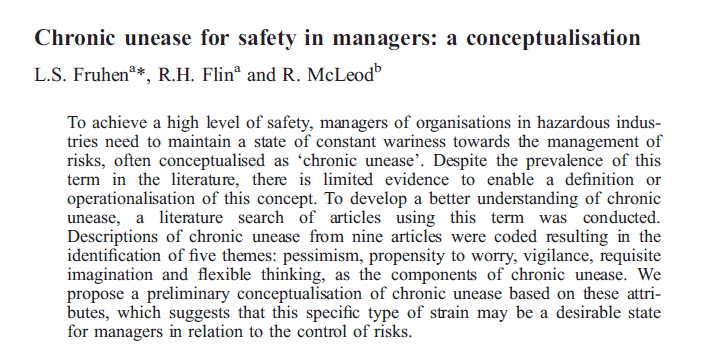
Chronic unease for safety in managers: a conceptualisation
Just a basic post today – some extracts from a paper exploring chronic unease: · Drawing on Reason’s concept, chronic unease has gone by various definitions over the years (image 1) · For Reason, it was the “tendencies of wariness towards risks” · And as a “contrast to complacency, resulting from the absence of negative events, leading ‘people… Continue reading Chronic unease for safety in managers: a conceptualisation

Understanding Accidents – From Root Causes to Performance Variability
This 2002 discussion paper from Erik Hollnagel unpacks some assumptions of different accident models. Note: In this work, accident model isn’t the specific tool or method (e.g. ICAM), but a “frame of reference as the accident model, i.e., a stereotypical way of thinking about how an accident occurs”. i.e. the mental models and justifications on… Continue reading Understanding Accidents – From Root Causes to Performance Variability
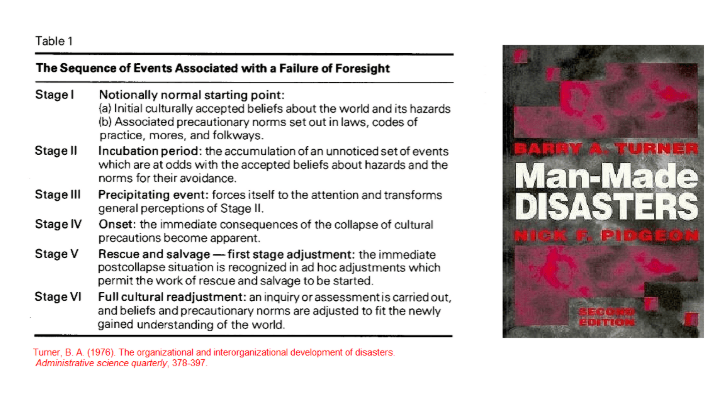
Foresights before disaster: An ode to Barry Turner
So while I don’t often explicitly refer to the late Barry Turner’s work on LinkedIn or regularly post his articles, he’s been the most influential researcher on my own work and is tacitly embedded in my language and thinking. If you’ve heard of Man-Made Disasters, disaster incubation, perceptual horizon, decoy phenomena, failures of foresight (and… Continue reading Foresights before disaster: An ode to Barry Turner

What Control Measures Should I Use? Applying the Total Worker Health Hierarchy of Controls to Manage Workplace Fatigue
This new paper from Drew Dawson and others reconceptualised fatigue risk management within Total Worker Health (TWH) Hierarchy of Controls (HOC). THW HOC works as an extension to the traditional HOC, and “presents strategies in order of effectiveness, ranging from “eliminate,” “substitute,” “redesign,” “educate,” and “encourage” categories” They say that while is mostly associated with… Continue reading What Control Measures Should I Use? Applying the Total Worker Health Hierarchy of Controls to Manage Workplace Fatigue

Attributing Cause for Occupational Accidents in Construction: A Descriptive Single Case Study
This thesis from Jennifer Serne explored how construction safety professionals attribute accident causes. 37 participants were included with 20 accident scenarios, 13 individual semi-structured interviews and 8 summative focus groups. For background: · Originally proposed by Heider in 1958, it’s said that people are “psychologically driven to determine the causes of others’ behavior” · And… Continue reading Attributing Cause for Occupational Accidents in Construction: A Descriptive Single Case Study
 SafetyInsights.org