
What’s the link between shift work and safety incidents? This systematic review of 24 studies explored the links. Extracts: · It’s estimated that 10-30% of the workforce in industrialised societies engage in non-standard work / shift work · Overall, they found “an increased risk of safety incidents during or after night shifts” · “Accumulated exposure to evening or… Continue reading Association of non-standard working time arrangements with safety incidents: a systematic review
Tag: accidents

Who should manage worker safety to reduce occupational accidents?
This study investigated how workplace accidents are affected by who manages occupational safety – owner/partner, managing directors, branch managers, OHS officers or safety representatives. They control for company size. Survey data was collected was across the EU (at least 32 countries and >44k companies). For context: Results They found: · “evidence that it is not… Continue reading Who should manage worker safety to reduce occupational accidents?
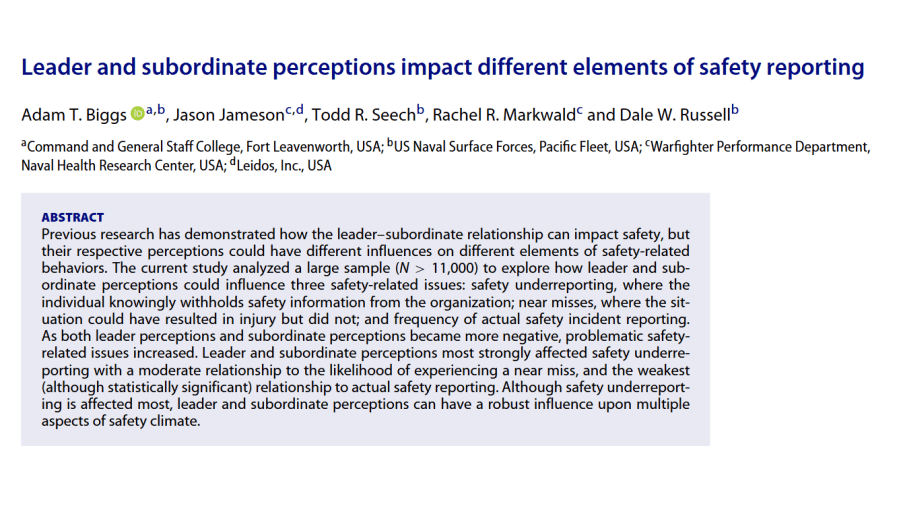
Leader and subordinate perceptions impact different elements of safety reporting
This study investigated the leader-subordinate relationships and how it impacts safety underreporting, near misses, and actual safety incident reporting. >11k US Navy personnel were surveyed. Background: · “maintaining a positive safety climate can be complicated by the sheer number of influences involved, such as the wider organizational climate [6] or individual factors such as sleep… Continue reading Leader and subordinate perceptions impact different elements of safety reporting

Preventing serious injuries & fatalities: time for a sociotechnical model for an operational risk management system
Here’s a 2008 article from Fred Manuele which was included in my SIF compendium (link to compendium & article below). Fred explores a sociotechnical approach to preventing SIFs. The fatality rate in the US from 1971 to 2005 decreased from 17 to 4, but remained stable from 06 to 2011 at ~3.5; hence SIF prevention… Continue reading Preventing serious injuries & fatalities: time for a sociotechnical model for an operational risk management system
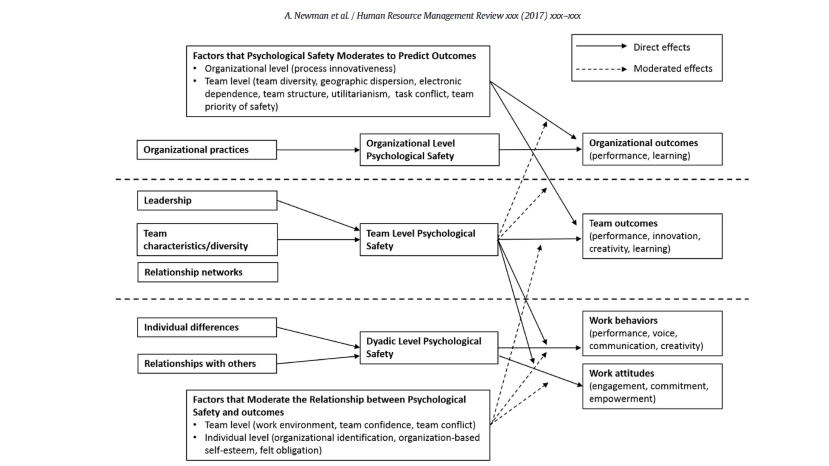
Mini-Compendium: Psychological Safety
Given the prominence of Psychological Safety (PS), it’s worth sharing some research. It’s likely among the most studied modern concepts in organisational theory – so I can barely scratch the surface. Focus first is articles I’ve summarised, and then on any other full-text items I can find. In my haste, I’ve probably included some psychological… Continue reading Mini-Compendium: Psychological Safety

Human Success: Old wine in new bottles, or a shift of mindset for HRA in an automated world?
A really interesting conference paper from Andreas Bye, discussing whether shifting Human Reliability Analysis (HRA) terminology from human error to human success would help alleviate some of the blame-connotations. Also discussed is the human role in automated systems. It was meant to be a mini-post with a few dot-points and a couple of images, but… Continue reading Human Success: Old wine in new bottles, or a shift of mindset for HRA in an automated world?
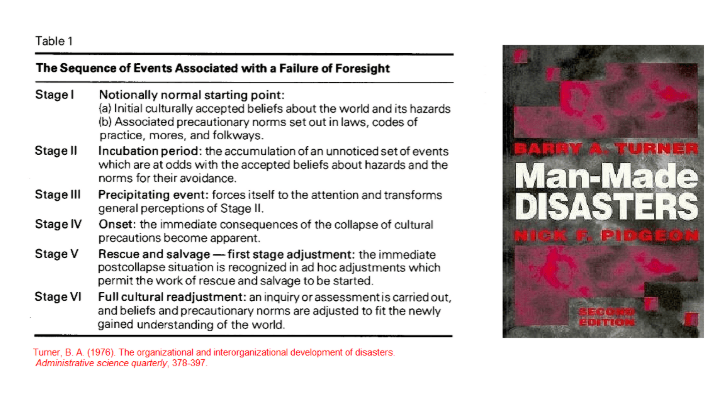
Foresights before disaster: An ode to Barry Turner
So while I don’t often explicitly refer to the late Barry Turner’s work on LinkedIn or regularly post his articles, he’s been the most influential researcher on my own work and is tacitly embedded in my language and thinking. If you’ve heard of Man-Made Disasters, disaster incubation, perceptual horizon, decoy phenomena, failures of foresight (and… Continue reading Foresights before disaster: An ode to Barry Turner
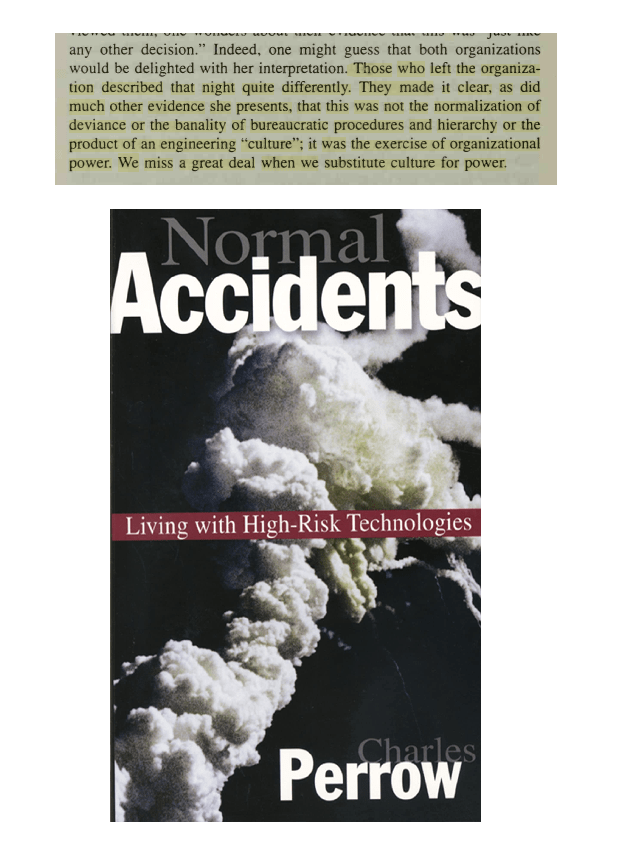
“We miss a great deal when we substitute culture for power” – Charles Perrow on the role of power in disaster
“We miss a great deal when we substitute culture for power” I love this quote from Perrow in Normal Accidents (emphasis added). Perrow briefly discusses the role of power in organising risky technology. Discussing Vaughan’s interpretation of the Challenger disaster: · “I also find the role of power and interests minimized in Diane Vaughn’s otherwise excellent… Continue reading “We miss a great deal when we substitute culture for power” – Charles Perrow on the role of power in disaster

Why do doctors make poor decisions? Spotlighting ‘noise’ as an under-recognised source of error in clinical practice
A brief read covering the concept of noise, pertaining to judgements. This is based on the work from Kahneman, Sibony and Sunstein. From the article: · While biases in judgements have captured a lot of attention, “it has been suggested that ‘noise’ (defined as an undesirable variability in human judgements) is a highly important, yet under-recognised… Continue reading Why do doctors make poor decisions? Spotlighting ‘noise’ as an under-recognised source of error in clinical practice
Compendium: Learning and improvement without incidents
Here’s a mini-compendium of…well, probably a lot of stuff with only a tenuous link to ‘learning’. I tried to focus on learning that doesn’t require incidents, but you’ll find those here, too. There’s >100 articles, mostly full-text. I think I went overboard. Unfortunately, it’s barely sorted. It includes: Shout me a coffee Learning Strengths &… Continue reading Compendium: Learning and improvement without incidents
 SafetyInsights.org