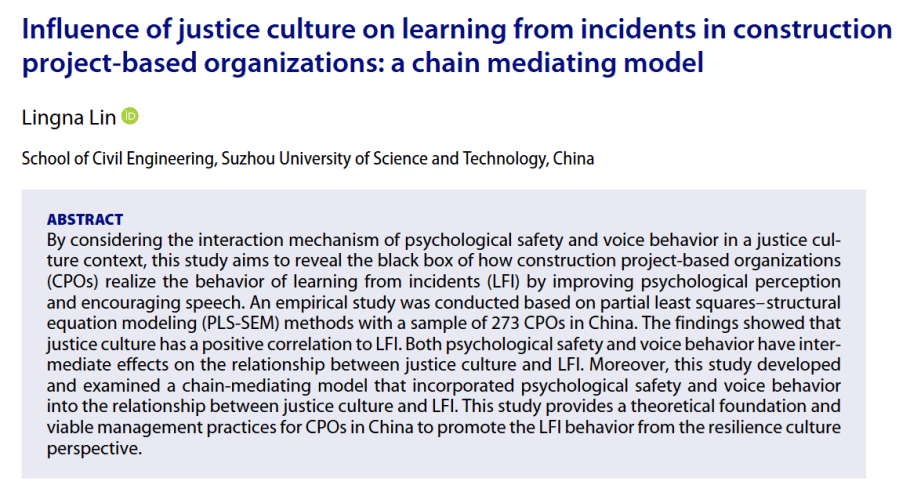
This study investigated the interaction mechanism of psychological safety and voice behaviour in a justice culture context. Specifically they explored how construction project-based organisations (CPOs) can realise learning from incidents by improving psychological perception and encouraging voice. 273 CPOs in China were studied. Background: · Learning from incidents is often said to be an important… Continue reading Influence of justice culture on learning from incidents in construction project-based organizations: a chain mediating model
Tag: blame
Safe As 43: How ‘no blame’ can potentially subvert learning and improvement
Few would disagree that blame negatively impacts learning. However, can efforts to promote ‘no blame’ approaches also carry their own negative and unintended impacts on learning and improvement? Today’s article is: Sherratt, F., Thallapureddy, S., Bhandari, S., Hansen, H., Harch, D., & Hallowell, M. R. (2023). The unintended consequences of no blame ideology for incident… Continue reading Safe As 43: How ‘no blame’ can potentially subvert learning and improvement

Safe As 28: How language shapes blame in investigations
Does the language we use in investigations shape allocations of blame? Quite possibly. Today’s study is from Vesel, C. (2020). Agentive language in accident investigation: Why language matters in learning from events. ACS Chemical Health & Safety, 27(1), 34-39. Spotify: https://open.spotify.com/episode/3PfEq7a3Bsq6zq48TDYMDe?si=AyiJO2O4Rbe-NmjbV5ot9w Apple: https://spotifycreators-web.app.link/e/j6EE8d95bWb Make sure to subscribe to Safe As on Spotify/Apple, and if you find it… Continue reading Safe As 28: How language shapes blame in investigations

Disinheriting Fitts and Jones `47 (2001 Sid Dekker article)
A 2001 article from Sid Dekker discussing a contemporary view of human performance and organisational failure. You may recognise parts of this from Dekker’s later article ‘Is it 1947 yet?’. Too much to cover. And I’m relying heavily on quotes. Dekker reverts back to Fitts and Jones’ 1947 article which “laid the foundation for aviation… Continue reading Disinheriting Fitts and Jones `47 (2001 Sid Dekker article)

“Punishing is about keeping our beliefs in a basically safe system intact. Learning is about changing these beliefs, and changing the system”
“Punishing is about keeping our beliefs in a basically safe system intact. Learning is about changing these beliefs, and changing the system” An interesting extract from Sid Dekker’s 2001 article ‘Disinheriting Fitts and Jones `47’. Summary in a week or two – but if you’ve read his later SafetyDifferently article ‘Is it 1947 yet?’, then… Continue reading “Punishing is about keeping our beliefs in a basically safe system intact. Learning is about changing these beliefs, and changing the system”
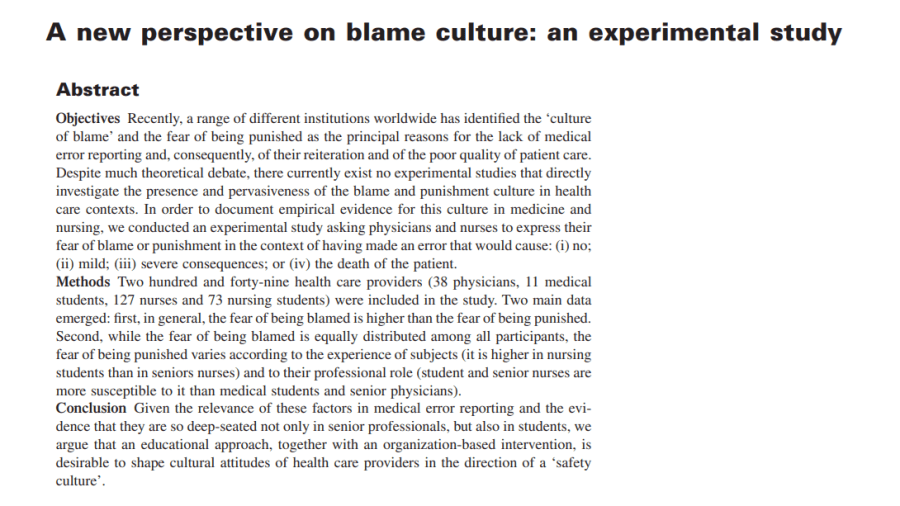
A new perspective on blame culture: an experimental study
This study explored how fear of blame and punishment affects different healthcare professions, experience levels and gender. 249 healthcare practitioners were involved, and were asked how fear of blame or punishment resulting from an error which caused no, mild, severe or death of a patient. Extracts: · “blame culture can be defined as a set of… Continue reading A new perspective on blame culture: an experimental study

Avoiding ‘second victims’ in healthcare: what support do staff want for coping with patient safety incidents, what do they get and is it effective? A systematic review
This systematic review evaluated evidence for what support staff want vs what they receive, and whether the support is effective. 99 studies were included. Some extracts: · PSI (patient safety incident) lead to emotional shame, guilt, anger, shock, depression, fear, flashbacks, helplessness, fatigue, withdrawal and more · The three most desired support types staff want before and… Continue reading Avoiding ‘second victims’ in healthcare: what support do staff want for coping with patient safety incidents, what do they get and is it effective? A systematic review
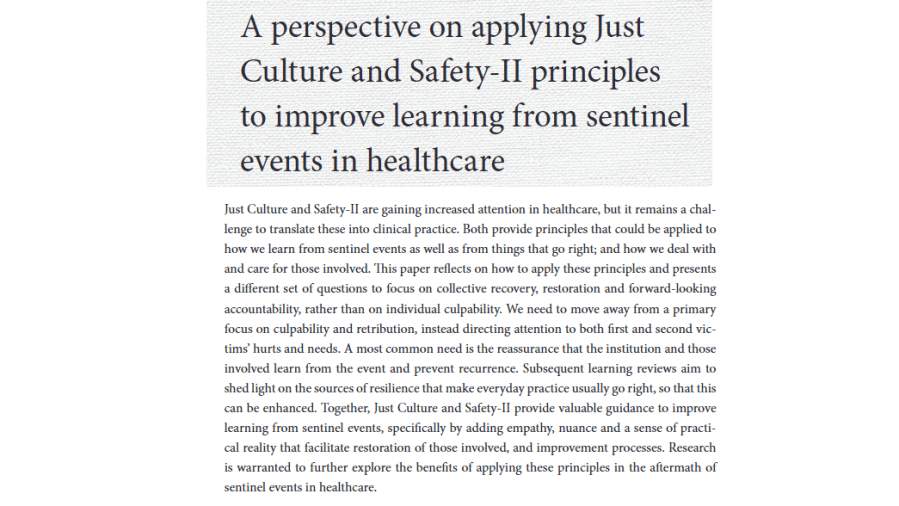
A perspective on applying Just Culture and Safety-II principles to improve learning from sentinel events in healthcare
This discussion paper from de Vos, Dekker and others discusses applying Just Culture and Safety-II to improving from healthcare sentinel events. I think it’s based on de Vos’s PhD. They start showing some evidence that among hospitals convinced that they have a “blame-free” culture also “reported that culpability was of primary concern in their investigations… Continue reading A perspective on applying Just Culture and Safety-II principles to improve learning from sentinel events in healthcare

The systems approach to medicine: controversy and misconceptions — Dekker & Leveson
This was a really brief discussion paper from Dekker and Leveson, covering systems thinking in medicine. Three parts – see comments. Nothing new for most, but they cover: · “The ‘systems approach’ to patient safety has recently led to questions about its ethics and practical utility” · E.g. A recent paper from a retired neurosurgeon questioned systems… Continue reading The systems approach to medicine: controversy and misconceptions — Dekker & Leveson
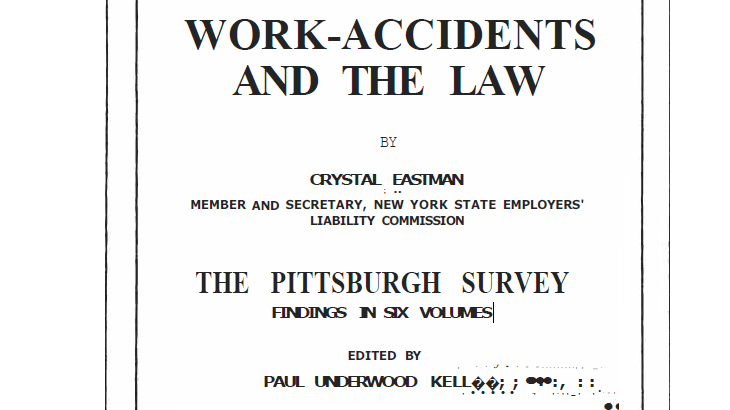
1910 Pittsburgh Survey challenging worker ‘carelessness’ as main ’cause’ of accidents
Really interesting findings from 1910 challenging the concept of carelessness and workers as the main ‘cause’ of traumatic accidents. From Eastman’s book 2 of the Pittsburgh’s Survey. Was meant to be a mini-post. But, too many interesting statements. Extracts: · Eastman starts with “So you’ve come to Pittsburgh to study accidents, have you?” says the… Continue reading 1910 Pittsburgh Survey challenging worker ‘carelessness’ as main ’cause’ of accidents
 SafetyInsights.org