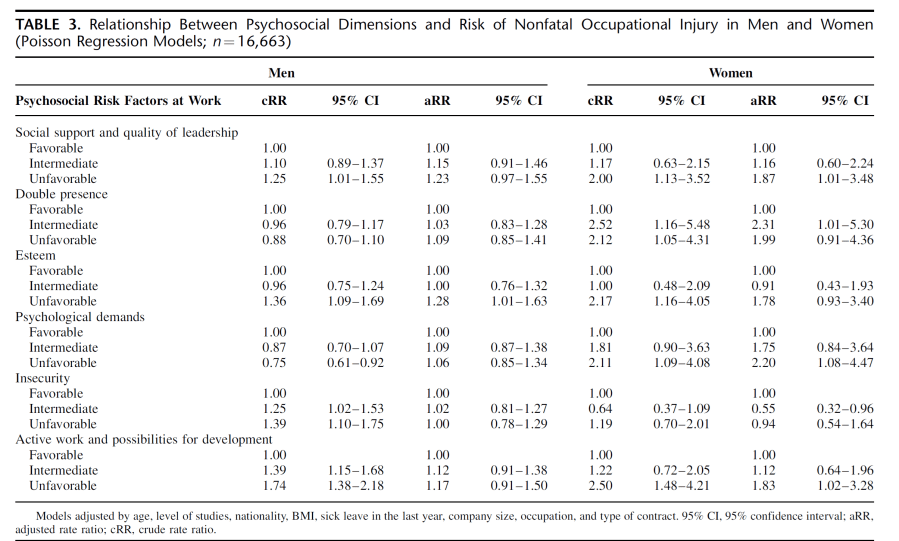
This study explored the links between psychosocial risk factors (PRF) on the incident of occupational injuries (OIs). Compared to many other studies, they used a dynamic cohort longitudinal design (>16k) participants over 1 year follow-up. The Copenhagen Psychosocial Questionnaire was used. For background: Findings: Why are PRF and OI potentially linked? They suggest: Limitations were… Continue reading Exposure to Psychosocial Risk Factors at Work and the Incidence of Occupational Injuries: A Cohort Study in Spain
Tag: injury

Compendium: SIFs, Major Hazards, Fatal & Traumatic hazards, risks
This is an expansion to my prior compendium on Critical Controls, Barriers and Energy thinking. Suggest you read that in conjunction to this, link here: Barriers, Critical Controls, Verifications, Energy Models If you’re after indicators check this mini-compendium out: Safety & Risk Performance indicators (lead, lag, drive, process safety + more) This compendium focuses on articles… Continue reading Compendium: SIFs, Major Hazards, Fatal & Traumatic hazards, risks

Visualizing what’s missing: Using deep learning and Bow-Tie diagrams to identify and visualize missing leading indicators in industrial construction
This study, among a few other things, compared 633 incidents against >9 inspection reports with similar contexts to understand the overlap. Data was from a Canadian construction project over 3 years. E.g. They used multi-methods, including natural language processing, text mining, bow ties and more to evaluate if field inspections are looking at the same… Continue reading Visualizing what’s missing: Using deep learning and Bow-Tie diagrams to identify and visualize missing leading indicators in industrial construction

Workplace Psychosocial Factors and Their Association With Musculoskeletal Disorders
More data on the links between workplace psychosocial factors and injury – this time specifically on musculoskeletal disorders (MSD). 47 studies met inclusion. Findings: · The most common MSDs investigated were lower back pain, neck and shoulder pain, and upper extremity symptoms and disorders · Workplace psychosocial factors that were statistically significant were support, collaboration, job control,… Continue reading Workplace Psychosocial Factors and Their Association With Musculoskeletal Disorders

Work injuries and mental health challenges: A meta-analysis of the bidirectional relationship
This meta-analysis investigated the relationship between work injuries and mental health challenges. 139 studies included. Background: · Mental health challenge is defined as prolonged deviations from the state of an individual’s psychological well-being · “These deviations manifest as noticeable shifts in cognition, emotion, or behavior resulting in psychological distress” · “various studies have documented that work injuries are… Continue reading Work injuries and mental health challenges: A meta-analysis of the bidirectional relationship

Co-exposures to physical and psychosocial work factors increase the occurrence of workplace injuries among French care workers
Psychosocial and physical workplace exposures found to be co-related in workplace injury (WI), according to this study. It’s one of heaps of studies highlighting the interactions between psychosocial factors and physical and psychological injury. E.g. Physical exposures were on their own were not great predictors of self-declared injury, and it was the interactions that best… Continue reading Co-exposures to physical and psychosocial work factors increase the occurrence of workplace injuries among French care workers
1910 Pittsburgh Survey challenging worker ‘carelessness’ as main ’cause’ of accidents
Really interesting findings from 1910 challenging the concept of carelessness and workers as the main ‘cause’ of traumatic accidents. From Eastman’s book 2 of the Pittsburgh’s Survey. Was meant to be a mini-post. But, too many interesting statements. Extracts: · Eastman starts with “So you’ve come to Pittsburgh to study accidents, have you?” says the… Continue reading 1910 Pittsburgh Survey challenging worker ‘carelessness’ as main ’cause’ of accidents

Production Pressure, Cognitive Failures, and Injuries Under an Insecure Job Climate
This study explored the links between production pressure, cognitive failures and injuries within an insecure job climate (JIC) environment. Data came from 1-month lagged survey data from 176 US workers. Extracts: · “Production pressure refers to an organizational emphasis on production to increase corporate profits and efficiency” · While intending to “eliminate wasteful contingencies of material, people,… Continue reading Production Pressure, Cognitive Failures, and Injuries Under an Insecure Job Climate
Trust, uncertainty and the reporting of workplace hazards and injuries
This study interviewed 121 workers across several Canadian sectors in temporary and permanent employment, exploring ways workers managed workplace hazards given employment insecurity. Not a summary – way too much to cover. Extracts: Ref: Hall, A. (2016). Trust, uncertainty and the reporting of workplaces hazards and injuries. Health, Risk & Society, 18(7-8), 427-448. Study link: https://doi.org/10.1080/13698575.2016.1264576 My… Continue reading Trust, uncertainty and the reporting of workplace hazards and injuries
Cooking the books: how injury measures and Executive incentives (can) lead to ruin
Another interesting report from Safe Work Australia, authored by O’Neill, Wolfe & Holley, which explored performance measurement & CEO/executive incentives. Too much to cover, so just a few points on injury measures: · They highlight the limits of a “single injury rate as a generic, all-purpose indicator of WHS performance”, relating to data quality and the… Continue reading Cooking the books: how injury measures and Executive incentives (can) lead to ruin
 SafetyInsights.org