
Investigations are reputed to be ‘fact finding’ exercises: objective searches for facts and truth. How what role does investigator bias play in constructing the incident findings? Today’s article is: MacLean, C. L., & Dror, I. E. (2023). Measuring base-rate bias error in workplace safety investigators. Journal of safety research, 84, 108-116. Spotify: https://open.spotify.com/episode/2sd92JGDTL4vq4s9AGJ2ac?si=tWpXuga6RwqmF0r-AiWPnw Apple: https://podcasts.apple.com/us/podcast/e39-how-biased-are-incident-investigators/id1819811788?i=1000728238089 Make sure… Continue reading Safe As 39: How biased are incident investigators?
Tag: investigation

Safe As podcast ep16: Systems thinking and investigations
Do construction investigations take broader systems perspectives of accident causation, or stuck in the mud focused on local factors, people and behaviour? Further, do investigations help organisations navigate complex, often entangled sociotechnical matters, or hinder progress in safety capacities? Today’s paper is from Woolley, M. J., Goode, N., Read, G. J., & Salmon, P. M.… Continue reading Safe As podcast ep16: Systems thinking and investigations

Safe As podcast ep15: Root Cause Analyses (RCA) and incident prevention – do they ‘work’?
Many organisations rely on their root cause analyses (RCA) to help learn about incidents, and, ideally, prevent incident reoccurrences. So the logic goes. But does the published evidence support RCA approaches as effective means for preventing incident reoccurrences? Today’s paper is Martin-Delgado, J., Martínez-García, A., Aranaz, J. M., Valencia-Martín, J. L., & Mira, J. J.… Continue reading Safe As podcast ep15: Root Cause Analyses (RCA) and incident prevention – do they ‘work’?
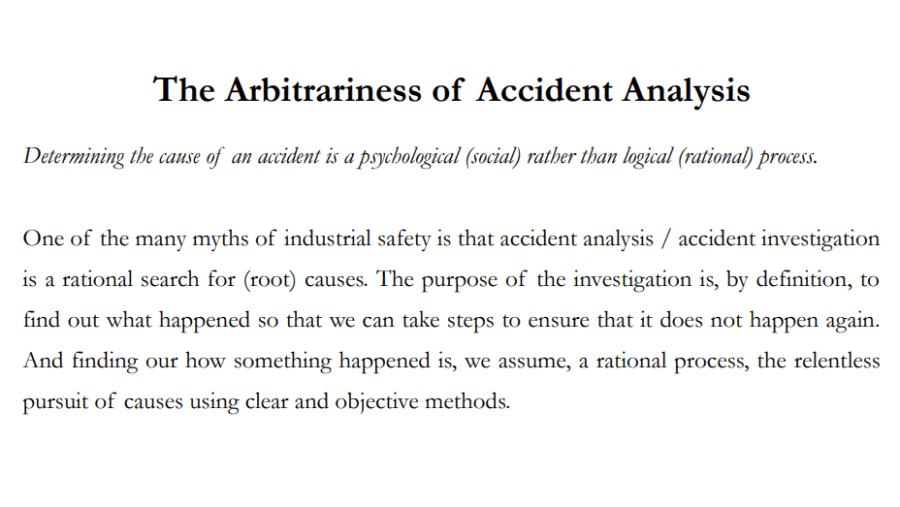
The Arbitrariness of Accident Analysis
A brief article from Hollnagel on the ‘arbitrariness’ of accident analyses. Relying on a lot of direct quotes. First it’s argued that one of the many myths within safety is that accident analysis / investigation “is a rational search for (root) causes”. By this logic, the purpose of an investigation is to found out what… Continue reading The Arbitrariness of Accident Analysis
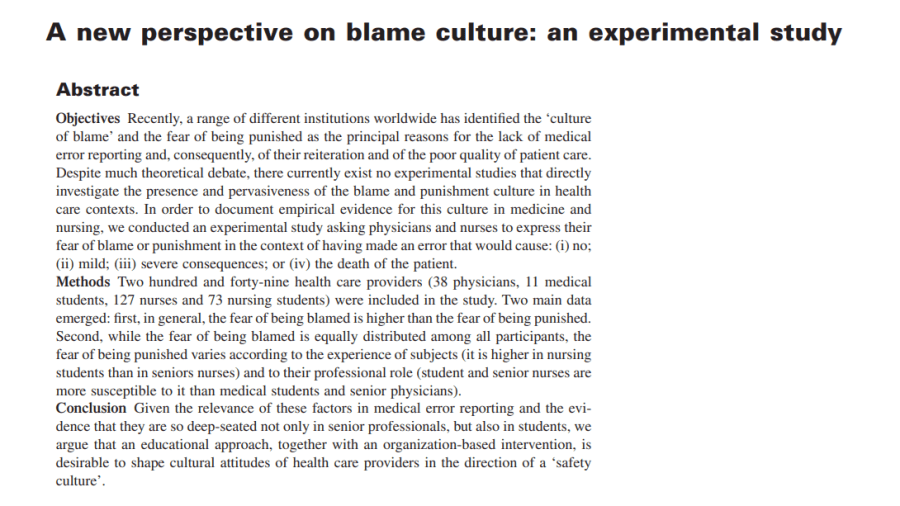
A new perspective on blame culture: an experimental study
This study explored how fear of blame and punishment affects different healthcare professions, experience levels and gender. 249 healthcare practitioners were involved, and were asked how fear of blame or punishment resulting from an error which caused no, mild, severe or death of a patient. Extracts: · “blame culture can be defined as a set of… Continue reading A new perspective on blame culture: an experimental study
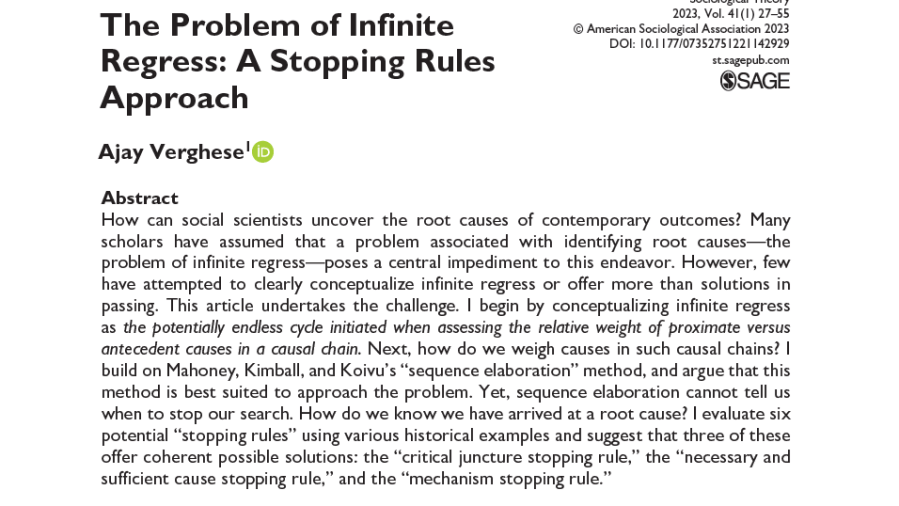
The issues of ‘root causes’ and infinite regression (the endless search for the causes of causes)
A really interesting, but challenging, read about the ontological status of ‘root causes’ and more pointedly, the problem of infinite regression. The author also proposes some stop rules to help navigate infinite regression. I’ve previously posted articles critical of the status of ‘root causes’, who argue it is more a process of implicit or explicit… Continue reading The issues of ‘root causes’ and infinite regression (the endless search for the causes of causes)

Confirmation bias and priming in investigations: ‘Human & Organizational Potential’
Here’s one of (prob) several upcoming posts about Ivan Pupulidy, PhD and Crista Vesel, MSc’s book ‘Human and Organizational Potential’. This part looks at confirmation bias within investigations and uses the US Forest Service’s then current Investigation Guide: · “Confirmation bias is a tendency to search for information that confirms one’s preconceptions. When discussing confirmation bias… Continue reading Confirmation bias and priming in investigations: ‘Human & Organizational Potential’
“there is no such thing as a root cause [and therefore] there is technically no such thing as the beginning of a mishap” — Dekker
Extracts from Dekker’s work about the ontological and empirical shakiness of ‘root causes’. I’ve taken material from two versions of The Field Guide to Understanding Human Error (Investigations). In Dekker’s view: · “There is no ‘root’ cause” (or ‘root causes’) · Given the multiple angles and interactions in complex systems, you “can really construct “causes” from everywhere”… Continue reading “there is no such thing as a root cause [and therefore] there is technically no such thing as the beginning of a mishap” — Dekker

Root-Causal Factors: Uncovering the Hows & Whys of Incidents
This 2016 article from Fred Manuele explores some facets of causality in investigations. It’s based mainly on two key sources: Hollnagel’s 2004 ‘Barriers and accident prevention’ and Dekker’s 2006 ‘Field Guide to Understanding Human Error’. Won’t be much new for most but has some nice arguments from authors like Hollnagel, Dekker and Leveson. First he… Continue reading Root-Causal Factors: Uncovering the Hows & Whys of Incidents

Unveiling Untapped Potential: Leveraging Accident Narratives for Enhanced Construction Safety Management
This study explored the value and insights derived from investigation reports, comparing tabulated data vs extracted narratives. It was interested in what sorts of trends and insights about risk factors could be derived from either data stream. Their method to extract the info was tested against 400 OSHA reports. For context: · Tabular data is… Continue reading Unveiling Untapped Potential: Leveraging Accident Narratives for Enhanced Construction Safety Management
 SafetyInsights.org