
This new paper from Drew Dawson and others reconceptualised fatigue risk management within Total Worker Health (TWH) Hierarchy of Controls (HOC). THW HOC works as an extension to the traditional HOC, and “presents strategies in order of effectiveness, ranging from “eliminate,” “substitute,” “redesign,” “educate,” and “encourage” categories” They say that while is mostly associated with… Continue reading What Control Measures Should I Use? Applying the Total Worker Health Hierarchy of Controls to Manage Workplace Fatigue
Tag: mental-health

Safety Management Systems may struggle with psychosocial factors and other complex phenomena
Certified safety management systems (OHSM) may struggle with complex, multi-factorial matters, like psychosocial safety. Extracts: · The OHSM “does not necessarily tackle the most urgent work environment issues and may exclude important aspects of the work environment such as psychosocial factors” · “some [OHSM] approaches may be ill-equipped to tackle complex sociotechnical issues and psychosocial matters, and… Continue reading Safety Management Systems may struggle with psychosocial factors and other complex phenomena

Why do doctors make poor decisions? Spotlighting ‘noise’ as an under-recognised source of error in clinical practice
A brief read covering the concept of noise, pertaining to judgements. This is based on the work from Kahneman, Sibony and Sunstein. From the article: · While biases in judgements have captured a lot of attention, “it has been suggested that ‘noise’ (defined as an undesirable variability in human judgements) is a highly important, yet under-recognised… Continue reading Why do doctors make poor decisions? Spotlighting ‘noise’ as an under-recognised source of error in clinical practice
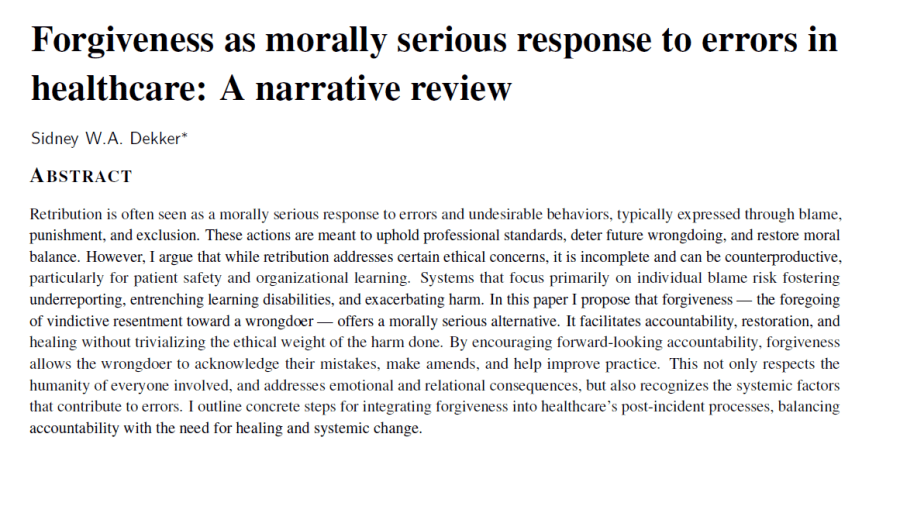
Forgiveness as morally serious response to errors in healthcare: A narrative review
An interesting and recent discussion paper from Sidney Dekker, exploring forgiveness as a ‘morally serious response’ to incidents, as opposed to retributive approaches. Tl;dr: · “while retribution addresses certain ethical concerns, it is incomplete and can be counterproductive, particularly for patient safety and organizational learning” · “Systems that focus primarily on individual blame risk fostering… Continue reading Forgiveness as morally serious response to errors in healthcare: A narrative review
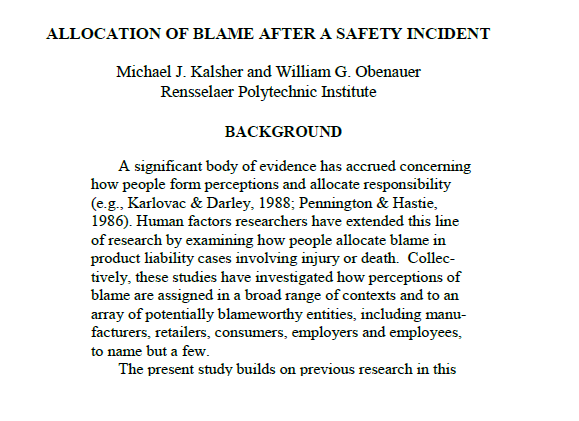
Allocation of Blame After a Safety Incident
This single page conference paper discussed an experiment on how blame is allocated following incidents. The scenario was a “realistic, but fictitious” incident involving a worker (both experienced or not experienced, depending on the scenario), whom is killed when touching an energised bus bar while feeding electrical wire into a pedestal. They systematically manipulated the… Continue reading Allocation of Blame After a Safety Incident

The Impact of Physical Hazards on Workers’ Job Satisfaction in the Construction Industry: A Case Study of Korea
This explored the effects of physical hazard exposures on worker job satisfaction. Survey from >2k Korean construction workers. Background: · “physical hazards such as noise, vibration, and exposure to hazardous substances also contribute to job stress” and behavioural changes · “Continuous exposure to such risks can result in cumulative mental and physical strain, increasing job-related stress, and… Continue reading The Impact of Physical Hazards on Workers’ Job Satisfaction in the Construction Industry: A Case Study of Korea
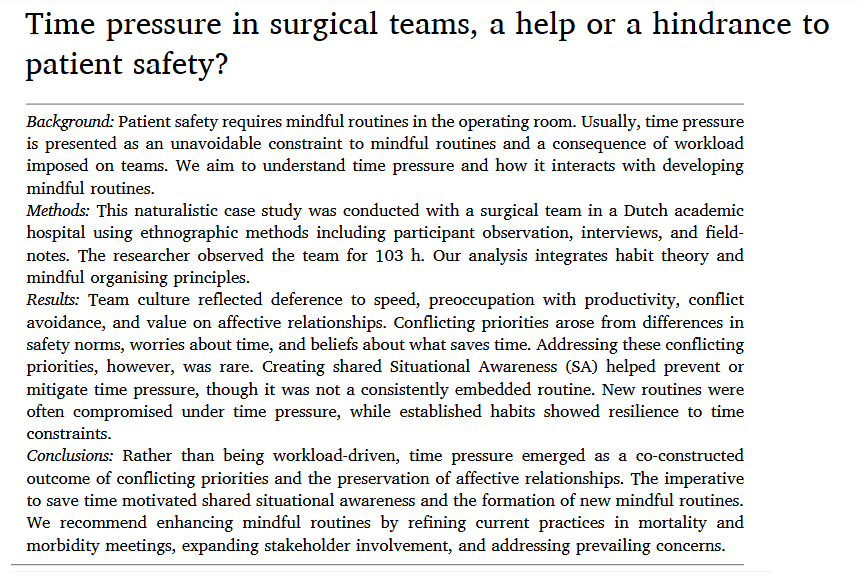
Time pressure in surgical teams, a help or a hindrance to patient safety?
I found this an interesting and brief read about the mindful routines of operating room staff, using a naturalistic decision making approach. Extracts: Ref: van Harten, A., Niessen, T. J., Koksma, J. J., Gooszen, H. G., & Abma, T. A. (2025). Heliyon. Shout me a coffee Study link: https://doi.org/10.1016/j.heliyon.2025.e41967 Shout me a coffee: https://buymeacoffee.com/benhutchinson LinkedIn post:… Continue reading Time pressure in surgical teams, a help or a hindrance to patient safety?

Production Pressure, Cognitive Failures, and Injuries Under an Insecure Job Climate
This study explored the links between production pressure, cognitive failures and injuries within an insecure job climate (JIC) environment. Data came from 1-month lagged survey data from 176 US workers. Extracts: · “Production pressure refers to an organizational emphasis on production to increase corporate profits and efficiency” · While intending to “eliminate wasteful contingencies of material, people,… Continue reading Production Pressure, Cognitive Failures, and Injuries Under an Insecure Job Climate
Poor psychosocial safety climate increases teleworker vulnerability to suicidal ideation
A poor psychosocial safety climate (PSC) increases teleworker vulnerability to suicide ideation, according to a new Japanese study. 1,988 participants were surveyed in a cross-sectional design. Key findings: · “poor PSC had a direct effect on an increase in suicidal ideation, even after controlling for task-level occupational factors in both teleworkers and nonteleworkers” · “the association between… Continue reading Poor psychosocial safety climate increases teleworker vulnerability to suicidal ideation
Impact of work hours on sleep quality: a non-linear and gendered disparity
This study explored the tipping point at which weekly workhours harm sleep in Australian adults – 25 to 64. Data was drawn from >9k people. Providing background they say: Results Key findings: Ref: Doan, T., Leach, L., & Strazdins, L. (2024). Impact of work hours on sleep quality: a non-linear and gendered disparity. Archives of Women’s… Continue reading Impact of work hours on sleep quality: a non-linear and gendered disparity
 SafetyInsights.org