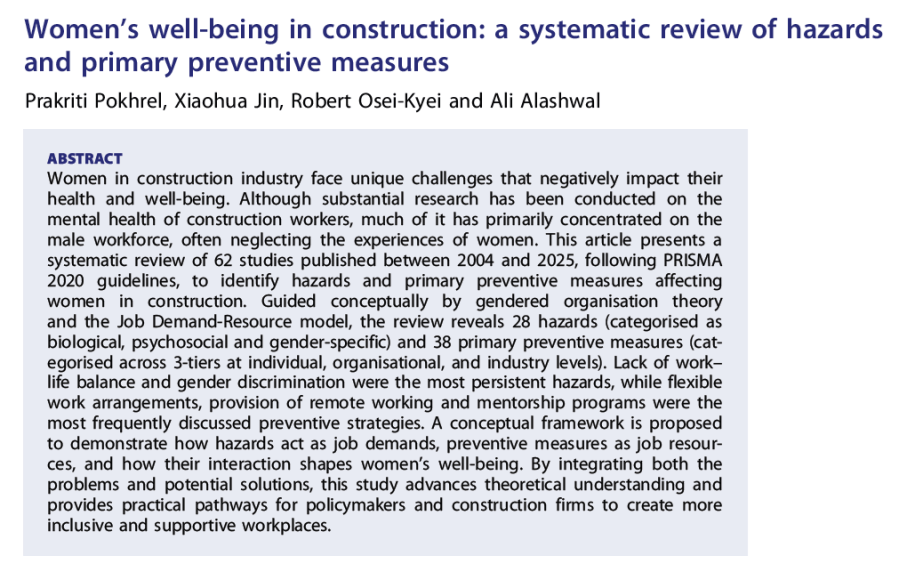
This systematic review unpacked 62 studies looking at women’s well-being in construction, and key hazards and prevention measures. ** Check out my YouTube channel: https://www.youtube.com/@safe_as_pod Background: · “construction industry is often shaped by a macho work culture marked by aggression, bullying, and job insecurity due to the nomadic and cyclical nature of projects” · “women face not… Continue reading Women’s well-being in construction: a systematic review of hazards and primary preventive measures
Tag: news
Safe As week in review: Ineffectiveness of individual mental health interventions / Fatigue risk via defences in depth / AI LLMs are BS’ing you
Safe As covered this week: 31: Do individual mental health interventions work? Maybe not. Do individual level mental health interventions, like personal resilience training, yoga, fruit bowls and training actually improve measures of mental health? This study suggests not. Using survey data from >46k UK workers, it was found that workers who participated in individual-level… Continue reading Safe As week in review: Ineffectiveness of individual mental health interventions / Fatigue risk via defences in depth / AI LLMs are BS’ing you

Safe As 25: Do workers in high-risk industries use and value procedures?
Are your safety procedures effective aids to help navigate safe and reliable work? Do you know? And, do your workers use and value those procedures? Today we’re uncovering the painful realisation of how a compliance culture can erode trust, disengage workers and leave you dangerously exposed when things go wrong. Today’s study is Peres, S.… Continue reading Safe As 25: Do workers in high-risk industries use and value procedures?

Physical and Psychosocial Correlates of Occupational Physical Injury in the Global Construction Industry: A Scoping Review
This recent scoping review evaluated 77 construction studies covering various geographical regions on the physical and psychosocial correlates of physical injury. They stratified the correlates into three domains: 1. workplace physical environment (eg, exposure to physical hazards, PPE, company size & more) 2. workplace culture (eg, psychosocial stressors, gender-related barriers, migrant and ethnic disparities, educational background) 3. physical… Continue reading Physical and Psychosocial Correlates of Occupational Physical Injury in the Global Construction Industry: A Scoping Review
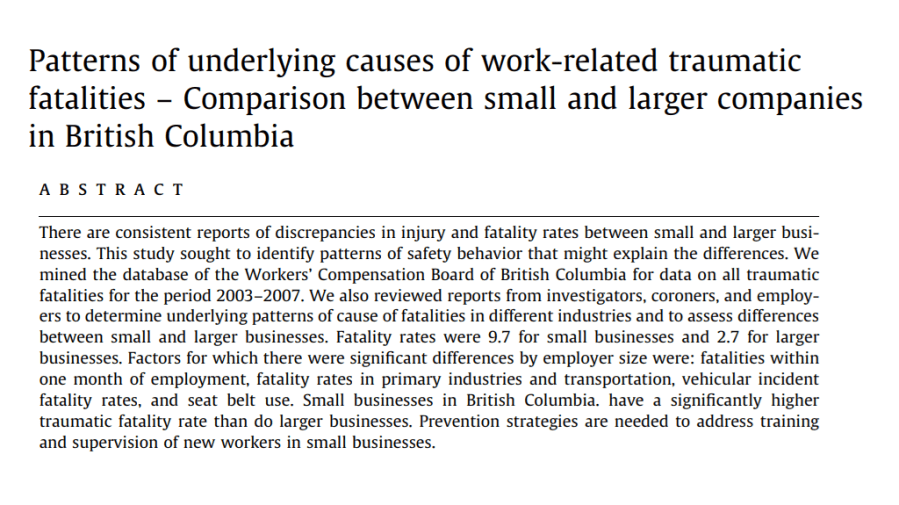
Patterns of underlying causes of work-related traumatic fatalities – Comparison between small and larger companies in British Columbia
This study mined the Workers’ Compensation Board of British Columbia (WCB) to compare discrepancies in injury and fatalities between small and large businesses. I’ve skipped a lot. For background: · Data from 2003-07 found the traumatic fatality rate among workers in small businesses (<20 person-years) was 9.7 per 100k person-years vs 2.7 per 100k in… Continue reading Patterns of underlying causes of work-related traumatic fatalities – Comparison between small and larger companies in British Columbia

The Psychosocial Hierarchy of Controls: Effectively Reducing Psychosocial Hazards at Work
This study redesigned the hierarchy of controls (HoC) to target workplace psychosocial hazards, specifically, adapting the NIOSH Total Worker Health HoC. These called this the Psychosocial Hierarchy of Control (P-HoC). Won’t be anything earth shattering for most, but nice to see it properly articulated. For background: · “There is consistent evidence that psychosocial hazards at… Continue reading The Psychosocial Hierarchy of Controls: Effectively Reducing Psychosocial Hazards at Work

Mental Health Causation in the Construction Industry: A Systematic Review Employing a Psychological Safety Climate Model
This systematic review studied the links between psychological safety climate (PSC) on mental health in the construction industry. 71 studies included. Key findings: · 42 mental health causation factors were identified · High job demand was the most significant contributor, followed by interpersonal relationships, low job control, low job support, and physical status · High job demand was… Continue reading Mental Health Causation in the Construction Industry: A Systematic Review Employing a Psychological Safety Climate Model

Building Resilience into Safety Management Systems: Precursors and Controls to Reduce Serious Injuries and Fatalities (SIFs)
Another on SIF prevention. This (interim) report (another from the recent compendium – see comments for link) covers the findings from a few activities, including two SIF workshops about ID, implementing and monitoring critical controls for SIF hazards, and the role of human and org factors. Too much to cover, so a few extracts: · “the… Continue reading Building Resilience into Safety Management Systems: Precursors and Controls to Reduce Serious Injuries and Fatalities (SIFs)
Resilience terminology and a visualisation of resilience/robustness in practice
This may interest people. It covers concepts of resilient performance within seaports. It’s a bit random (seaports), but otherwise gives a handy overview of resilience terms and applications. The first two images are just basic definitions. Extracts: · Image 3 represents resilience elements during disruptions – from pre-disruption, to the disruption, then post-disruption. · During pre-disruption, the… Continue reading Resilience terminology and a visualisation of resilience/robustness in practice

ChatGPT for analysing investigations
I think this is one of the better uses of LLMs regarding investigations – they trained their model to evaluate accident reports and extract key details from the reports. They found: · It could extract key information from unstructured data and “significantly reduce the manual effort involved in accident investigation report analysis and enhance the overall… Continue reading ChatGPT for analysing investigations
 SafetyInsights.org