
This 2016 article from Fred Manuele explores some facets of causality in investigations. It’s based mainly on two key sources: Hollnagel’s 2004 ‘Barriers and accident prevention’ and Dekker’s 2006 ‘Field Guide to Understanding Human Error’. Won’t be much new for most but has some nice arguments from authors like Hollnagel, Dekker and Leveson. First he… Continue reading Root-Causal Factors: Uncovering the Hows & Whys of Incidents
Tag: safety differently

Designing work systems for resilient performance: insights from resilience engineering
This explored Design for Resilient Performance (DfRP) via their framework. Not a summary – just a few extracts, but maybe I’ll summarise it in the future. Some extracts: · “Resilient performance (RP) is a socio-technical system’s ability to adjust its functioning prior to, during, or following changes and disturbances, thereby sustaining operations under both expected and… Continue reading Designing work systems for resilient performance: insights from resilience engineering
Resilience terminology and a visualisation of resilience/robustness in practice
This may interest people. It covers concepts of resilient performance within seaports. It’s a bit random (seaports), but otherwise gives a handy overview of resilience terms and applications. The first two images are just basic definitions. Extracts: · Image 3 represents resilience elements during disruptions – from pre-disruption, to the disruption, then post-disruption. · During pre-disruption, the… Continue reading Resilience terminology and a visualisation of resilience/robustness in practice

The systems approach to medicine: controversy and misconceptions — Dekker & Leveson
This was a really brief discussion paper from Dekker and Leveson, covering systems thinking in medicine. Three parts – see comments. Nothing new for most, but they cover: · “The ‘systems approach’ to patient safety has recently led to questions about its ethics and practical utility” · E.g. A recent paper from a retired neurosurgeon questioned systems… Continue reading The systems approach to medicine: controversy and misconceptions — Dekker & Leveson
Identification of management traits related to human factors in new views of safety approaches
This paper from Leônidas Brasileiro and colleagues evaluated common attributes across approaches grouped under ‘New View’. i.e. HRO, S-II, SD, RE & HOP – they used both literature and Delphi method. Not a summary since you can read the full paper. It’s an accessible read if you’re keen to quickly understand some key differences and… Continue reading Identification of management traits related to human factors in new views of safety approaches
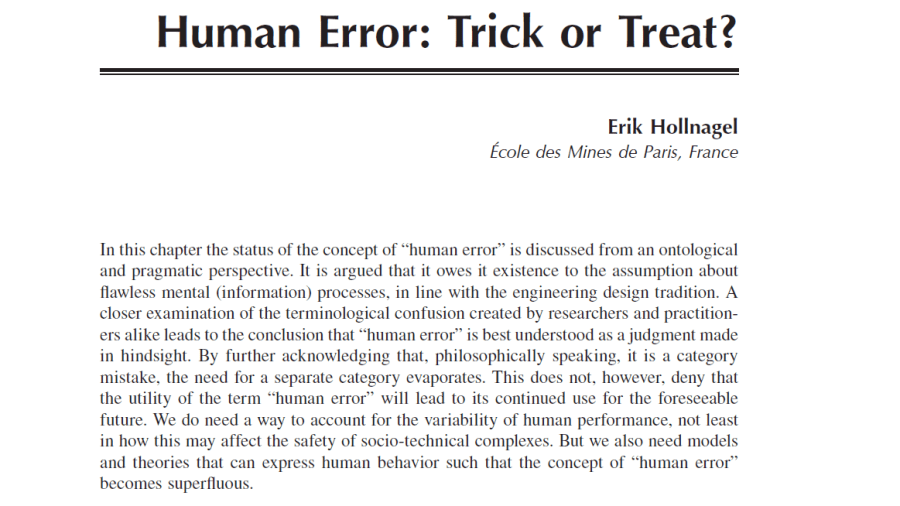
Human Error: Trick or Treat?
This 2007 chapter from Hollnagel unpacked whether we really need the concept of “human error” (HE). It’s a whole chapter, so I’ve skipped HEAPS. Tl;dr according to Hollnagel: · “there is no need of a theory of “human error” because the observed discrepancies in performance should be explained by a theory of normal performance rather… Continue reading Human Error: Trick or Treat?

Understanding Accidents – From Root Causes to Performance Variability
This 2002 discussion paper from Erik Hollnagel unpacks some assumptions of different accident models. Note: In this work, accident model isn’t the specific tool or method (e.g. ICAM), but a “frame of reference as the accident model, i.e., a stereotypical way of thinking about how an accident occurs”. i.e. the mental models and justifications on… Continue reading Understanding Accidents – From Root Causes to Performance Variability
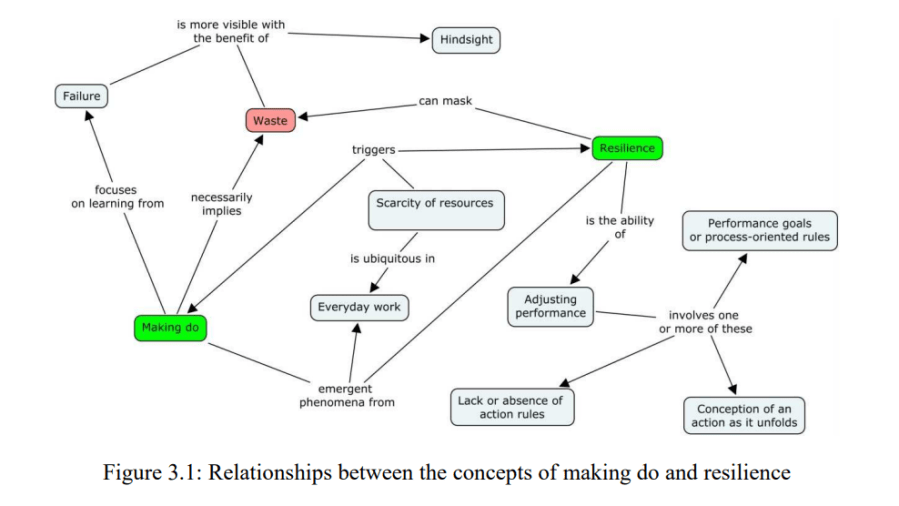
The difference between ‘making do’ and resilience in complex systems
This paper explores the difference between ‘making do’ and resilience. Not a summary, but a few extracts: · Making do has been defined, from a waste perspective as “a situation where a task is started without all its standard inputs, or the execution of a task is continued although the availability of at least one standard… Continue reading The difference between ‘making do’ and resilience in complex systems

Compendium: Learning and improvement without incidents
Here’s a mini-compendium of…well, probably a lot of stuff with only a tenuous link to ‘learning’. I tried to focus on learning that doesn’t require incidents, but you’ll find those here, too. There’s >100 articles, mostly full-text. I think I went overboard. Unfortunately, it’s barely sorted. It includes: Check out my YouTube channel: https://youtube.com/@safe_as_pod?si=sZmhFw3gB3ubXjzK Shout… Continue reading Compendium: Learning and improvement without incidents

Analyzing Procedure Performance using Abstraction Hierarchy: Implications of Designing Procedures for High-risk Process Operations
This paper explored the use of procedures and operator performance from the perspective of work domain analysis/abstraction hierarchy. I’ve skipped heaps – the ‘doing’ part of the abstraction hierarchy, but their descriptions of the problem and the discussion had some gold. For context: · Procedural issues have been linked in a number of major accidents… Continue reading Analyzing Procedure Performance using Abstraction Hierarchy: Implications of Designing Procedures for High-risk Process Operations
 SafetyInsights.org