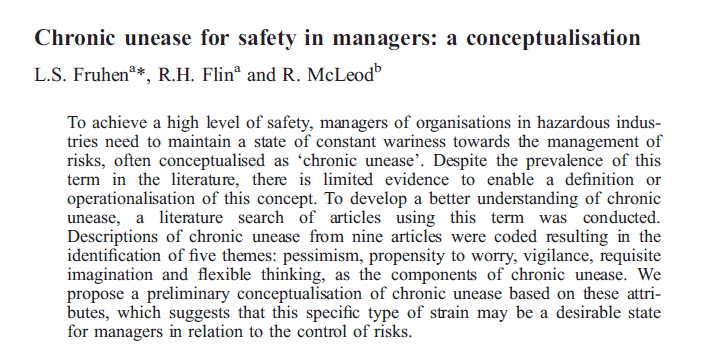
Just a basic post today – some extracts from a paper exploring chronic unease: · Drawing on Reason’s concept, chronic unease has gone by various definitions over the years (image 1) · For Reason, it was the “tendencies of wariness towards risks” · And as a “contrast to complacency, resulting from the absence of negative events, leading ‘people… Continue reading Chronic unease for safety in managers: a conceptualisation
Tag: whs

Human Success: Old wine in new bottles, or a shift of mindset for HRA in an automated world?
A really interesting conference paper from Andreas Bye, discussing whether shifting Human Reliability Analysis (HRA) terminology from human error to human success would help alleviate some of the blame-connotations. Also discussed is the human role in automated systems. It was meant to be a mini-post with a few dot-points and a couple of images, but… Continue reading Human Success: Old wine in new bottles, or a shift of mindset for HRA in an automated world?

Understanding Accidents – From Root Causes to Performance Variability
This 2002 discussion paper from Erik Hollnagel unpacks some assumptions of different accident models. Note: In this work, accident model isn’t the specific tool or method (e.g. ICAM), but a “frame of reference as the accident model, i.e., a stereotypical way of thinking about how an accident occurs”. i.e. the mental models and justifications on… Continue reading Understanding Accidents – From Root Causes to Performance Variability

What Control Measures Should I Use? Applying the Total Worker Health Hierarchy of Controls to Manage Workplace Fatigue
This new paper from Drew Dawson and others reconceptualised fatigue risk management within Total Worker Health (TWH) Hierarchy of Controls (HOC). THW HOC works as an extension to the traditional HOC, and “presents strategies in order of effectiveness, ranging from “eliminate,” “substitute,” “redesign,” “educate,” and “encourage” categories” They say that while is mostly associated with… Continue reading What Control Measures Should I Use? Applying the Total Worker Health Hierarchy of Controls to Manage Workplace Fatigue
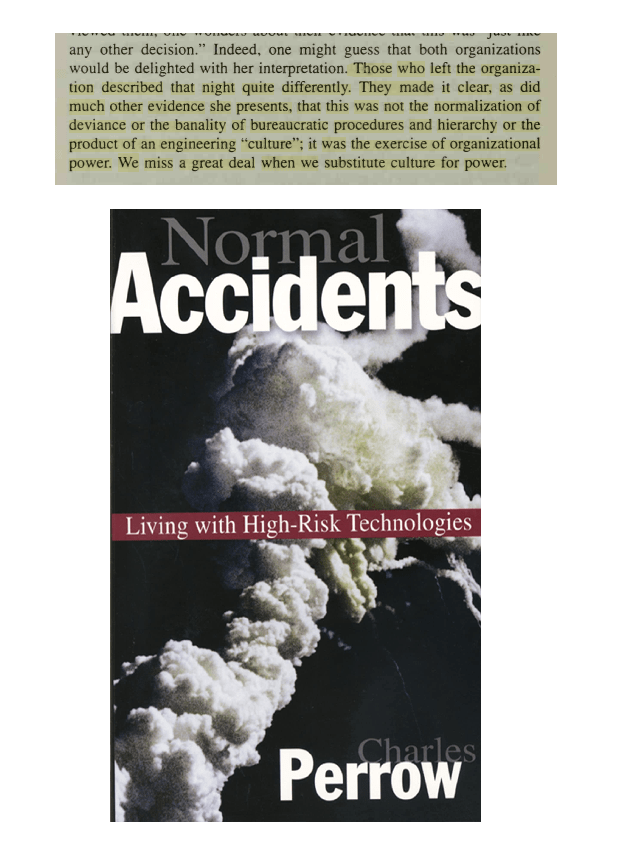
“We miss a great deal when we substitute culture for power” – Charles Perrow on the role of power in disaster
“We miss a great deal when we substitute culture for power” I love this quote from Perrow in Normal Accidents (emphasis added). Perrow briefly discusses the role of power in organising risky technology. Discussing Vaughan’s interpretation of the Challenger disaster: · “I also find the role of power and interests minimized in Diane Vaughn’s otherwise excellent… Continue reading “We miss a great deal when we substitute culture for power” – Charles Perrow on the role of power in disaster

Safety Management Systems may struggle with psychosocial factors and other complex phenomena
Certified safety management systems (OHSM) may struggle with complex, multi-factorial matters, like psychosocial safety. Extracts: · The OHSM “does not necessarily tackle the most urgent work environment issues and may exclude important aspects of the work environment such as psychosocial factors” · “some [OHSM] approaches may be ill-equipped to tackle complex sociotechnical issues and psychosocial matters, and… Continue reading Safety Management Systems may struggle with psychosocial factors and other complex phenomena
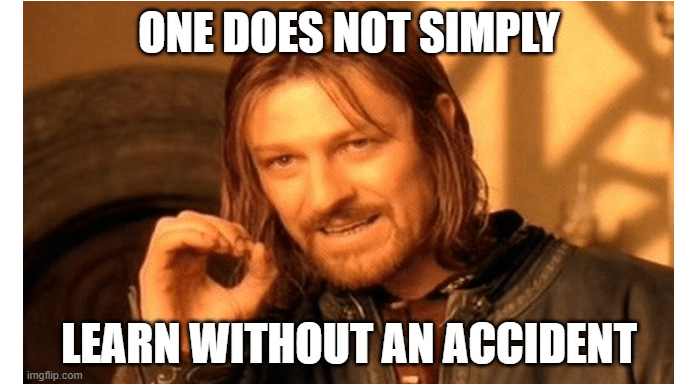
Compendium: Learning and improvement without incidents
Here’s a mini-compendium of…well, probably a lot of stuff with only a tenuous link to ‘learning’. I tried to focus on learning that doesn’t require incidents, but you’ll find those here, too. There’s >100 articles, mostly full-text. I think I went overboard. Unfortunately, it’s barely sorted. It includes: Shout me a coffee Learning Strengths &… Continue reading Compendium: Learning and improvement without incidents

ChatGPT for analysing investigations
I think this is one of the better uses of LLMs regarding investigations – they trained their model to evaluate accident reports and extract key details from the reports. They found: · It could extract key information from unstructured data and “significantly reduce the manual effort involved in accident investigation report analysis and enhance the overall… Continue reading ChatGPT for analysing investigations

Human factor analysis of cockpit work incidents in high-speed workboats: the mystery hidden between the lines
This study unpacked what investigators look at and how they construct causes in high-speed workboats. It employed a Safety-II / HOP / HF perspective. Tl;dr: human factors are poorly evaluated and largely seen as individual-level factors. Some extracts: · “Although the analysis focused on negative observations, it also identified HFs that supported the activity” · “Many pivotal… Continue reading Human factor analysis of cockpit work incidents in high-speed workboats: the mystery hidden between the lines

Efficacy and Understanding of the Safety Hierarchy of Controls
This PhD thesis from Stephen Young was interesting. They studied evidence supporting the hierarchy of control (HOC), constraints on its efficacy, and more. Way too much to cover. Some extracts: · There isn’t a lot of evidence supporting the efficacy of the HOC · One reason is: “An unequivocal demonstration of efficacy [of the HOC] is problematic,… Continue reading Efficacy and Understanding of the Safety Hierarchy of Controls
 SafetyInsights.org